

 See units
Fire on ships: fire chemistry, ignition sources, detection and fixed systems (STCW A-VI/1-2)
How fire spreads, flashover and backdraught
1The lesson in plain words
On a steel ship heat travels through bulkheads, up stairways and across rooms. Learn flashover and backdraught signs; keep suspected fire compartments closed.
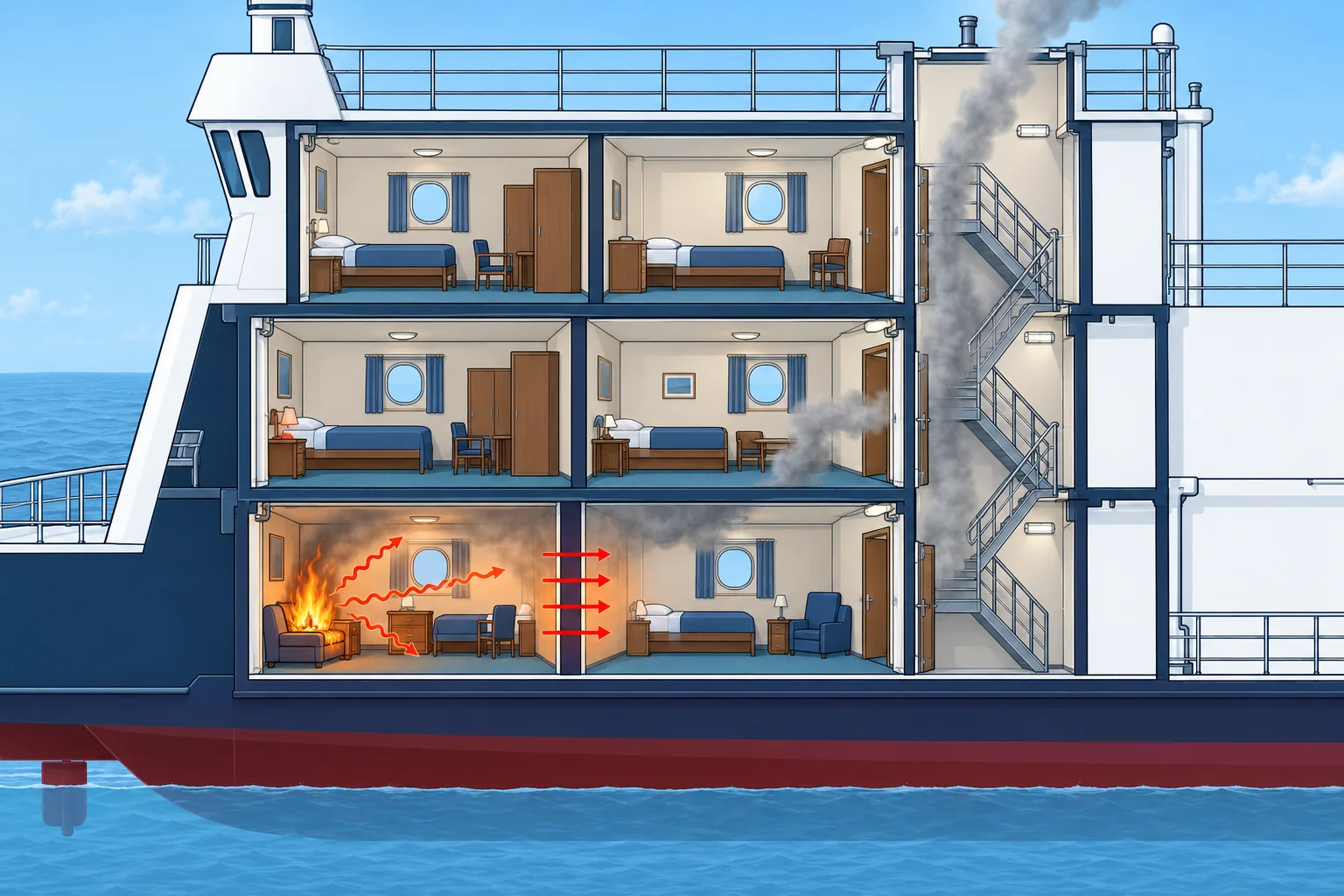
Four ways fire spreads
Conduction carries heat through steel bulkheads (walls) and decks (floors), which can ignite material on the far side. Convection carries hot gases upwards through stairways and vertical enclosures around machinery, lifts and ventilation ducts. Radiation transfers heat across a gap, without contact with hot gases or solids. Direct burning spreads fire when flames reach the next fuel.
Smoke travels fastest
Hot smoke rises, fills the top of a space and then banks down towards the deck. It carries carbon monoxide (CO) and other toxic gases, and it hides exits. Smoke can travel along alleyways and up stairways much faster than you can walk. That is why you stay low, close doors behind you and use your escape route before smoke fills it.
Flashover
In a closed space the hot smoke layer under the deckhead (ceiling) radiates heat down. Contents heat up and give off flammable gases. Often at 500–600 °C in the smoke layer, they ignite almost together: flashover. It can kill even a fully equipped firefighter. Warning signs include rapidly rising heat, smoke thickening and banking down, flames rolling through the smoke (rollover) and contents starting to smoke. Withdraw immediately if these signs develop.
Backdraught
A fire in a closed space can use up its oxygen and die down, leaving the space full of hot, unburnt gas. If someone opens a door, fresh air rushes in and the gas ignites with explosive force: a backdraught. Warning signs: a hot door or bulkhead, smoke pulsing or puffing out of gaps, yellow-grey or brown smoke, oily stains on glass, whistling as air is drawn in, and little visible flame.
Keep suspect doors closed
If you suspect fire behind a door, keep it closed, raise the alarm and report. Opening it can feed the fire, cause a backdraught and let smoke into your escape route. A cool door does not prove safety: insulation can hide the heat. Suspected-fire entry is for the equipped fire party, using breathing apparatus (BA) and charged hoses, filled and ready.
2Key data
- Conduction
- Through steel bulkheads and decks to the next space
- Convection
- Hot gases rise through stairways, enclosures and ventilation ducts
- Flashover
- Rapid transition to a fully developed compartment fire
- Backdraught
- Air enters a hot, oxygen-starved space: gas explodes
- Suspected fire behind a door
- Keep it closed; a cool door does not prove safety
3Key points
- 1
Steel conducts heat: fire can start on the other side of a bulkhead or deck.
- 2
Convection drives smoke up stairways and enclosures, faster than you walk.
- 3
Flashover signs: rapid heat, thick banking smoke, flames rolling through smoke.
- 4
Backdraught signs: hot door, pulsing smoke, brown smoke, air drawn in.
- 5
Keep suspected fire compartments closed, even if the door feels cool; withdraw and report.
4Frequent mistakes
Wrong: A steel bulkhead stops a fire spreading to the next cabin.
Right: Steel conducts heat. The far side can become hot enough to ignite nearby paint or furnishings.
Wrong: Little visible flame behind a door means the fire is nearly out.
Right: It may be starved of oxygen and full of hot gas. Opening the door can cause a backdraught.
Wrong: A cool door means it is safe to open a suspected fire compartment.
Right: Insulation can hide the heat. Keep suspect doors closed, withdraw, raise the alarm and report.
5Practice case & exam keys
You smell smoke in the accommodation. The door of a store room is shut. Grey-brown smoke is puffing out round its edges in pulses, and you hear a faint whistling. A shipmate reaches for the handle to see what is inside.
Show the answer
Stop your shipmate. Pulsing smoke and air being drawn in can warn of backdraught: hot gas may ignite explosively when air enters. Raise the fire alarm and report the location to the bridge. Keep the door shut, withdraw and warn people nearby. Follow your emergency duties. Entry is for the equipped fire party using breathing apparatus (BA) and charged hoses, filled and ready.
Exam keys
- Fire spreads by conduction, convection, radiation and direct burning.
- Flashover: exposed combustible surfaces ignite almost together; signs are rapid heat, banking smoke and rollover.
- Backdraught: air enters a hot, oxygen-starved space; signs are pulsing smoke, brown smoke and a hot door.
- Keep suspected fire compartments closed; a cool door can conceal dangerous heat behind insulation.
Finish this unit
When you've read it, answer three questions. Get all three right to finish the unit; opening the page alone doesn't count.
My notes for this unit
No notes