

 See units
Fire on ships: fire chemistry, ignition sources, detection and fixed systems (STCW A-VI/1-2)
Structural fire protection and fire doors
1The lesson in plain words
Steel divisions, insulation and fire doors split the ship into boxes that hold a fire back. A wedged-open fire door undoes all of it.
Boxes of steel
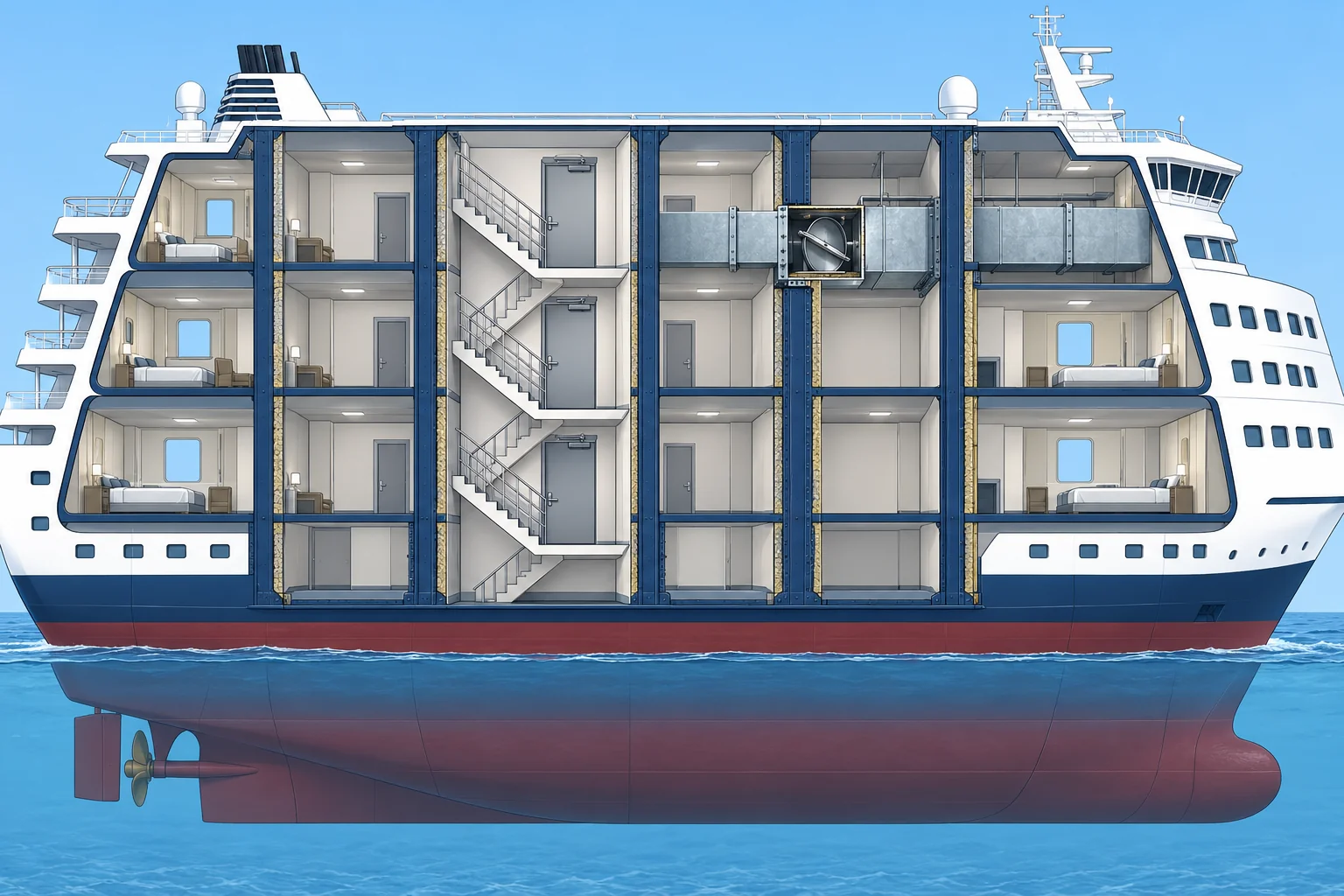
SOLAS II-2/9 splits a ship into spaces bounded by fire divisions, so that a fire stays where it starts long enough to be fought and for people to escape. Divisions are rated by how long they stop smoke, flame and heat in a standard fire test. The required rating depends on the spaces on each side and the applicable SOLAS table.
A-class divisions
A-class divisions are steel or equivalent bulkheads and decks that stop smoke and flame for one hour. With insulation they also limit heat on the unexposed side: the average temperature may rise no more than 140 °C, and no single point more than 180 °C, within the rated time. A-60 holds this for 60 minutes; A-30 for 30, A-15 for 15, and A-0 has no specified heat-insulation period.
B- and C-class
B-class divisions are non-combustible panels, often in cabins and alleyways, that stop flame for the first half hour. B-15 limits heat on the far side for 15 minutes, B-0 for none. C-class divisions are simply made of non-combustible materials, with no fire-test rating.
Main vertical zones
Passenger ships are divided into main vertical zones by A-class divisions, generally rated A-60, running from deck to deck through the whole ship. Their length on any deck is generally no more than 40 m. The divisions and their fire doors limit spread from one zone to the next.
Fire doors and dampers
A fire door must match its division’s fire resistance. Stairway doors are self-closing. Approved magnetic hold-backs release remotely or on power loss. Never wedge, tie or obstruct a fire door. Fire dampers close ventilation ducts to stop fire and smoke travelling through them. Detectors give early warning; closed doors and dampers help the divisions contain the fire. Follow your ship’s instructions for any door that fails to close.
2Key data
- A-class
- Steel/equivalent; smoke/flame 60 min; heat rating 60/30/15/0 min
- A-class heat limit
- Unexposed side: average +140 °C, any point +180 °C
- B-class
- Non-combustible; stops flame 30 min; B-15 or B-0
- C-class
- Non-combustible materials, no fire-test rating
- Main vertical zone
- Passenger ships; generally ≤ 40 m long on any deck
- Rule
- SOLAS II-2/9 (containment of fire)
3Key points
- 1
Fire divisions keep a fire in its space long enough to fight it and escape.
- 2
A-class: steel, one hour against smoke and flame; A-60 insulated for 60 minutes.
- 3
B-class stops flame for 30 minutes; C-class is non-combustible only.
- 4
Main vertical zones on passenger ships are bounded by A-class divisions.
- 5
Never wedge open a fire door or block it with hoses or cables.
4Frequent mistakes
Wrong: An A-0 bulkhead stops heat reaching the next space.
Right: A-0 still resists smoke and flame for one hour in the standard test, but has no rated period limiting heat transmission.
Wrong: Wedging a fire door open is fine while you carry stores through.
Right: An open fire door lets smoke and fire spread. Hold it, or use the approved hold-back with remote release.
Wrong: The number in A-60 is the temperature the bulkhead can stand.
Right: It is the time, 60 minutes, for which the insulation limits heat on the far side.
5Practice case & exam keys
During stores loading, a shipmate ties back a self-closing stairway fire door with a rope so that trolleys can pass. Later, the fire alarm sounds for a fire two decks below.
Show the answer
Cut or untie the rope and let the door close, if you can do it safely on your way out. The stairway fire door holds smoke and fire out of an escape route used by everyone above. Tell the bridge or your team leader that the door was tied open. Afterwards, the stores team should use the approved hold-back arrangement or someone to hold the door, never a rope or wedge.
Exam keys
- A-class: steel, stops smoke and flame 1 h; A-60/30/15/0 is the insulation time; +140 °C average, +180 °C point.
- B-class: non-combustible, stops flame 30 min; C-class: non-combustible only.
- Main vertical zones on passenger ships, bounded by A-class divisions (SOLAS II-2/9).
- Fire doors are self-closing and never wedged open; fire dampers close the ducts.
Finish this unit
When you've read it, answer three questions. Get all three right to finish the unit; opening the page alone doesn't count.
My notes for this unit
No notes