

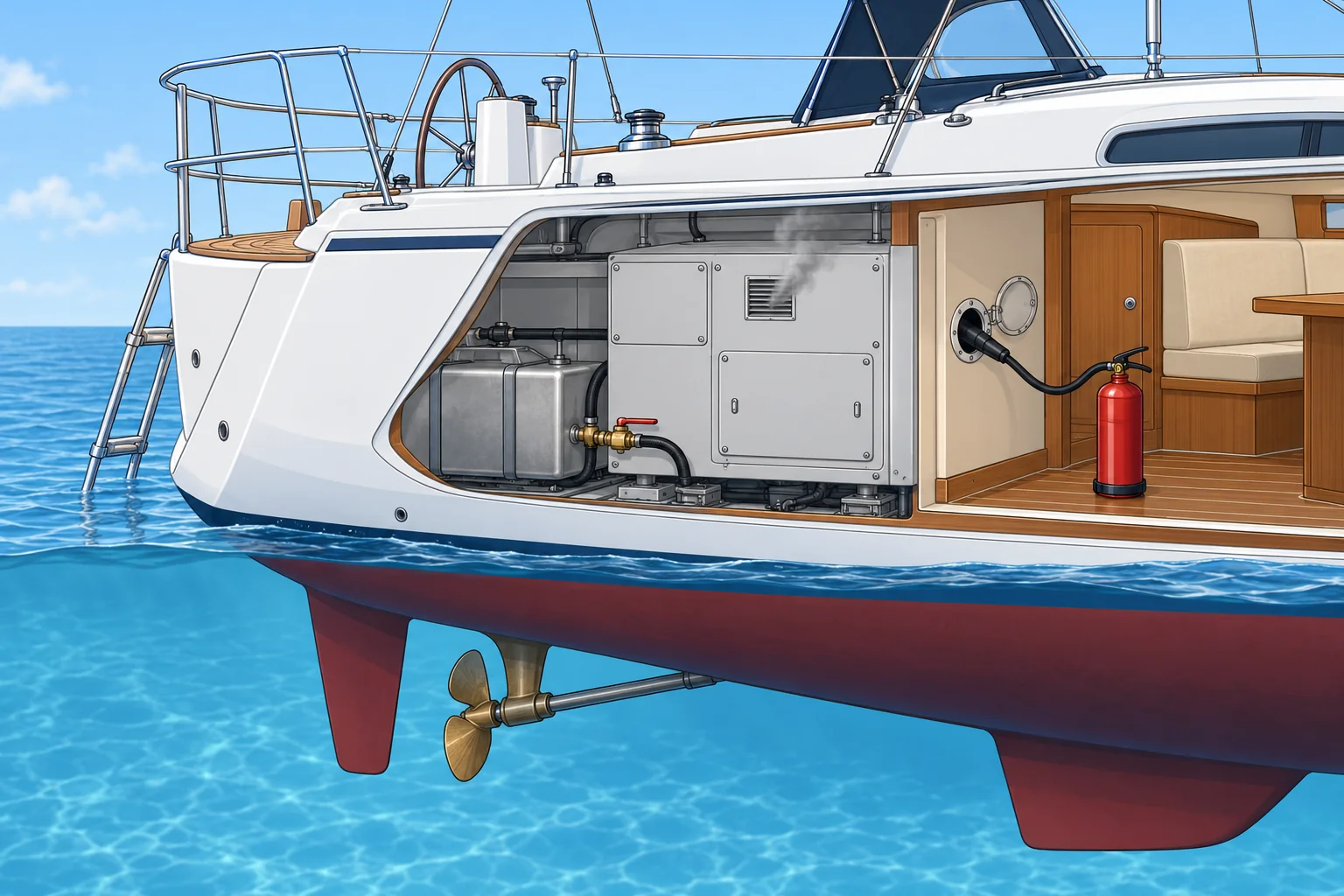
Engine compartment fire
1The lesson in plain words
Use safe external controls: stop engine, shut fuel, close vents. Use the fixed system or specified extinguisher through the fire port. Keep the hatch shut.
Why engines burn
Engine fires usually start with fuel or oil spraying onto a hot exhaust or turbocharger, an electrical short, an overheated exhaust hose after a cooling-water failure, or oily rags. Warning signs are a smell of burning, smoke from vents, a high-temperature alarm or a sudden loss of power. Act at once.
Starve it, don’t feed it
An enclosed engine space holds limited air. Use safely accessible controls outside the engine space to stop the engine and blowers, shut fuel and close vents. Never open the hatch or enter smoke to reach a control. Keeping the hatch shut starves the fire. Opening it lets in air that can turn smoke into a fireball in your face, a backdraught.
Fixed systems and fire ports
Many boats have a fixed system in the engine space that discharges a clean gaseous agent, automatically by heat or by a manual pull. It needs the space closed and the engine stopped, or the engine sucks the gas out. A fire port is a small covered opening. Without a fixed system, use a fire port with the extinguisher type and capacity specified for that compartment, keeping the hatch shut.
After discharge
Follow the system maker’s instructions. Keep the space closed until the fire is out and it has fully cooled. Check for heat and smoke from outside. Time alone and a cool hatch do not prove safety. If heat or smoke remains, or you are unsure, keep it shut and seek emergency-service advice before reopening. Have another extinguisher ready. Do not restart until the cause has been found and repaired.
2Step by step
Engine compartment fire
- 1
Raise the alarm, clear the engine space and get lifejackets on. Have a crew member call for help immediately while you respond.
Help takes time. Mayday is for grave and imminent danger; Pan-Pan is for urgency without that danger.
- 2
Use safely accessible controls outside the engine space to stop the engine and blowers and shut fuel. Never open the hatch or enter smoke to reach them.
A running engine draws in air and the fuel feeds the fire.
- 3
Close vents only using safely accessible controls outside the engine space. Keep the hatch shut; never enter smoke to reach a control.
Starving the fire of air helps put it out; opening it can cause a backdraught.
- 4
Use the fixed system, or the specified suitable extinguisher through the fire port, from outside.
The agent fills the space without letting air in.
- 5
Update rescuers and prepare the liferaft.
Keep rescuers informed and be ready to abandon if necessary.
- 6
Follow system instructions. Keep shut until the fire is out and fully cooled; if unsure, seek emergency-service advice.
Time and a cool hatch do not prove safety. Air can re-ignite hidden hot fuel.
3Key points
- 1
Use safe external controls to stop engine and blowers, shut fuel and close vents. Never enter smoke to reach them.
- 2
Do not open the hatch: fresh air feeds the fire.
- 3
Use the fixed system or the specified suitable extinguisher through the fire port, from outside.
- 4
Follow system instructions; check heat and smoke outside. Keep shut until out and fully cooled; if unsure, seek help.
- 5
Call early: Mayday for grave and imminent danger; Pan-Pan for urgency without that danger.
4Frequent mistakes
Wrong: Open the engine hatch to see how bad it is.
Right: Opening the hatch lets air in and can blow fire out at you. Keep it shut; use the fixed system or specified suitable extinguisher through the fire port.
Wrong: Keep the engine running so you can reach harbour.
Right: A running engine pulls air in and sucks out the extinguishing gas. Stop it and shut fuel only using safe external controls.
Wrong: Once the system has fired, open up straight away to check.
Right: Follow system instructions. Keep shut until the fire is out and fully cooled. A cool hatch proves nothing; if unsure, keep shut and seek specialist help.
5Practice case & exam keys
Motoring three miles offshore, you smell burning and see smoke from the engine vents. The engine is still running and the boat has a fire port but no fixed system. What do you do?
Show the answer
Alert crew, get lifejackets on; have someone call for help now. Use safe external controls to stop engine and blowers, shut fuel and close vents; never open the hatch to reach them. Use the specified suitable extinguisher through the fire port. Mayday: grave and imminent danger; Pan-Pan: urgency without it. Ready the liferaft. Follow system instructions. Keep shut until out and fully cooled; if unsure, seek specialist advice.
Exam keys
- Engine fire: use safe external controls to stop engine and blowers, shut fuel and close vents. Never open the hatch or enter smoke to reach controls.
- Fixed system or specified suitable extinguisher through the fire port, from outside, with the hatch shut.
- Follow system instructions; keep shut until out and fully cooled. Check heat/smoke outside; time or a cool hatch is no proof. If unsure, keep shut and seek specialist help.
- Call for help early and prepare to abandon.
Finish this unit
When you've read it, answer three questions. Get all three right to finish the unit; opening the page alone doesn't count.
My notes for this unit
No notes