

How fire works and the classes of fire
1The lesson in plain words
Fire needs fuel, heat and oxygen, sustained by a chain reaction. Interrupt one to extinguish it; match your extinguisher to the fuel.
The fire triangle
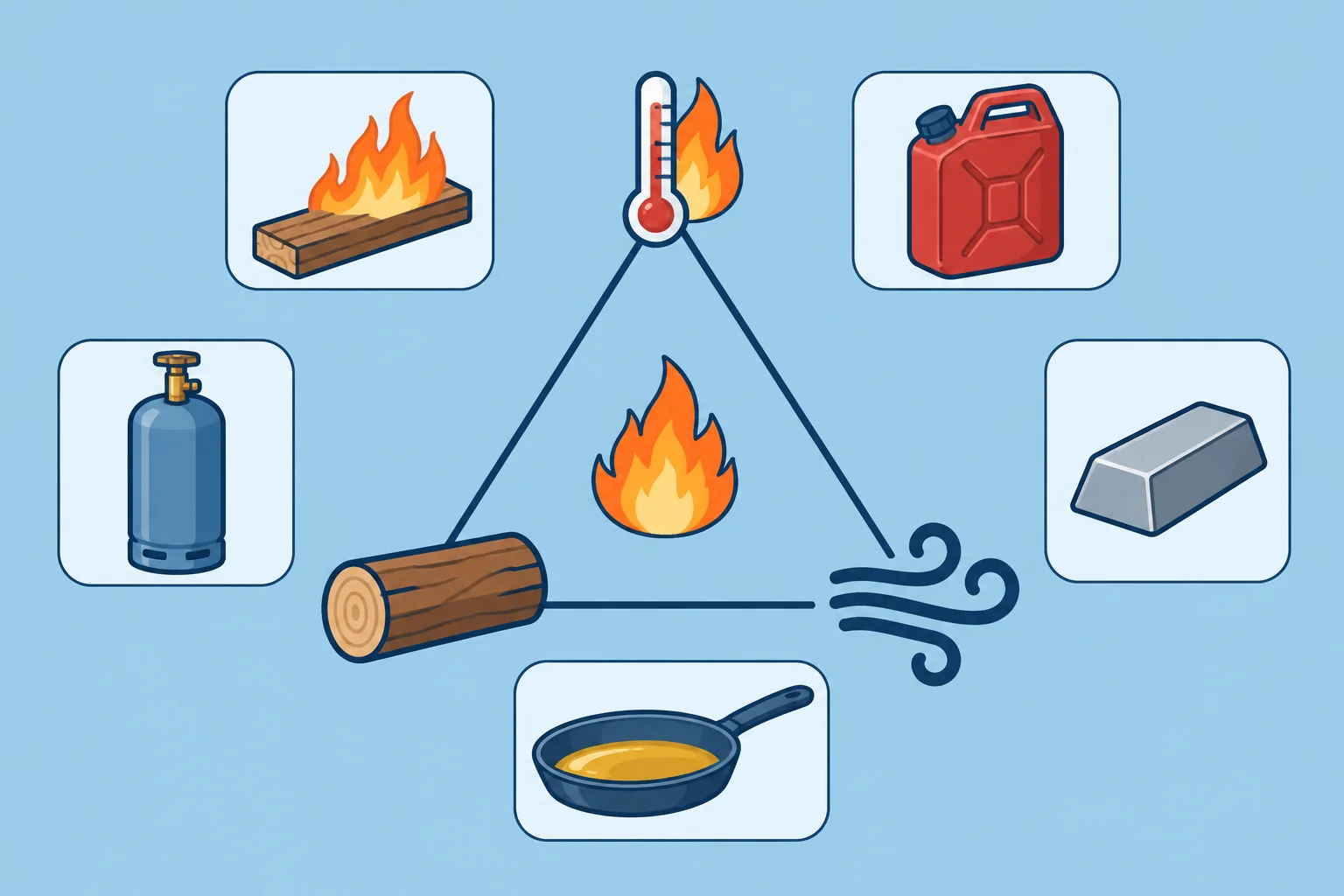
A fire needs three things: fuel to burn, heat to keep it at ignition temperature and oxygen from the air. This is the fire triangle. Take one away and the fire goes out: cool it to remove heat, smother it to remove oxygen, or shut off the fuel. A boat is full of all three: diesel, petrol, gas, wood, cloth and resin, in a small space with a running engine.
The fire tetrahedron
Flames also need a self-sustaining chain reaction in the burning gases. Adding it to the triangle gives the fire tetrahedron. Dry powder works mainly by breaking that chain reaction, which is why it knocks flames down fast. It does not cool, so hot material can re-ignite once the powder settles. Keep watching a fire you think is out.
Classes of fire
In Europe, standard EN 2 sorts fires by fuel. Class A: solids normally forming embers, such as wood, cloth and paper. Class B: liquids and liquefiable solids (solids that melt), such as petrol, diesel and wax. Class C: gases such as LPG (bottled gas). Class D: metals such as magnesium. Class F: cooking oils and fats. Electrical equipment is not a class: it adds a risk of electric shock until you isolate it.
Other letters
The letters are not the same everywhere. In the United States, NFPA 10 uses A for solids, B for liquids and gases, C for live electrical equipment, D for metals and K for cooking oils. Read the pictograms on the extinguisher rather than trusting a letter, especially on a charter boat abroad.
Smoke kills first
Burning plastics, foam and resins give thick, toxic smoke. On a boat the danger often comes from smoke before flames. One or two breaths can disable you. Stay low, keep a way out behind you, and fight a fire only if you can do so safely. Fit smoke and carbon monoxide (CO) alarms and test them.
2Key data
- Class A (EN 2)
- Solids normally forming embers: wood, cloth, paper
- Class B (EN 2)
- Liquids and liquefiable solids: petrol, diesel, wax
- Class C (EN 2)
- Gases: LPG, butane, propane
- Class D (EN 2)
- Burning metals
- Class F (EN 2)
- Cooking oils and fats
- US letters (NFPA 10)
- A, B (liquids and gases), C (live electrical), D, K (cooking)
3Key points
- 1
Fire needs fuel, heat and oxygen, plus a chain reaction.
- 2
Fight it by cooling, smothering, cutting the fuel or breaking the chain.
- 3
EN 2: A ember-forming solids, B liquids and melting solids, C gases, D metals, F cooking oils.
- 4
Electrical is a hazard, not an EN 2 class; US letters differ.
- 5
Smoke is often the first killer: stay low and keep an exit.
4Frequent mistakes
Wrong: Once the flames are out the fire is over.
Right: Hot material can re-ignite, especially after powder. Keep cooling and watching.
Wrong: Class C means electrical fires everywhere.
Right: EN 2 uses C for gases; NFPA uses C for energised electrical equipment. Check the label.
5Practice case & exam keys
On a charter yacht abroad you find an extinguisher marked ‘ABC’. A crew member says it is for wood, petrol and electrical fires. Is that right?
Show the answer
It depends on the classification system. Under NFPA, ABC means ordinary solids, flammable liquids and gases, and energised electrical equipment, so the crew member is right. Under EN 2, C means gases. Check the label and electrical-use instructions before choosing it.
Exam keys
- Fire triangle: fuel, heat, oxygen; tetrahedron adds the chain reaction.
- Extinguish by cooling, smothering, starving the fuel or breaking the chain reaction.
- EN 2 classes: A ember-forming solids, B liquids and melting solids, C gases, D metals, F cooking oils; electrical is not a class.
- US NFPA letters differ: C electrical, K cooking.
Finish this unit
When you've read it, answer three questions. Get all three right to finish the unit; opening the page alone doesn't count.
My notes for this unit
No notes