

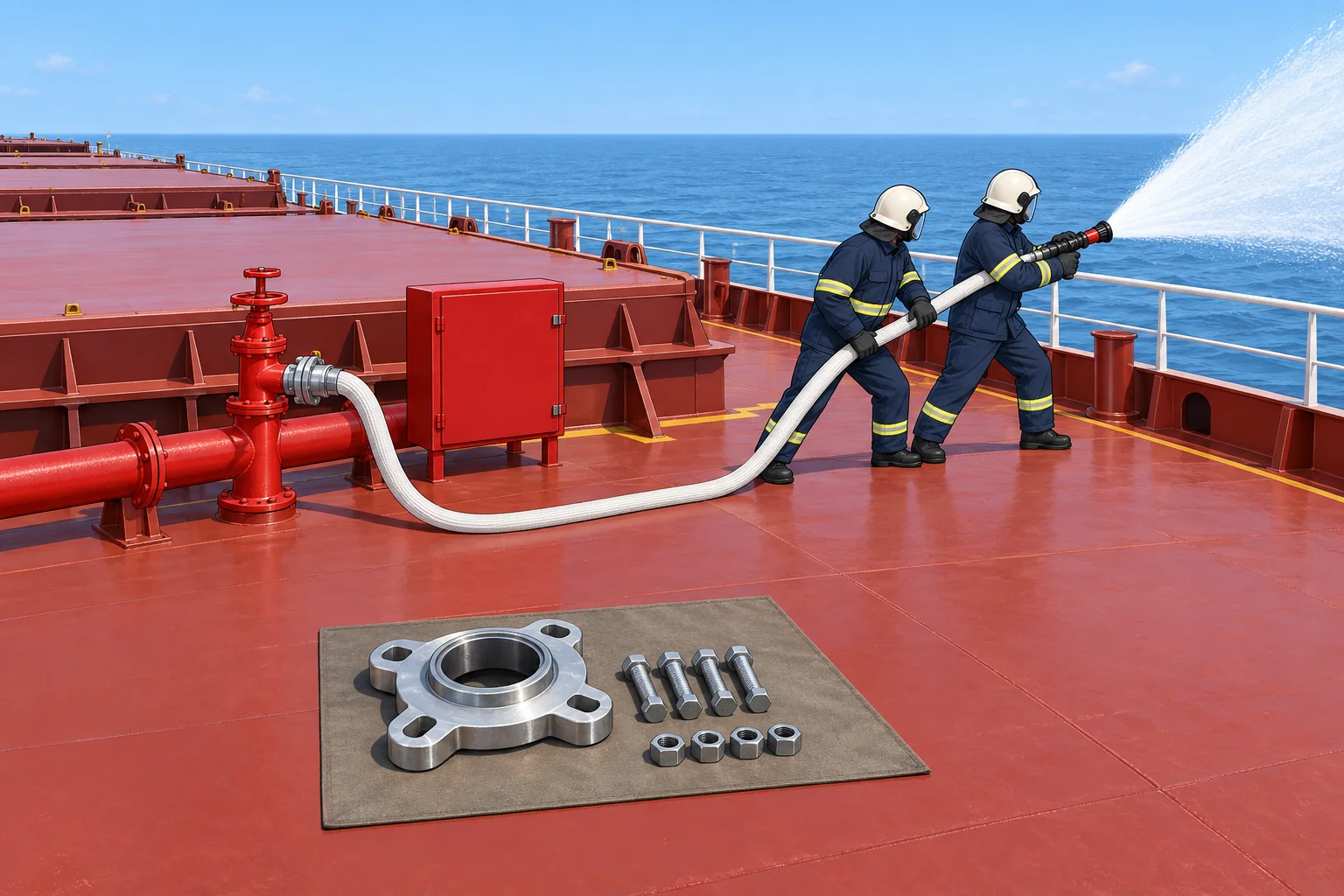
The fire main, hydrants, hoses and nozzles
1The lesson in plain words
The fire main brings seawater to every deck. Know the hose lengths, the nozzle settings and the international shore connection.
Pumps and main
Fire pumps push seawater through the fire main, the ship's firefighting pipe system, to hydrants, hose connection points. An emergency fire pump provides water if fire disables the main pumps. Know the hydrants on your assigned route and keep access clear.
Hoses
Fire hoses are stowed in boxes or on racks near the hydrants, with a nozzle and couplings ready. SOLAS II-2/10.2.3 sets their length: at least 10 m, and no more than 15 m in machinery spaces, 20 m in other spaces and on open decks, and 25 m on the open decks of ships wider than 30 m. Lay it out without kinks, connect it and open the hydrant slowly. Two people handle a charged hose, filled with pressurised water.
Nozzles: jet or spray
Ships use dual-purpose nozzles that give a jet or spray, with a shut-off. A jet reaches far and penetrates deep fires in solid materials such as bedding or cargo. A spray (or fog) cools surfaces and makes a water curtain to shield the team when correctly applied. Control flow and application time. Never jet water into burning oil: it spreads the fire. Keep both jet and spray off live electrical equipment; have electrical isolation confirmed before applying water.
International shore connection
Hose couplings differ between countries. The international shore connection (ISC) is a standard flange, with a gasket, four bolts, four nuts and eight washers, that lets a shore fire brigade or another ship feed your fire main, or yours feed theirs. Ships of 500 gross tonnage (GT, a measure of enclosed volume) and over must carry one, ready for use on either side. FSS Code chapter 2 sets the flange: 178 mm outside diameter and four 16 mm bolts.
Look after the system
A hose that leaks, a hydrant that will not turn or a missing nozzle can lose a fire. Report damaged hoses and never use fire hoses to wash decks unless the ship allows it. Keep hydrants and hose boxes clear of stores and lashings. In freezing weather, the officers may drain exposed sections of the fire main; know which.
2Key data
- Hose length (SOLAS II-2/10.2.3)
- At least 10 m; at most 15 m in machinery spaces
- Hose length elsewhere
- At most 20 m; 25 m on open decks of ships over 30 m wide
- Emergency fire pump
- Provides water if fire disables the main pumps
- Nozzle sizes
- 12, 16 or 19 mm, dual-purpose jet/spray with shut-off
- International shore connection
- Ships ≥ 500 GT; flange 178 mm; usable on either side
3Key points
- 1
Fire pumps supply the fire main and hydrants; know the connections on your route.
- 2
Hoses: at least 10 m; at most 15 m in machinery spaces, 20 m elsewhere, 25 m on wide decks.
- 3
Jet for reach and penetration; spray for cooling and shielding. Control flow and application time.
- 4
Never jet burning oil. Keep both jet and spray off live electrical equipment.
- 5
The international shore connection lets shore or another ship feed your fire main.
4Frequent mistakes
Wrong: Open the hydrant fully at once to get water quickly.
Right: Open it slowly. A sudden surge makes the hose whip and can knock the team over.
Wrong: A jet is always better because it reaches further.
Right: Spray cools faster and protects you. Use the jet for reach or deep-seated fires.
Wrong: Any hose length will do in the engine room.
Right: SOLAS limits engine-room hoses to 15 m so they can be handled in tight spaces.
5Practice case & exam keys
A shore fire brigade's hose couplings do not fit your ship's fire main. You fetch the international shore connection, but its gasket is missing. A crew member suggests bolting it together without the gasket to save time.
Show the answer
Tell the officer that the gasket is missing. Fetch the correct gasket and check for four bolts, four nuts and eight washers. Do not improvise a seal or pressurise an incomplete connection. The standard flanges join the differing couplings, but the complete assembly is needed for a sound connection. Bring it to the side ordered and report when the kit is ready.
Exam keys
- Fire pumps supply the fire main and hydrants; the emergency pump supplies water if fire disables the main pumps.
- Hoses: minimum 10 m; maximum 15 m machinery spaces, 20 m other spaces, 25 m open decks of ships over 30 m wide.
- Dual-purpose nozzles: jet for reach, spray to cool and shield. Never jet burning oil; keep both patterns off live electrics.
- International shore connection: ships of 500 GT and over, usable on either side.
Finish this unit
When you've read it, answer three questions. Get all three right to finish the unit; opening the page alone doesn't count.
My notes for this unit
No notes