

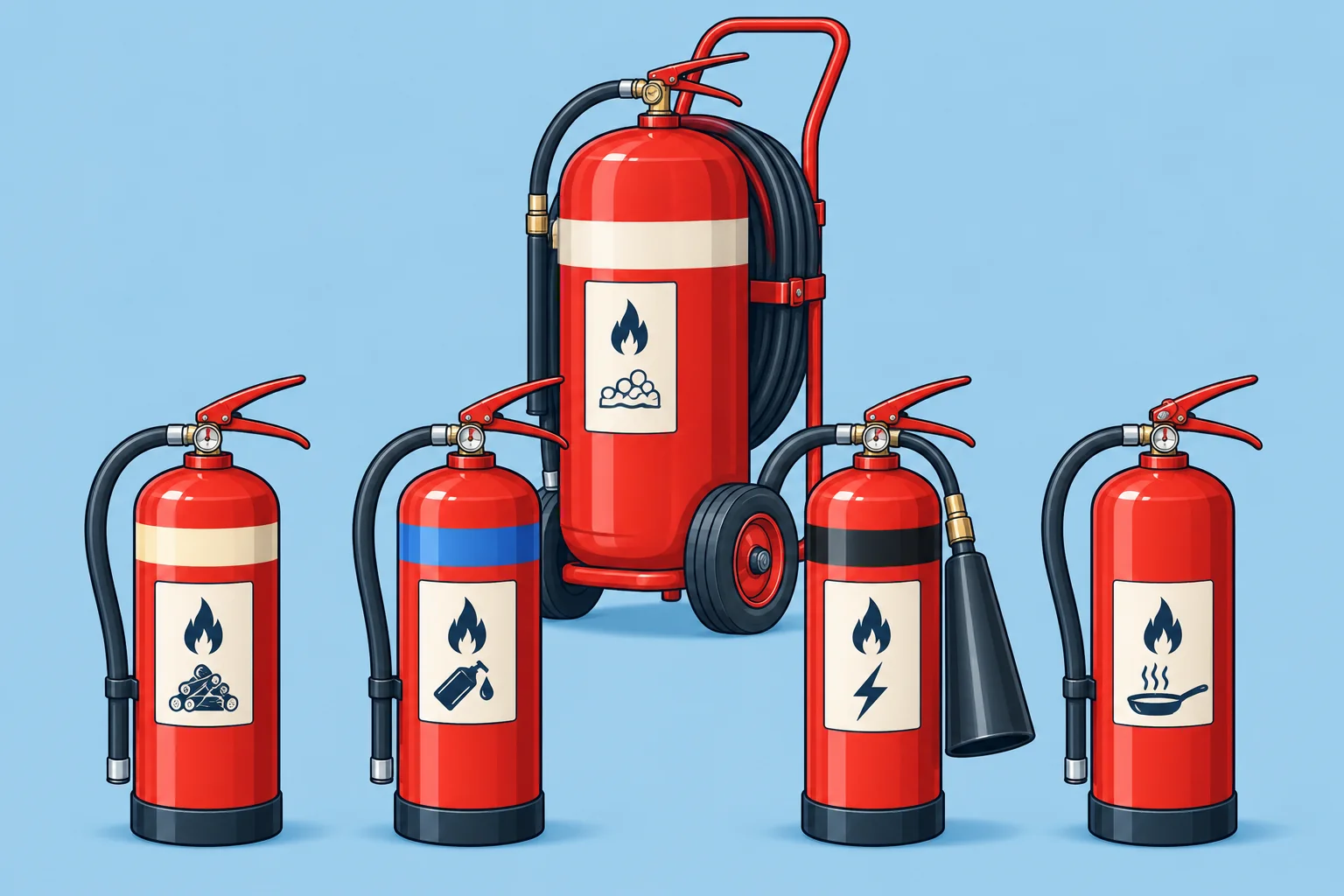
Portable and wheeled extinguishers at ship scale
1The lesson in plain words
Portable extinguishers are for a fire that has just started. Pick the right agent, check it, keep your exit behind you, and know when to back off.
First-aid fire fighting
A portable extinguisher is for a small fire caught early. The Fire Safety Systems (FSS) Code, chapter 4, sets minimum sizes: water and foam at least 9 L, dry powder and CO₂ at least 5 kg, and nothing heavier than 23 kg when full. 6 kg powder units are common. SOLAS, the international ship-safety convention, sets how many go in each space and requires spare charges. You discharge real extinguishers on real fires in your approved course.
Which agent where
Water cools solid materials such as bedding; never use it on burning oil or live electrics. Foam covers solids and flammable liquids. Dry powder covers the classes on its label: ABC includes solids; BC does not. For burning gas, isolate its supply if safe; otherwise withdraw rather than extinguish a continuing leak. Powder cools little: watch for re-ignition. CO₂ suits electrical equipment and small oil fires and leaves no residue. It can suffocate you in small, poorly ventilated spaces.
Colours and labels
Under EN 3-7, the extinguisher standard, the body is red. Any agent-colour panel follows the applicable national marking system; always read the label. It states the agent, fire classes and rating (such as 13A or 55B), electrical limits and operating instructions. Check the instructions in the ship's working language and English.
Using one
Raise the alarm. Read the label for range and electrical limits. Check the pin, seal and gauge if fitted; test as instructed. Approach low with your exit behind you, within the maker's stated working range. Aim at the base and sweep. Apply foam gently off a surface, never into burning fuel. Back away facing the fire. Typical discharge: powder/CO₂ 10–20 s; water/foam about one minute. Hold CO₂ by its handle or designated insulated grip: the horn freezes. Withdraw if heat or smoke threatens your exit.
Bigger units
Where SOLAS II-2/10.5 requires them, internal-combustion machinery spaces carry 45 L foam units or approved equivalents; oil-fired boiler rooms normally require a 135 L foam unit or equivalents. Hoses must reach the fire risks. A portable foam applicator is a foam branch, a nozzle connected to the fire main by hose, with a portable tank of at least 20 L of foam concentrate and a spare tank. Wheeled units and applicators need two people.
2Key data
- Minimum sizes (FSS ch. 4)
- Water and foam 9 L; powder and CO₂ 5 kg (6 kg powder usual)
- Maximum mass
- 23 kg for a portable extinguisher
- Labels (EN 3-7)
- Red body; read the label for agent, rating and electrical limits
- Typical duration
- Powder and CO₂ about 10–20 s; water and foam about 1 min
- Foam where required; equivalents allowed
- 45 L combustion-machinery; 135 L in oil-fired boiler rooms
- Foam applicator
- Branch on the fire main; 20 L concentrate plus a spare tank
3Key points
- 1
Portable extinguishers are for small, early fires: raise the alarm first.
- 2
Choose water, foam, powder or CO₂ by the label; check electrical limits.
- 3
Read the label, not just the colour band.
- 4
Test as instructed; use the maker's working range, exit behind you, aim low and sweep.
- 5
Powder and CO₂ last only seconds: have a second extinguisher ready.
4Frequent mistakes
Wrong: The colour tells you everything about an extinguisher.
Right: Bodies are mostly red now. Read the label for the agent, classes and electrical limits.
Wrong: Aim foam straight into a pool of burning oil.
Right: A jet into the fuel splashes it. Let foam run gently off a bulkhead or surface onto the pool.
Wrong: Powder has put the fire out, so the job is done.
Right: Powder barely cools. Watch for re-ignition and cool hot material if safe.
5Practice case & exam keys
A small fire starts in oily rags beside a live bench grinder that you cannot safely isolate. By your clear exit are a 9 L water extinguisher and a 6 kg ABC powder extinguisher whose label permits use on live electrical equipment.
Show the answer
Raise the alarm and report to the engine control room. If a safe small-fire attack is possible, use the labelled ABC powder within its stated range, keeping your exit behind you. ABC covers the burning rags; its electrical suitability matters while the grinder is live. Do not use water where it could reach live equipment. If heat or smoke threatens your exit, withdraw and close the door. Report the result and watch for re-ignition from safety.
Exam keys
- FSS ch. 4: water and foam at least 9 L; powder and CO₂ at least 5 kg; portable at most 23 kg.
- Water for solids; foam for solids/liquids; powder as labelled (ABC includes solids). Isolate burning gas before extinguishing. CO₂ for electrics/small oil fires.
- EN 3-7: red body; agent-colour panels follow national markings. Read the label for agent, rating, range and electrical limits.
- Where required: 45 L foam for combustion-machinery, 135 L for oil-fired boiler rooms; approved equivalents allowed. Applicator: 20 L concentrate plus spare.
Finish this unit
When you've read it, answer three questions. Get all three right to finish the unit; opening the page alone doesn't count.
My notes for this unit
No notes