

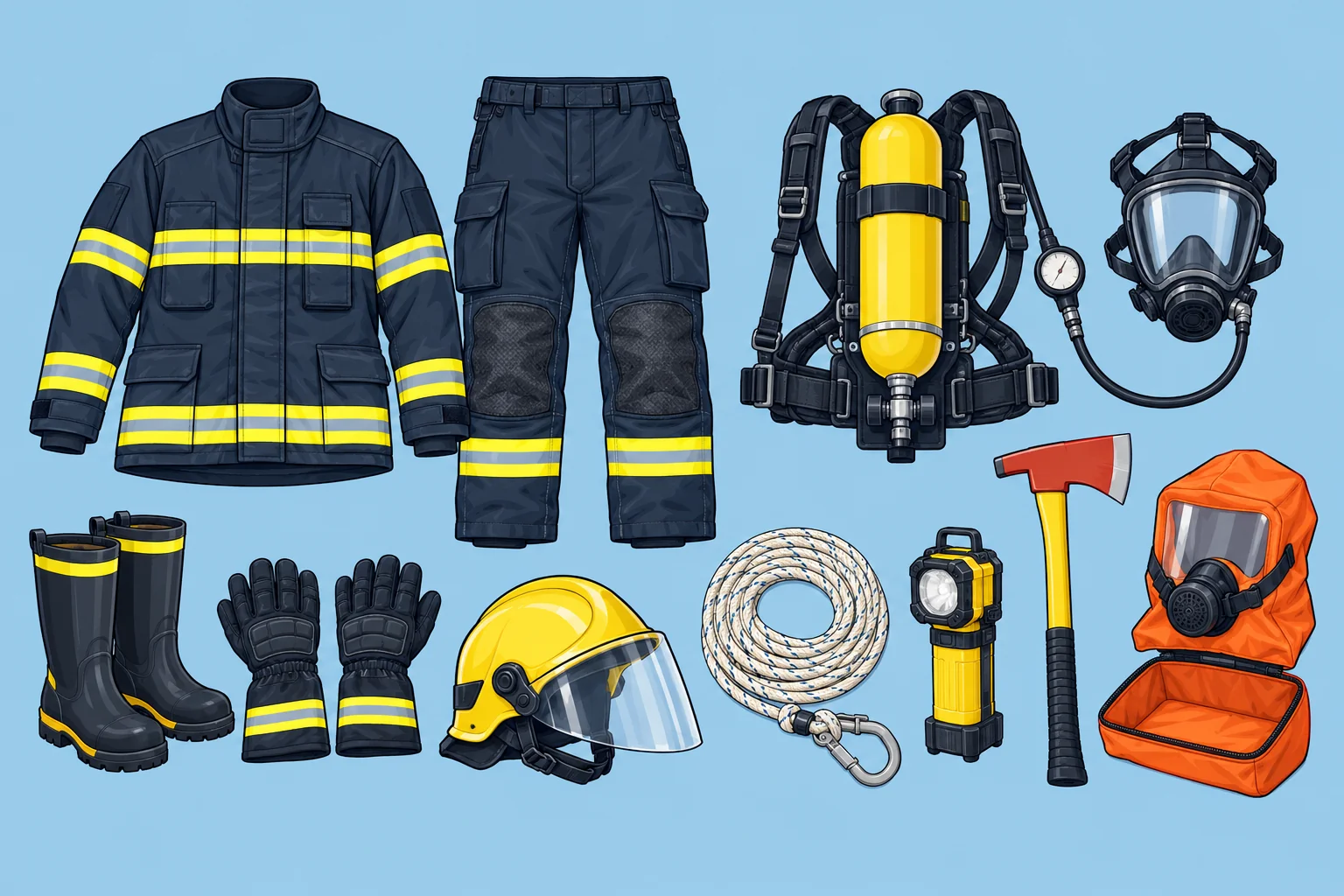
The firefighter's outfit, breathing apparatus and EEBDs
1The lesson in plain words
Check your equipment, monitor your air and plan an early exit. If either warning whistle sounds, withdraw together immediately.
The firefighter's outfit
SOLAS II-2/10.10 requires at least two firefighter's outfits on cargo ships, and more on passenger ships, stored ready in separate places. FSS Code chapter 3 says what each holds: protective clothing that shields the skin from radiant heat, burns and scalding, with a water-resistant outer surface; boots and gloves of rubber or another non-conducting material; a rigid helmet; an electric safety lamp that burns for at least 3 hours (explosion-proof on tankers); and an axe with an insulated handle.
Breathing apparatus
Each outfit includes self-contained breathing apparatus (SCBA), with a harness, gauge, demand valve and full face mask. Compressed-air sets contain at least 1,200 L; other self-contained types must function for at least 30 minutes. Interchangeable cylinders and spare charges are carried on board. Hard work in heat uses air faster. Each set has a fireproof lifeline at least 30 m long; each fire party has at least two explosion-proof two-way radios.
Checks before use
Follow the maker's pre-use checks. Inspect the cylinder, harness, hoses and mask. Open the cylinder and read the gauge: pressure must meet the maker's limit. Close it and check for a pressure drop within the maker's leak-test limit. Vent slowly and confirm the warning whistle sounds. Fit the mask and check its seal as the maker directs. Reopen the cylinder fully as instructed, confirm air flows while you breathe, then buddy-check.
The whistle
Agree your withdrawal pressure or time with the BA controller, who tracks entry and air supplies, before entry. Check your gauge often and leave together early enough to reach safety with reserve air. Never wait for the low-pressure warning whistle. If either warning sounds, withdraw together immediately and report. The warning must sound before remaining air falls to 200 L. This reserve is for escape, not extra working time.
EEBDs are for escape
An emergency escape breathing device (EEBD) is a hood or mask with a small air or oxygen supply, carried in accommodation and machinery spaces. It gives at least 10 minutes of breathing to escape from smoke. It is never for fighting fires, entering tanks or rescuing others: it is designed and approved for escape, not firefighting or rescue. Know where the EEBDs are on your route.
2Step by step
Pre-use check of a breathing apparatus
- 1
Inspect cylinder, harness, hoses and mask for damage.
A cracked mask or worn strap fails in the smoke.
- 2
Open the cylinder fully and read the gauge.
You need a full cylinder to plan your time.
- 3
Close the cylinder and monitor pressure for the maker's specified test period.
Reject the set if the pressure drop exceeds the maker's permitted limit.
- 4
Vent slowly and confirm the whistle sounds.
Confirm the reserve alarm works; it is not your planned turn-back signal.
- 5
Check the mask seal, reopen the cylinder as instructed and confirm normal breathing and gauge pressure.
A poor seal lets smoke in with every breath.
- 6
Buddy check with your partner and report to the BA controller. If any check fails, do not use the set; report and replace it.
Two checks catch what one misses.
3Key data
- SCBA air (FSS ch. 3)
- Compressed air: at least 1,200 L; other SCBA types: at least 30 min
- Low-pressure warning
- Sounds before the air left falls to 200 L
- Lifeline
- Fireproof, at least 30 m, tested to 3.5 kN
- Safety lamp
- At least 3 h; explosion-proof on tankers
- Outfits on cargo ships
- At least two (SOLAS II-2/10.10)
- EEBD
- Escape only; at least 10 min of air
4Key points
- 1
Outfit: protective clothing, non-conducting boots and gloves, helmet, safety lamp, axe.
- 2
Compressed-air SCBA: at least 1,200 L; other types: at least 30 minutes. Hard work uses air faster.
- 3
Check gauge, leaks, whistle and mask seal; reopen the cylinder, check breathing, then buddy-check.
- 4
Leave together at the planned air or time limit, before the whistle; either warning means withdraw immediately.
- 5
An EEBD gives at least 10 minutes to escape; never use it to fight fire.
5Frequent mistakes
Wrong: A 30-minute set always gives you 30 minutes inside the fire.
Right: Hard work in heat uses air fast. Watch your gauge and plan your exit early.
Wrong: The whistle means finish the job quickly.
Right: Withdraw together immediately. Plan to leave before the whistle; the reserve is for escape.
Wrong: An EEBD will do for a quick search of a smoky cabin.
Right: EEBDs are for escape only. Searching needs full BA, a partner and a team.
6Practice case & exam keys
You and your partner are searching a smoke-filled alleyway in BA. Your warning whistle sounds while you can still see a door you have not checked. Your partner's gauge shows more air than yours.
Show the answer
Tell your partner and leave together at once, by the way you came. The whistle means your reserve has started; it is for getting out, not for one more door. Report to the BA controller on the way out, giving what you checked and the door you did not reach, so the next team can search it. Never let one of the pair stay behind. Do not normally wait for the whistle to start withdrawing.
Exam keys
- Firefighter's outfit: protective clothing, boots, gloves, helmet, safety lamp (3 h), axe, SCBA and lifeline.
- Compressed-air SCBA: at least 1,200 L; other types: at least 30 min. Warning before 200 L remain; lifeline at least 30 m.
- Pre-use: gauge, leak test, whistle, mask seal, reopened cylinder, breathing check, buddy check. Plan withdrawal before the warning.
- EEBD: escape only, at least 10 min; never for firefighting.
Finish this unit
When you've read it, answer three questions. Get all three right to finish the unit; opening the page alone doesn't count.
My notes for this unit
No notes