

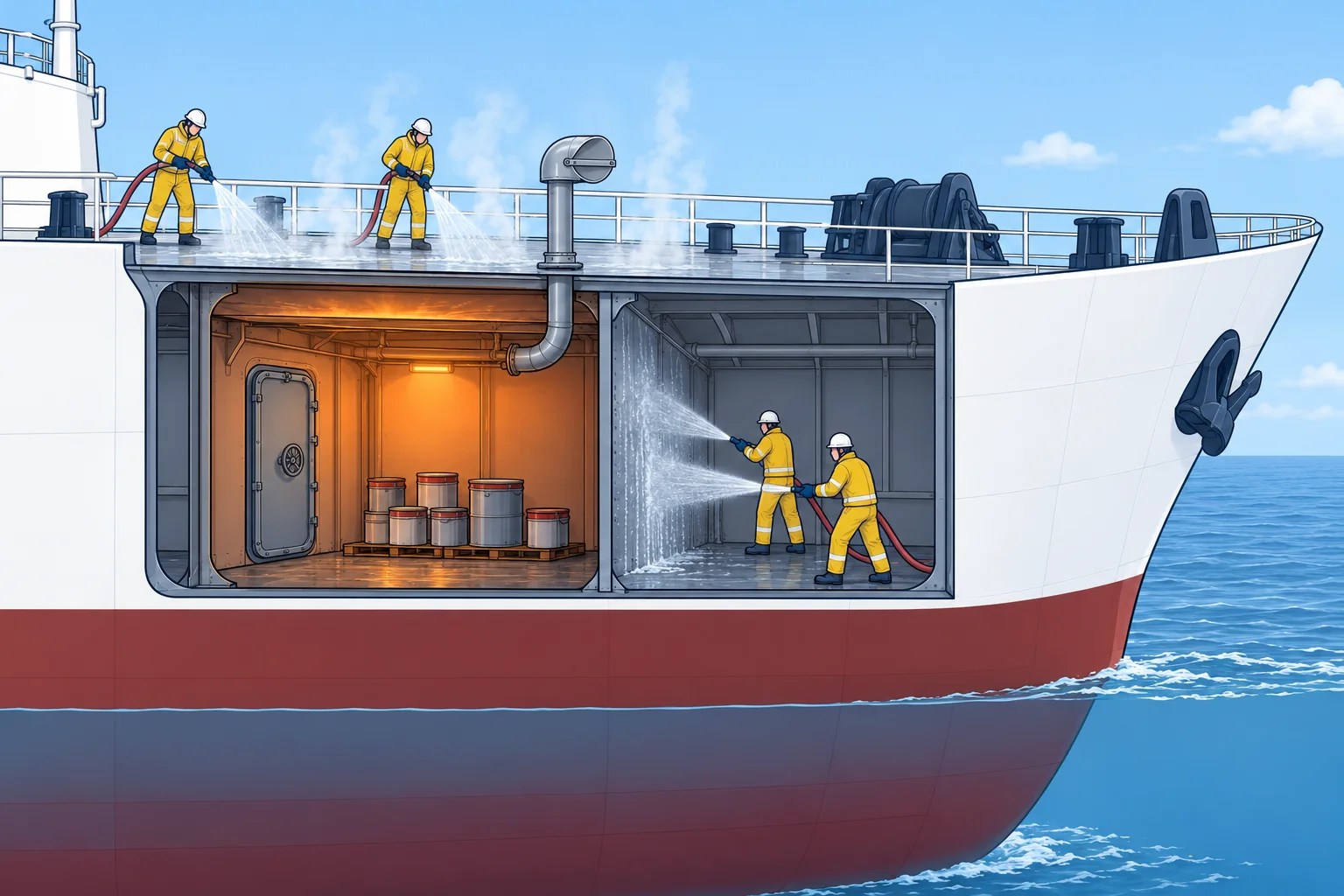
Boundary cooling, closing down and water on board
1The lesson in plain words
Contain the fire: check all six sides and cool hot boundaries as directed. Control air and fuel as ordered, and report water building up.
Six sides
A fire space has six boundaries: four bulkheads (ship's walls), the deck above, whose underside is the deckhead, and the deck below. Heat conducts through all of them. The boundary-cooling team checks spaces on every side for heat and smoke, removes anything that can burn and cools hot steel as directed. The deck above needs most attention, because heat rises. Report any boundary you cannot reach, such as a tank or cargo on the far side.
How to cool
Apply controlled spray to hot steel and move it across the surface. Reassess temperatures regularly, using the ship's checking method or a thermal camera. Report persistent or increasing heat and blistering paint. Visible steam alone does not establish that the boundary is safe; no steam does not prove it is cool. Keep checking temperatures and follow your team leader's instructions. Use only the water needed for effective cooling.
Ventilation control
Closing down means cutting the fire's air and fuel supplies as ordered: stop fans; close fire dampers (shutters in ventilation ducts), skylights, portholes and doors. In the engine room, stop fuel pumps and close quick-closing valves, fuel shut-off valves operated remotely. These remote controls are outside the space. The fire control plan shows where they are.
Before a fixed system
Before a fixed-system release, report that everyone is out and accounted for. Stop fans and isolate fuel as ordered. Prepare openings and ventilation exactly as the installed system requires: CO₂ total flooding needs the space sealed; foam systems may need designated air vents open. Do not improvise or release the system yourself. After release, keep cooling and watching boundaries as ordered. Do not reopen or enter until authorised under the ship's procedures.
Water and stability
Firefighting water can collect inside the ship. A hose can put in many tonnes an hour, often high up. Loose water sloshing across a deck has a free surface that reduces stability and can make the ship list or capsize. Use the flow and duration needed for effective cooling. Report water building up and help clear deck drains and scuppers (drain openings at the ship's sides). The stability side is covered in Stability: stability basics.
2Key data
- Six sides
- Four bulkheads, the deck above and the deck below
- Most attention
- The deck above: heat rises
- Closing down
- Fans off, dampers, doors, skylights shut; fuel off remotely
- Before a fixed system
- All out and counted; prepare space to installed system instructions
- Firefighting water
- Tonnes per hour per hose; free surface reduces stability
3Key points
- 1
Check all six sides and cool hot boundaries as directed, especially the deck above.
- 2
Use spray, move it across the steel and keep checking for heat.
- 3
Closing down: stop fans, close dampers and openings, shut fuel remotely.
- 4
Before release, account for everyone and prepare the space exactly as the installed system requires.
- 5
Firefighting water can reduce stability. Use enough for effective cooling and report water building up.
4Frequent mistakes
Wrong: Boundary cooling means the bulkheads next to the fire.
Right: Six sides: four bulkheads, the deck above and the deck below.
Wrong: More water always means a safer ship.
Right: Loose water high up can list or capsize the ship. Use only what is needed.
Wrong: Leave the fans running so the smoke clears.
Right: Fans feed the fire with air. Stop them and close the dampers.
5Practice case & exam keys
A fire is burning in a paint store in the forecastle. You are on the boundary-cooling team. The store has a deck above it with mooring ropes, a stores room alongside and a void space below with no safe access.
Show the answer
Check all six sides and cool hot boundaries as directed. Start with the deck above: move mooring ropes away from the hot area, spray hot steel and keep checking its temperature. Check the stores room alongside, remove combustibles from the shared bulkhead and cool hot steel. Report that the void below cannot be reached so the team leader can decide. Control flow and application time, and report water collecting.
Exam keys
- Check six boundaries: four bulkheads, deck above and deck below. Cool hot boundaries as directed.
- Spray hot boundaries; keep checking temperatures and report changes. Visible steam alone does not establish safety.
- Closing down: fans, dampers, openings and fuel valves shut by remote controls.
- Firefighting water and free surface threaten stability.
Finish this unit
When you've read it, answer three questions. Get all three right to finish the unit; opening the page alone doesn't count.
My notes for this unit
No notes