

Raising the alarm and working in the fire party
1The lesson in plain words
A ship's fire is fought by teams, not heroes. Raise the alarm, go to your station, and work in pairs under your team leader.
If you find a fire
Raise the alarm at once: shout, operate the nearest manual fire-alarm call point and tell the bridge. Give the location, what is burning, how big it is and whether anyone is trapped or injured. Attack it with an extinguisher only if it is small, you have a clear way out behind you and you can do it safely. Otherwise get out, close doors behind you to starve it of air and report.
Muster and teams
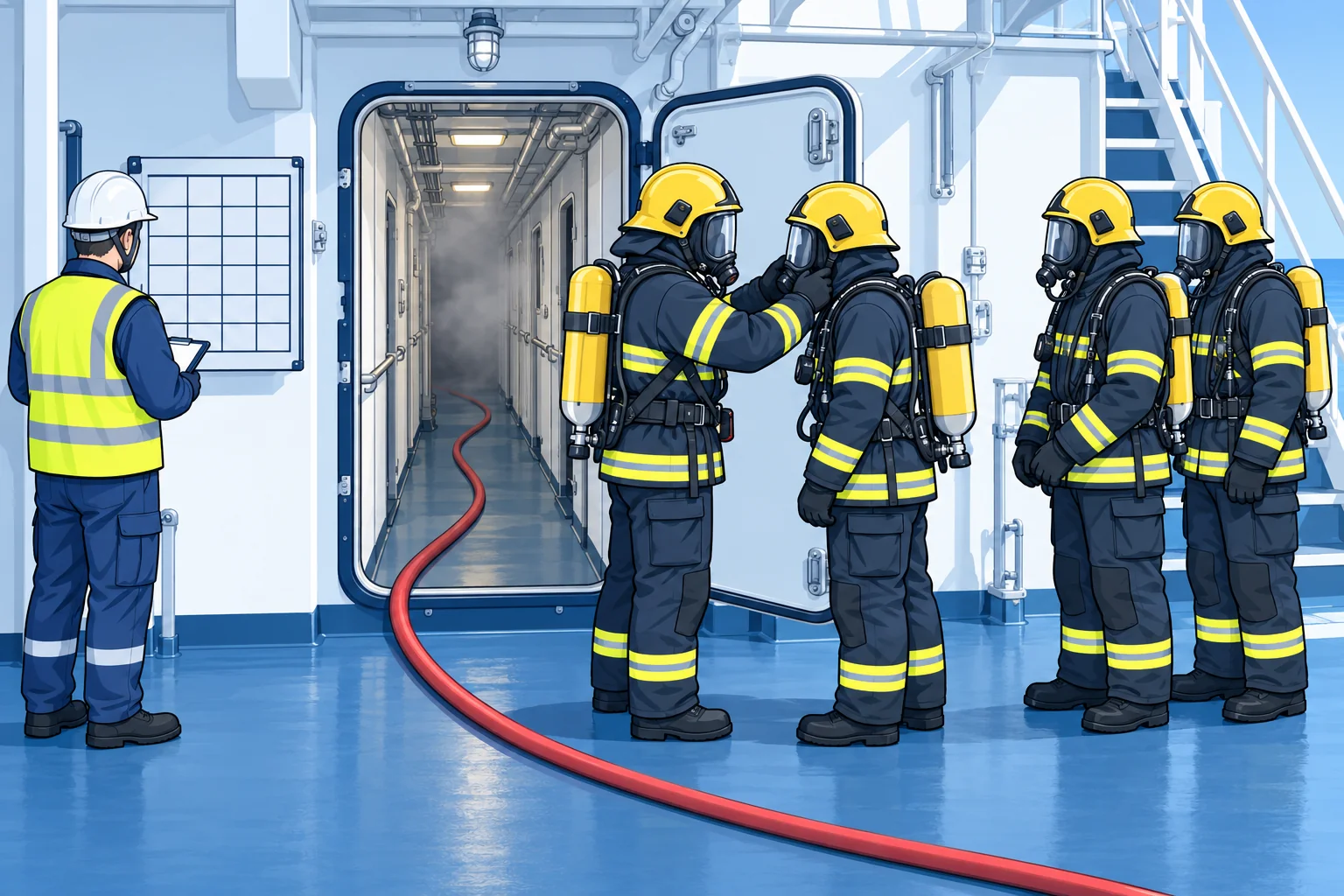
On the fire alarm, go to your station as the muster list says and report for the headcount. The master commands from the bridge. The fire party (often called the emergency party) is usually led by the chief officer, or by an engineer for an engine-room fire. Typical teams: an attack team of two in breathing apparatus (BA), a backup team ready to relieve or rescue them, a boundary-cooling team, and support for hoses, first aid, stretchers and closing down. Names vary by company.
Work in pairs
Nobody goes into smoke alone. BA wearers work in pairs, check each other and stay in touch. Withdraw together at the agreed air or time limit, before the warning whistle. Leave immediately if either has a problem or a whistle sounds. A BA controller at the entry keeps an entry control board: names, cylinder pressures, entry times and latest exit times. Report your gauge reading whenever asked.
Communications
The fire party uses portable radios, at least two per party, explosion-proof or intrinsically safe. Keep messages short and clear: who you are, where you are, what you see, what you need. Lifeline signals are a backup, such as the common OATH code (one pull OK, two Advance, three Take up slack, four Help); use the signals your ship has agreed. When you come out, report what you saw: heat, smoke, casualties, doors and hatches.
Your part as a new crew member
At first you may run hoses, carry equipment, cool boundaries, close ventilation or join the stretcher team. Do your task, stay with your team, follow orders and report back when it is done. Keep to your assigned task: a person acting alone can open the wrong door or end up as a casualty that others must rescue.
2Key data
- Report
- Location, what is burning, size, anyone trapped or hurt
- Overall command
- The master, from the bridge
- BA entry control
- Names, pressures, entry times and latest exit times
- Radios (SOLAS II-2/10.10.4)
- At least two per fire party; explosion-proof
- Lifeline signals (OATH)
- 1 OK, 2 Advance, 3 Take up slack, 4 Help
3Key points
- 1
Raise the alarm first, then report location, what, size and casualties.
- 2
Attack only a small fire, with your exit behind you.
- 3
Teams: attack, backup, boundary cooling, support; the master commands.
- 4
BA wearers always work in pairs and come out together.
- 5
The BA controller logs names, pressures and times at the entry point.
4Frequent mistakes
Wrong: Fight the fire first and raise the alarm once you know it is serious.
Right: Raise the alarm first. A fire can grow in seconds, and help takes time to arrive.
Wrong: If your partner is slow, carry on alone to save time.
Right: Pairs stay together. Alone in smoke you have no help if something goes wrong.
Wrong: Long radio messages make sure nothing is missed.
Right: Short, clear messages keep the channel free for everyone.
5Practice case & exam keys
On your evening round you find smoke coming from under a cabin door in the crew accommodation. A crew member says the cabin's occupant may be asleep inside.
Show the answer
Raise the alarm and report the deck, cabin number, smoke and possible casualty to the bridge. Keep the door closed; shout to the occupant from safety. Do not enter smoke without BA and your team. Warn nearby cabins only where safe. Report to your muster station for headcount unless the bridge directs you to guide the fire party. If redirected, report your location and task so you remain accounted for.
Exam keys
- Discovering a fire: alarm, report location, what, size and casualties; attack only if small and safe.
- Fire party teams: attack, backup, boundary cooling and support; the master commands.
- BA wearers in pairs; the BA controller keeps the entry control board.
- Communications: radios (at least two per party), short messages, agreed lifeline signals.
Finish this unit
When you've read it, answer three questions. Get all three right to finish the unit; opening the page alone doesn't count.
My notes for this unit
No notes