

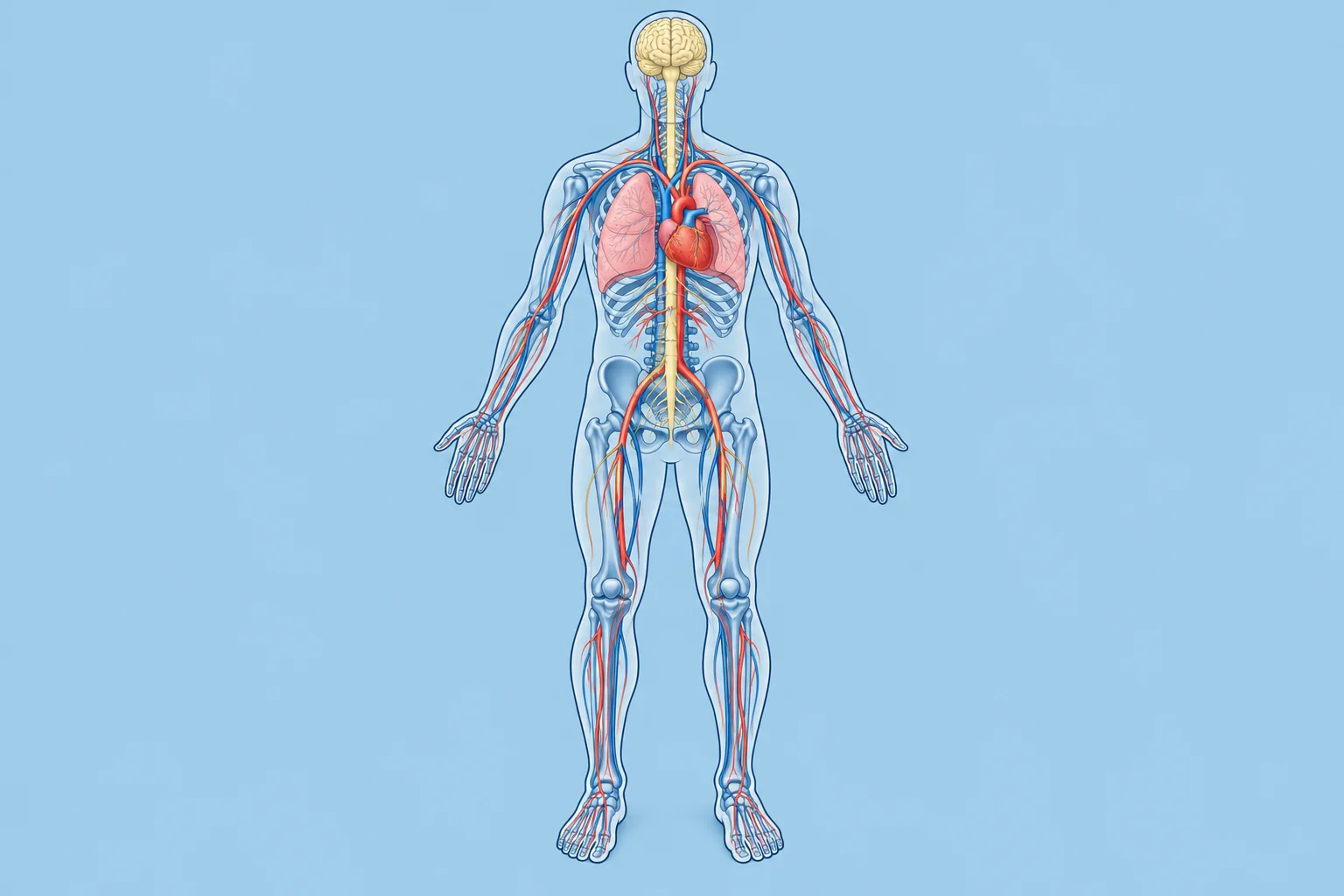
How the body works: a first-aider's map
1The lesson in plain words
First aid makes sense once you know what the bones, heart, lungs, nerves and skin do, and how fast the body fails without oxygen.
Why it matters
Elementary first aid is about keeping someone alive and stopping things getting worse until better help arrives. To do that you need a simple map of the body: what protects what, how oxygen gets to the brain, and what an injury stops working. This unit adds the ship's side to the first-aid, injuries and cold-weather lessons. The practical skills, such as CPR on a manikin and stretcher lifts, are done in your approved course.
Skeleton and muscles
The skeleton holds the body up and protects the organs. The skull protects the brain; the spine, a column of bones called vertebrae, protects the spinal cord; the ribcage protects the heart and lungs; the pelvis supports the lower body. Bones meet at joints, held by ligaments, strong bands of tissue. Muscles pull on bones through tendons, tough cords of tissue. A broken thigh bone or pelvis can bleed heavily inside, without anything showing.
Heart and circulation
The heart is a muscular pump behind the breastbone. At rest, an adult heart beats about 60–100 times a minute. Arteries carry blood away from the heart; veins return it. A limb artery may bleed in bright-red spurts; venous bleeding is usually darker and steadier. Either can be life-threatening. An adult has about 5 litres of blood; rapid loss can cause shock.
Lungs and breathing
Air passes through the nose and mouth, down the windpipe into the lungs. There, oxygen passes into the blood and carbon dioxide passes out. The diaphragm, a sheet of muscle under the lungs, does most of the work. An adult at rest breathes about 12–20 times a minute. If the brain gets no oxygen, damage starts within a few minutes.
Nervous system and skin
The nervous system carries messages and controls the body. The brain controls consciousness, breathing and the heartbeat; the spinal cord carries messages between brain and body through the nerves. Damage to the spinal cord can cause loss of feeling or movement below the injury. The skin is the body’s largest organ: it keeps germs out, limits fluid loss and helps control temperature. Burns damage that barrier, so the casualty loses fluid and heat and can get infected.
2Key data
- Adult heart rate at rest
- About 60–100 beats a minute
- Adult breathing at rest
- About 12–20 breaths a minute
- Adult blood volume
- About 5 litres
- No oxygen to the brain
- Damage begins within a few minutes
- STCW basis
- Regulation VI/1; Code table A-VI/1-3, elementary first aid
3Key points
- 1
Skull: brain. Spine: spinal cord. Ribs: heart and lungs. Pelvis: support for the lower body.
- 2
Arteries carry blood away from the heart; veins return it. Either can bleed dangerously.
- 3
An adult has about 5 litres of blood; fast loss leads to shock.
- 4
Without oxygen, the brain can be damaged within minutes.
- 5
Skin keeps germs out, limits fluid loss and helps control temperature; burns damage that protection.
4Frequent mistakes
Wrong: If there is no blood outside, the bleeding cannot be serious.
Right: A broken thigh bone or pelvis, or an injury to the abdomen, can bleed heavily inside.
Wrong: The heart is on the left side of the chest, so compress there.
Right: It lies in the centre, behind the breastbone. CPR compressions go in the centre of the chest.
Wrong: A burn only damages the skin's surface.
Right: The skin controls fluid, heat and infection. A large burn affects the whole body.
5Practice case & exam keys
A crew member falls about 3 m from a ladder onto the steel deck. He is pale and says his hip hurts badly. There is no blood to be seen. A shipmate says it is just a bruise and he can walk it off.
Show the answer
Do not let him walk. A fall from that height can break the pelvis or thigh bone, which can bleed heavily inside with nothing showing, and a back injury is possible. Raise the alarm and call the bridge. Keep him still and warm, with insulation between him and the cold steel, and watch for signs of shock. Wait for the stretcher team and the person in charge of medical care.
Exam keys
- Skeleton protects organs: skull, spine, ribcage, pelvis.
- Heart pumps blood through arteries and veins; adult about 60–100 beats/min, about 5 L of blood.
- Lungs exchange oxygen and carbon dioxide; adult about 12–20 breaths/min.
- Brain and spinal cord control the body; skin protects against infection, fluid and heat loss.
Finish this unit
When you've read it, answer three questions. Get all three right to finish the unit; opening the page alone doesn't count.
My notes for this unit
No notes