

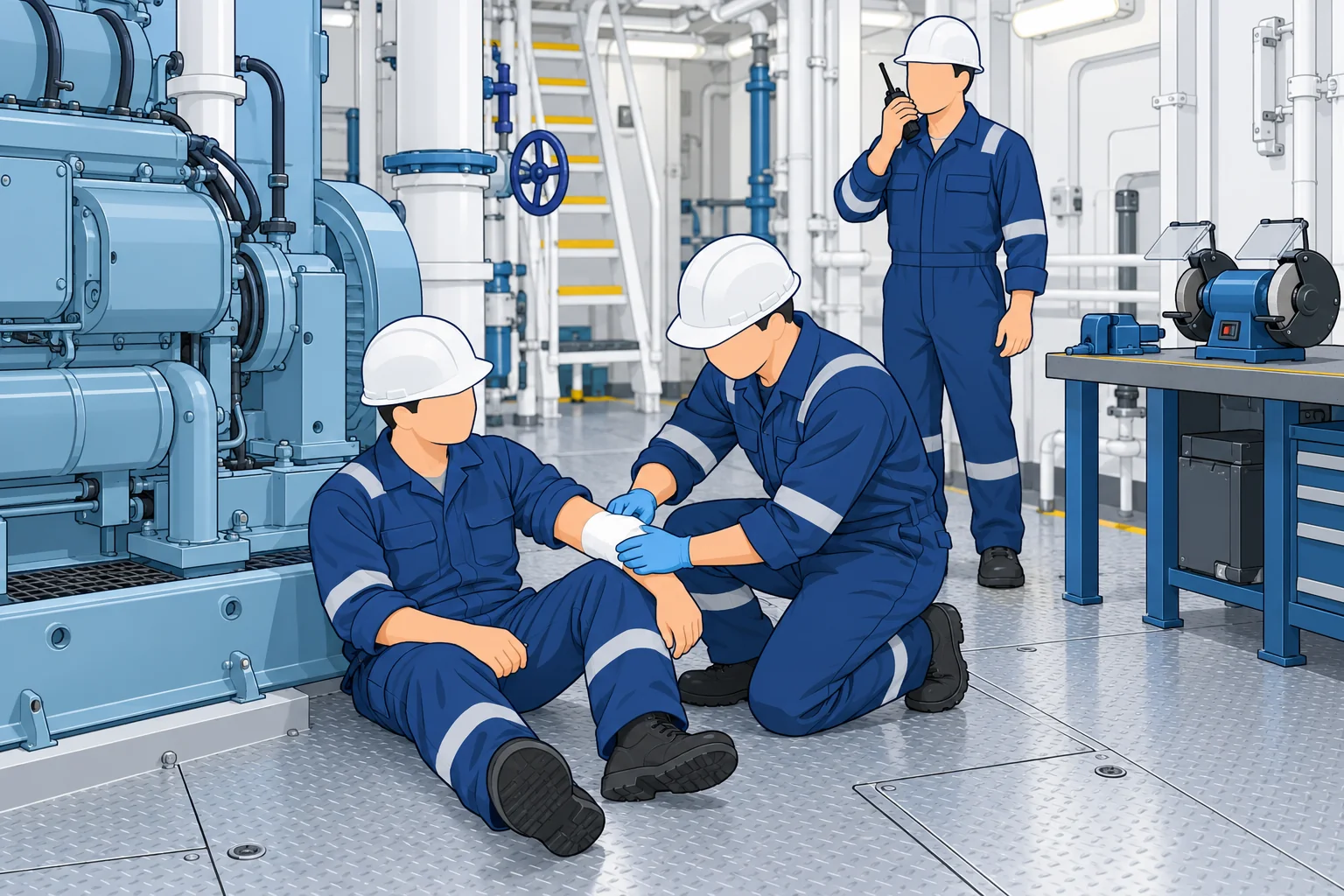
At the scene: safety, alarm and the ship's medical organisation
1The lesson in plain words
On a ship you are the first responder, and hospital may be days away. Make it safe, raise the alarm, assess, and use the ship's medical organisation.
Make it safe
Do not become the second casualty. On a ship the dangers include running machinery, live electrics, fire and smoke, gas in an enclosed space, moving cargo, work at height and the ship's motion. Stop machinery and isolate power through the person in charge if you can do it safely. Never go into an enclosed space or a smoke-filled room to reach a collapsed person: raise the alarm and wait for a team with breathing apparatus.
Raise the alarm
Call the bridge by phone or radio, or use the nearest alarm. Say where you are, what happened, how many are hurt, their condition and any danger at the scene. The bridge can sound the alarm, send the first-aid or stretcher team named in the muster list, which assigns emergency duties, and call the person in charge of medical care. Stay with the casualty if you can, and send someone to guide the team.
Assess needs
From a safe position, report how many casualties there are, whether they respond, their visible condition and any change. Tell the bridge about remaining hazards, access difficulties, equipment needs and trained help needed. Record times, observations and care for handover. Use First aid and resuscitation for the primary survey.
The ship’s medical organisation
Basic-trained crew learn elementary first aid (STCW A-VI/1-3). A designated medical first-aider holds A-VI/4-1 competence; where required, the person in charge of medical care holds A-VI/4-2 competence. Roles depend on ship and flag requirements, not rank alone. Know who is assigned and how to summon them. Follow your ship’s medical guide and keep records confidential. A ship carrying 100 or more people on international voyages of more than three days must carry a doctor (MLC 2006).
Radio medical advice
The designated seafarer can contact a doctor ashore through the ship’s telemedical service; see Radio medical advice.
2Key data
- Report to the bridge
- Where, what happened, how many, condition, dangers
- Basic-trained crew
- Elementary first aid, STCW A-VI/1-3
- Designated first-aider
- Medical first aid, STCW A-VI/4-1; as assigned on your ship
- Person in charge of medical care
- STCW A-VI/4-2 competence where required; check assigned roles
- Doctor on board (MLC 2006)
- 100 or more people, international voyages over 3 days
3Key points
- 1
Make it safe first; never enter an enclosed space or smoke to reach a casualty.
- 2
Report where, what happened, how many, their condition and dangers.
- 3
Tell the bridge about difficult access and any equipment or trained help needed.
- 4
The person in charge of medical care treats, records and calls for advice.
- 5
Use the ship’s medical guide. Record times, observations and care; keep records confidential.
4Frequent mistakes
Wrong: Run straight to a collapsed person in a tank.
Right: Raise the alarm and wait for the breathing-apparatus rescue team. The gas that felled them may fell you.
Wrong: Tell the bridge there is an injury and go back to help.
Right: Give the details: where, what, how many, condition and dangers, so the right team comes.
Wrong: Medical care at sea is the officers' job alone.
Right: You are often first on scene. Your first aid and notes shape everything that follows.
5Practice case & exam keys
In the engine room you find a motorman sitting on the deck beside a grinder, holding his forearm. Blood is running between his fingers and the grinder is still running. Nobody else is near.
Show the answer
Stop the grinder at its switch if you can reach it safely. Press firmly on the wound with a dressing or cloth to control the bleeding. Call the engine control room or bridge: engine room, grinder injury, one casualty, heavy bleeding from the forearm, conscious. Keep pressing, keep him sitting or lying down and warm, and watch for shock. Hand over to the first-aid team and tell them what happened and when.
Exam keys
- Scene safety first: machinery, electrics, fire, gas, cargo, height, ship's motion.
- Raise the alarm and report where, what, how many, condition and dangers.
- Report casualty numbers, condition, hazards, access and equipment needs; record times and care.
- Basic training: A-VI/1-3. Designated medical first aid: A-VI/4-1. Medical care: A-VI/4-2 where required; check assigned roles.
Finish this unit
When you've read it, answer three questions. Get all three right to finish the unit; opening the page alone doesn't count.
My notes for this unit
No notes