

Moving a casualty: stretchers and lifts on a ship
1The lesson in plain words
Steep ladders, hatches and engine rooms make moving a casualty hard. Move only when you must, with the right stretcher and enough people.
When to move
Treat a casualty where they are unless the place is dangerous, such as fire, smoke, gas, flooding or machinery, or unless you cannot treat them there. Moving can make injuries worse, especially to the spine. Move only as far as necessary to escape danger or make essential care possible. Otherwise wait for the stretcher team named in the muster list.
Emergency moves
For a quick move out of danger, drag the casualty along the deck by the clothing at the shoulders, supporting the head between your forearms, or on a blanket. Never lift a heavy casualty alone. Two trained people can use a hand-seat carry, making a seat with their hands, for a cooperative casualty without suspected serious injury. Lift with your legs and a straight back, and agree the command before you lift.
Ship’s stretchers
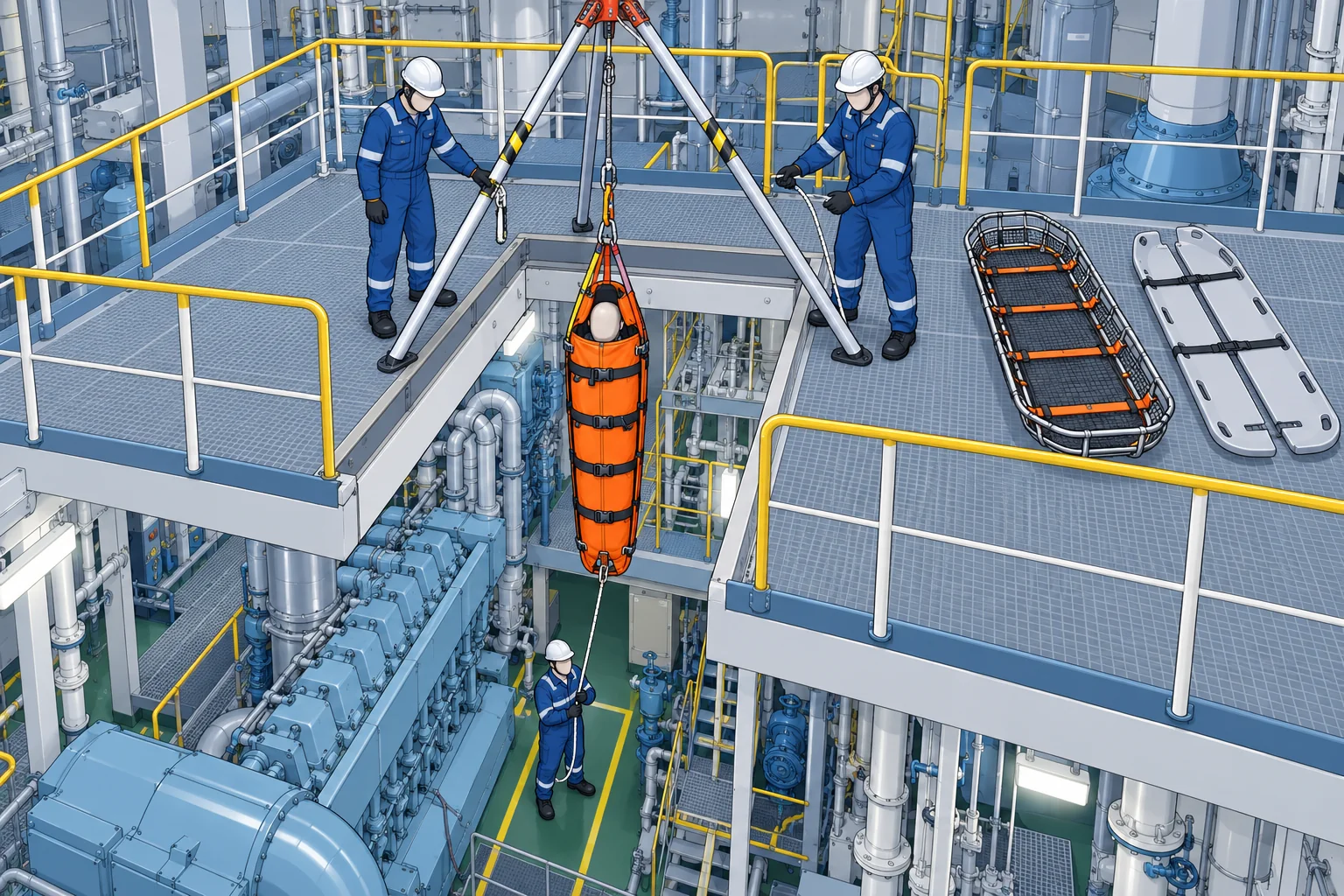
The Neil Robertson stretcher is canvas stiffened with wooden or bamboo slats. It wraps around the casualty for vertical lifts through narrow openings, when approved for their condition and the planned lift. The Stokes basket is a rigid wire or plastic basket for carrying and approved lifts. A scoop stretcher separates so a trained team can position its halves under the casualty with little movement. Never assume it is approved for hoisting. Know where your ship keeps its stretchers.
Carrying on board
Plan and clear the route, and strap the casualty in as the stretcher instructions require. Use enough trained bearers for the equipment and route, with one leader giving commands. On suitable stairs, carry head first going up; on the level, feet first. Keep the casualty supported and monitor them. For steep ladders or vertical openings, use the ship’s approved rescue-lifting arrangement rather than trying to carry a loaded stretcher up the ladder.
Vertical lifts
A trained rescue team chooses a stretcher suitable for the casualty’s condition and the planned lift. Use the ship’s approved casualty-lifting equipment, rigged by trained personnel, following its instructions and specified lifting points. A guide line at the foot steadies the stretcher; its operator stays outside the fall path. If the space may be unsafe, only the trained team with breathing apparatus enters. Entry rules are in Law: personal safety and Ropes: deck work safely.
2Key data
- Move only if
- Danger at the scene, or treatment impossible there
- Neil Robertson
- Wraps casualty; vertical lifts when suitable and approved
- Stokes basket
- Rigid basket; carrying and approved lifts
- Scoop stretcher
- Splits into two halves to reduce movement during transfer
- Direction
- Feet first on level; head first up suitable stairs
- Vertical lift
- Approved equipment; secured casualty; guide operator outside fall path
3Key points
- 1
Treat in place unless there is danger or essential care cannot be given there.
- 2
Emergency drag by the shoulders, head supported between your forearms.
- 3
Neil Robertson: vertical rescue; Stokes: basket; scoop: transfer. Check suitability and approval for each lift.
- 4
Plan the route, enough bearers, one person in command, casualty strapped in.
- 5
Vertical lifts: trained team, approved equipment, secured casualty; guide-line operator outside the fall path.
4Frequent mistakes
Wrong: Always move a casualty to the ship's hospital at once.
Right: Treat in place unless there is danger or essential care cannot be given there.
Wrong: One strong person can carry a casualty up an engine-room ladder.
Right: Steep ladders need the trained rescue team and an approved lifting arrangement, not a manual carry up the ladder.
Wrong: A Stokes basket is best for lifting through a small tank opening.
Right: The team must choose a stretcher suitable for the casualty, the opening and the planned lift, following its instructions.
5Practice case & exam keys
A fitter has fallen in the lower engine room and hurt his back. He is conscious, the space is safe, and the only way out is two steep ladders and a narrow passage to the upper deck.
Show the answer
Keep him still and warm, report to the bridge and wait for the trained team and medical lead. They assess the injury and choose a safe route and an approved rescue stretcher and lifting system. A scoop may help transfer him; it is not automatically suitable for hoisting. Clear the route. Use trained operators, one leader and a guide line controlled from outside the fall path.
Exam keys
- Move a casualty only for danger or when treatment is impossible in place.
- Neil Robertson: wraps for vertical rescue; Stokes: rigid basket; scoop: separates for transfer. Check lifting approval.
- Carry feet first on the level, head first up suitable stairs; one leader. Steep ladders need approved rescue lifting.
- Vertical lifts: suitable stretcher, approved lifting equipment, secured casualty; guide operator outside fall path.
Finish this unit
When you've read it, answer three questions. Get all three right to finish the unit; opening the page alone doesn't count.
My notes for this unit
No notes