

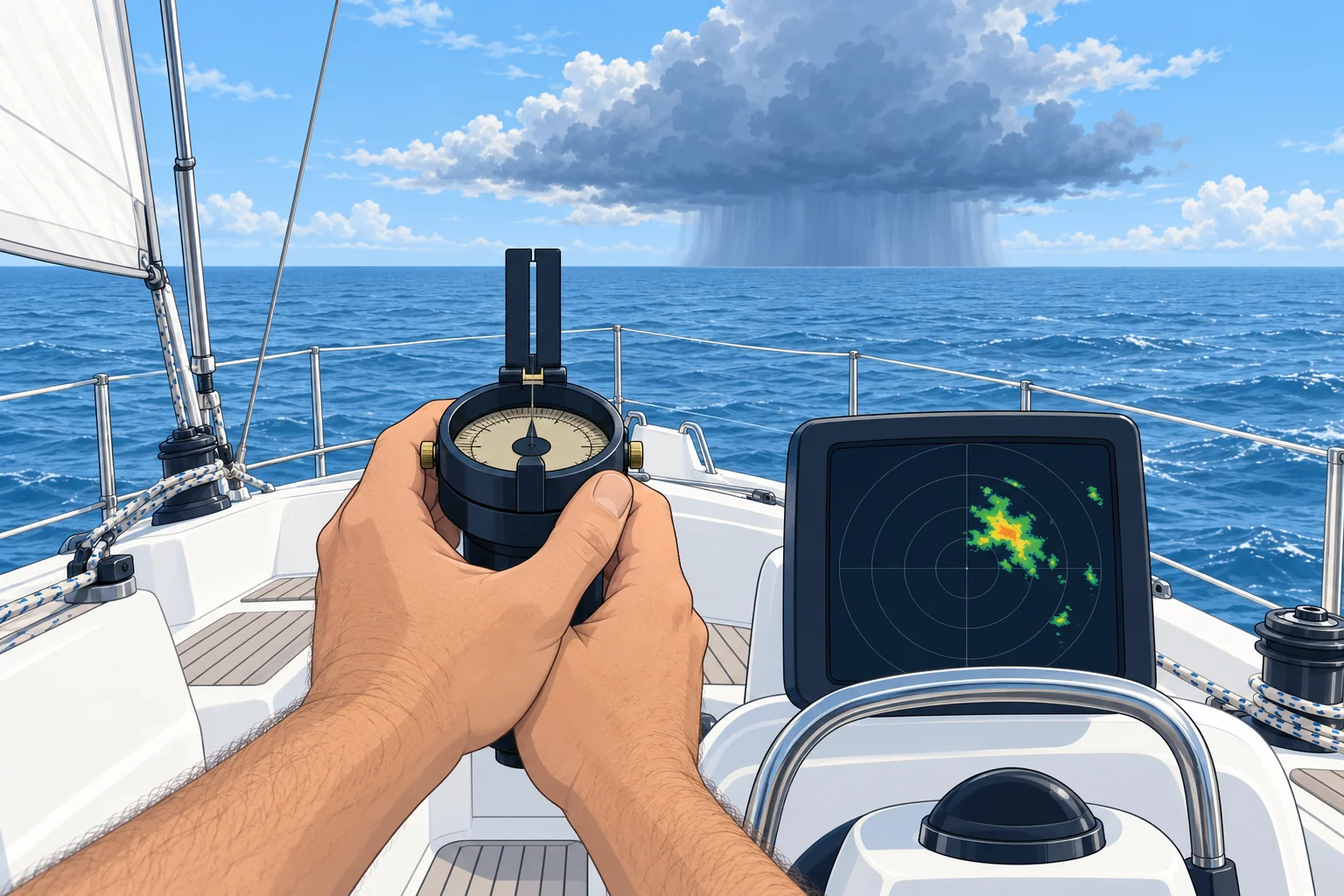
Spotting and tracking squalls by eye, radar and sound
1The lesson in plain words
Watch storms early, take their bearing and range, and work out whether they are coming at you. Then you can prepare in time or steer clear.
By eye
By day, look for a dark, hard-edged cloud base, rain shafts reaching the sea, a shelf cloud, and a dark, ruffled band on the water moving towards you. At night, lightning lights up the storms and shows where they are. Keep an all-round watch: storm movement can differ from the surface wind. Recheck every few minutes.
Bearing and range
Take compass bearings of the storm's centre and edges every few minutes. A steady bearing with decreasing range warns that it is approaching your position, as with a ship on a collision course. If bearings change steadily, it may pass to one side; keep checking both bearing and range. Note the times in the log.
Flash to bang
Light arrives at once; sound takes about 3 seconds per kilometre, or 5.4 seconds per nautical mile. Count from flash to thunder. A 12-second interval puts that discharge about 4 km (2.2 NM) away. A later 6-second interval puts that discharge about 2 km (1.1 NM) away. Flashes occur in different parts of a storm; confirm its movement with repeated bearings and radar ranges. If you hear thunder, you are within striking distance.
On your radar
Heavy rain often gives broad, fuzzy radar echoes. Track them with the EBL (electronic bearing line) and VRM (variable range marker). Rain echoes can mask boats; heavy rain can also weaken returns from beyond it. Rain-clutter suppression (sometimes called FTC) reduces rain echoes but can also remove small targets. Keep a careful lookout: a clear patch on the screen does not prove clear water.
Other tools
Near the coast, weather-radar and lightning-detection apps show storm cells and their movement, but they can lag by several minutes and need a phone signal. Forecasts warn with phrases such as risk of thunderstorms. GRIB files may include CAPE, a measure of instability: high values mean storms are possible, not certain.
2Key data
- Flash to bang (km)
- Seconds ÷ 3
- Flash to bang (nautical miles)
- Seconds ÷ about 5.4
- Worked example
- 12 s ≈ 4 km ≈ 2.2 NM; 6 s ≈ 2 km ≈ 1.1 NM
- Steady bearing, decreasing range
- Warns of an approaching storm
- Hear thunder
- You are within striking distance
3Key points
- 1
Take repeated bearings and ranges: a steady bearing with decreasing range warns of an approaching storm.
- 2
Flash-to-bang: seconds ÷ 3 = km; seconds ÷ about 5.4 = nautical miles.
- 3
Radar shows heavy rain as large, fuzzy echoes; track them with EBL and VRM.
- 4
Rain and rain-clutter suppression can hide boats; a clear radar patch does not prove clear water.
- 5
If you can hear thunder, you are close enough to be struck.
4Frequent mistakes
Wrong: Turn the rain clutter control up until the screen is clear.
Right: Too much rain-clutter suppression can remove small targets. Use only enough to reduce rain echoes, and maintain a lookout.
Wrong: The thunder is far away, so lightning cannot reach us yet.
Right: If you can hear thunder you are within striking distance. Lightning can strike well away from the rain.
5Practice case & exam keys
At 0110, lightning west of you has a 15-second flash-to-bang interval. At 0125 it is 9 seconds. The same rain echo remains near 270° while its radar range falls from 3 NM to 2 NM. What can you conclude?
Show the answer
15 seconds is about 5 km (2.8 NM); 9 seconds is about 3 km (1.7 NM). The later discharge is nearer, but flashes can occur in different places. The same radar echo has a steady bearing and decreasing range, confirming approach towards your position. Treat it as a threat. Keep tracking with timed EBL and VRM observations and maintain a lookout for vessels.
Exam keys
- Steady bearing and closing range: the storm is coming at you.
- Flash-to-bang: ÷3 for km, ÷ about 5.4 for nautical miles.
- Radar: heavy rain = fuzzy echoes; track with EBL/VRM; rain clutter can hide boats.
- Hearing thunder means you are within striking distance.
Finish this unit
When you've read it, match the terms, then answer three questions. Get them all right to finish the unit; opening the page alone doesn't count.
My notes for this unit
No notes