

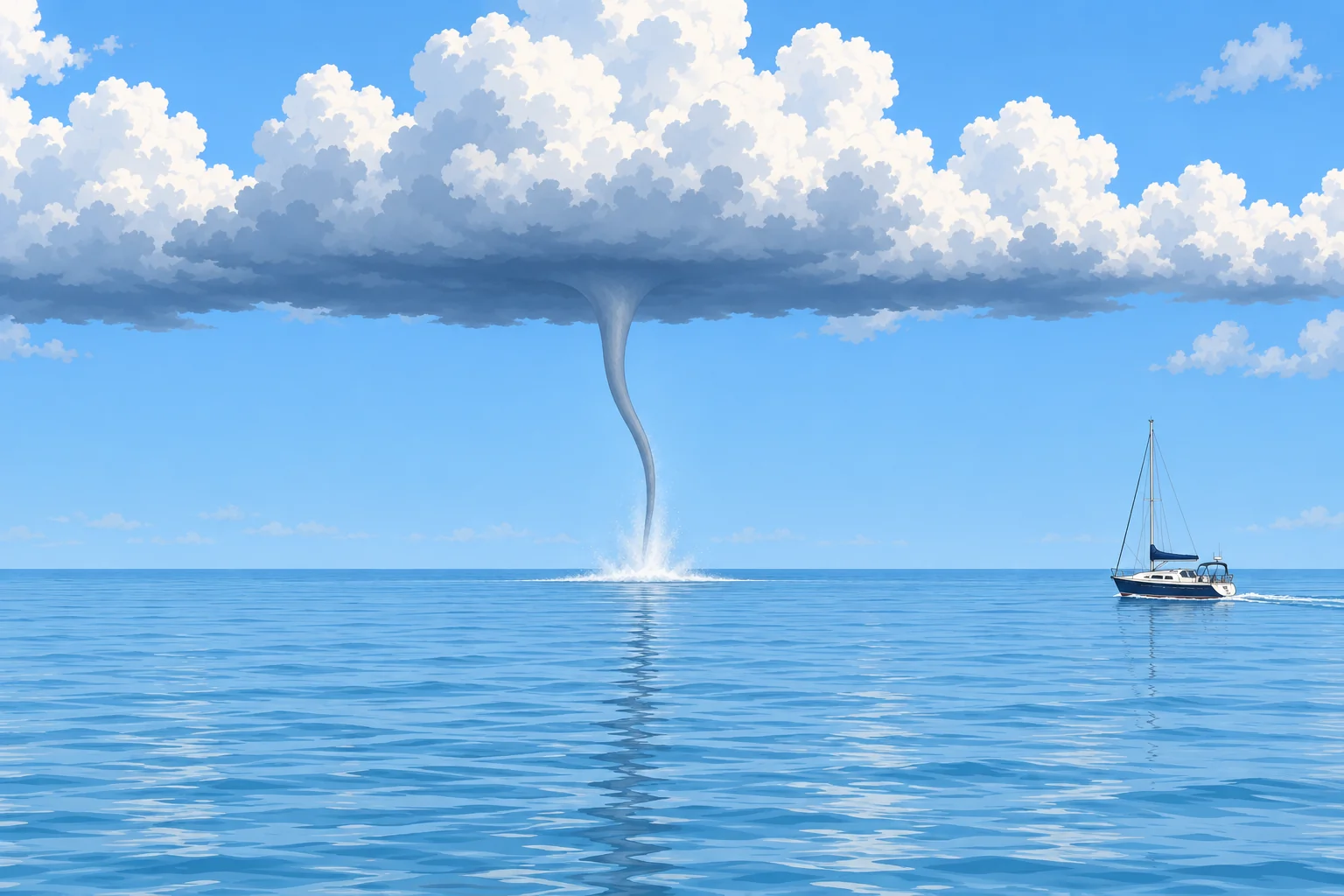
Waterspouts: fair-weather and tornadic
1The lesson in plain words
A waterspout is a spinning column of air over water. Some are tornadoes. Keep clear: choose the safe side at right angles to its track and increase separation.
Two kinds
NOAA describes two kinds. A fair-weather waterspout forms at the sea surface under a line of growing cumulus, in light winds, and builds upwards. It is usually unassociated with thunderstorms and often moves very little. A tornadic waterspout is a tornado over water. It can form over water beneath a severe thunderstorm or move onto the sea from land, and can be as violent as a tornado ashore.
Stages of a fair-weather spout
Researchers describe five stages. A dark spot appears on the water. A spiral pattern of light and dark bands forms round it. A spray ring of swirling spray rises at its centre. In the mature vortex, the circulation is fully developed. Finally it decays, often within minutes. A funnel may appear before maturity; its visibility alone does not tell you the stage or strength. Never wait for a funnel before acting.
Where and when
Waterspouts are commonest over warm water: for example the Florida Keys in summer and the Mediterranean from late summer into autumn. Look for them under dark, flat-based lines of cumulus, near showers and along fronts. Tornadic spouts may accompany lightning, hail, heavy rain and rough seas; do not require these signs before taking action.
How dangerous
Even a weak spout can capsize a dinghy, damage sails and rig, and throw people overboard. A tornadic spout can destroy a yacht. Weather services issue marine warnings when spouts are likely or seen; listen for them. If one reaches land it is treated as a tornado.
Avoiding one
Increase separation immediately while tracking its movement. Choose the safe side at right angles to its observed track; never turn towards it. Use the engine if needed, reduce sail, close hatches, and get people below or clipped on low in the cockpit. Keep watching its movement and report it to the coastguard.
2Key data
- Fair-weather spout
- Forms at the surface, light winds, little movement
- Tornadic spout
- Tornado over water, from a severe thunderstorm
- Five stages
- Dark spot, spiral, spray ring, mature vortex, decay
- Avoidance (NOAA)
- At 90° to its track, choose the safe side; increase separation
3Key points
- 1
Fair-weather spouts grow up from the sea; tornadic ones are tornadoes over water, sometimes arriving from land.
- 2
A dark spot and a spray ring on the water mean a spout is forming.
- 3
Even a weak spout can damage a rig and throw people overboard.
- 4
Move at right angles to its movement, choosing a safe course that increases separation. Never approach.
- 5
Listen for marine warnings and report spouts you see.
4Frequent mistakes
Wrong: Steer straight away from a waterspout, directly downwind of it.
Right: Choose the perpendicular direction that increases separation and keeps clear of hazards; keep watching its movement.
Wrong: Fair-weather waterspouts are harmless, so you can get close for a photo.
Right: Even a weak spout can damage a rig and injure people. Never approach any waterspout.
5Practice case & exam keys
Motor-sailing north off Mallorca, you see a dark patch and spray ring 1 NM north-east, moving west across your track. Open water lies south; shoals lie north. What do you do?
Show the answer
Turn south under engine now, at right angles to the spout's westward movement and away from its path. Reduce sail, close hatches, protect the crew and report it to the coastguard. Keep tracking its movement and watch for other spouts.
Exam keys
- Fair-weather: surface up, light winds, little movement; tornadic: tornado from a thunderstorm.
- Stages: dark spot, spiral pattern, spray ring, mature vortex, decay.
- Avoid: move at 90° to its movement on the safe side that increases separation; never approach.
- Reduce sail, close up, crew below or clipped on; report it.
Finish this unit
When you've read it, match the terms, then answer three questions. Get them all right to finish the unit; opening the page alone doesn't count.
My notes for this unit
No notes