

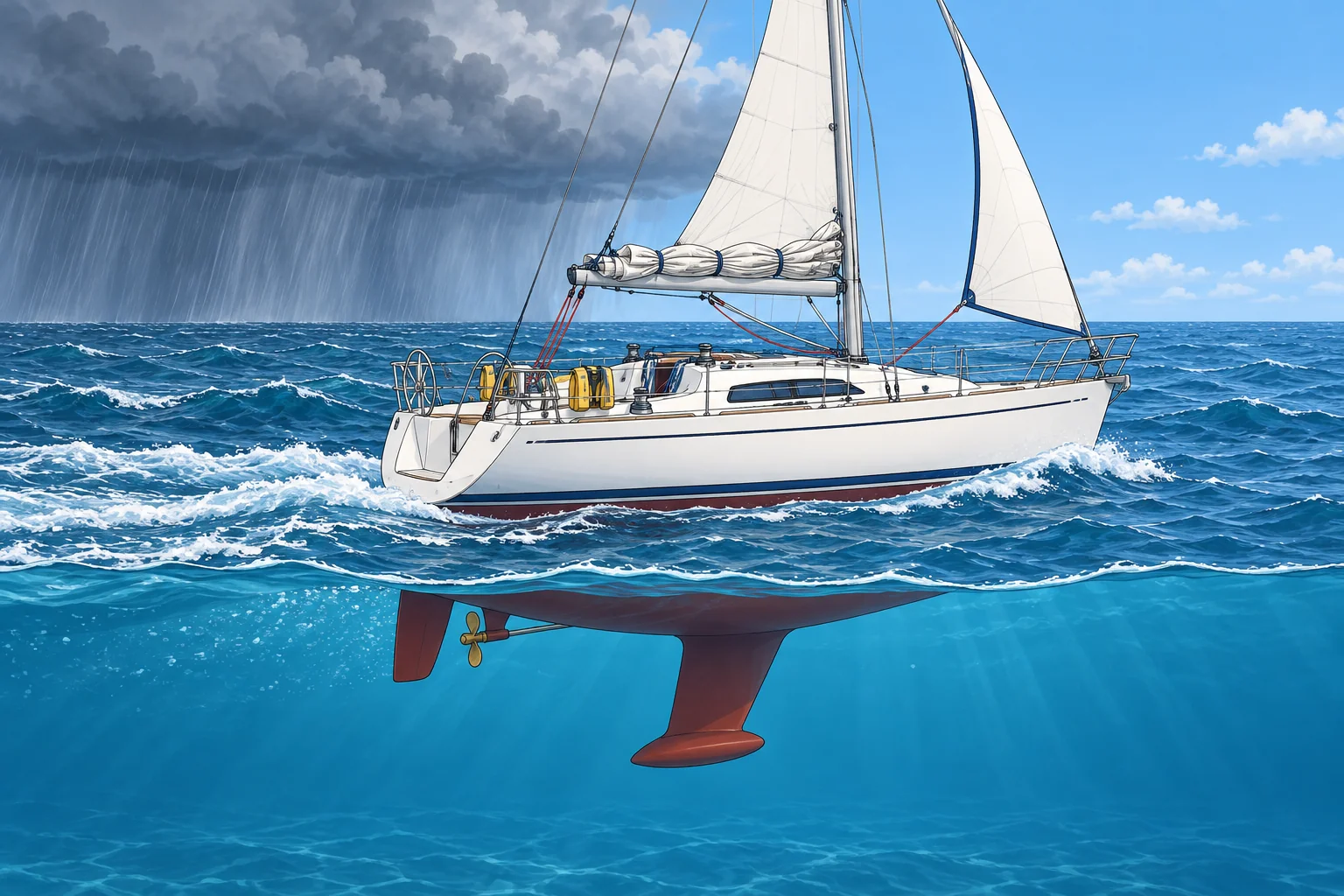
Squall tactics: reef early, keep sea room, choose your heading
1The lesson in plain words
When a squall is coming, reef early, keep clear water where the gust may push you, and choose your heading before it arrives.
Reef early
Reefing and rigging showed how to reef; here the point is timing. Reduce the whole sail plan for the expected gusts: reef or lower both mainsail and headsail as needed before the gust front arrives. Choose sail area for 30–50 knots, not the present breeze. At night, reef when you see storms building or when the forecast mentions thunder.
Prepare the boat
Close hatches and ports. Stow loose gear on deck and below. Everyone on deck wears a lifejacket and is clipped on. Start the engine in neutral to be ready. Fix your position and note it. Switch on navigation lights if visibility will drop. Brief the crew: who steers, who handles the sheets, what heading you will take.
Keep sea room
The gust can push you a long way in minutes, often from a new direction. Look at where the wind will blow you: usually away from the storm. Keep well clear of any coast, shoal or other boats on that side. Do not try to enter a narrow harbour or anchorage just as a squall arrives; stand off in open water instead.
Choose your heading
In open water with sea room, you can bear away (turn farther from the wind) under a small headsail. Alternatively, lower the sails and motor into wind if your engine can maintain steering control. Use enough power to hold the chosen heading; allow for waves and avoid beam-on exposure with too much sail. Choose before the gust arrives.
Dodge or wait
Once you know an isolated cell's movement, alter course early to increase separation and stay clear of its projected path. Choose clear water with safe sea room and keep tracking it. Do not count on sailing round a long, approaching squall line; prepare early. In heavy rain, restricted visibility rules apply: proceed at a safe speed, sound the appropriate fog signals and use radar if fitted. Shake reefs out only when the storm has clearly passed.
2Step by step
Squall coming: the five-minute drill
- 1
Lifejackets on, everyone on deck clipped on; close hatches.
A sudden heel or knockdown can throw people and water about.
- 2
Reduce the whole sail plan: reef or lower both mainsail and headsail as needed before the gust.
Reducing sail in a 40-knot gust is slow and dangerous.
- 3
Start the engine in neutral and check lines are clear of the propeller.
You may need power to hold a heading or keep off a hazard.
- 4
Fix and log your position; check sea room in the downwind direction.
The gust can drive you a long way quickly.
- 5
Agree the heading and who does what.
Decisions made beforehand save seconds when the gust hits.
- 6
Post a lookout and use radar as visibility drops.
Other vessels can vanish inside the rain.
3Key data
- Reef for
- 30–50 kn gusts, before the gust front arrives
- Sea room
- Open water downwind of the storm
- Common headings
- Bear away under small sail, or motor into wind with steerage
- Isolated cell
- Alter early to increase separation and stay clear of its path
- Heavy rain
- Restricted visibility: safe speed, sound signals, radar
4Key points
- 1
Reef before the gust front, for 30–50 knots.
- 2
Close hatches, clip on and have the engine running in neutral.
- 3
Keep sea room downwind of the storm; stay out of narrow entrances.
- 4
Choose a heading you can control before the squall, with safe sea room.
- 5
In heavy rain apply the restricted visibility rules.
5Frequent mistakes
Wrong: Wait to reef until you see how strong the gust is.
Right: Once the gust hits it is too late to reef safely. Reef while the wind is still easy.
Wrong: Run for the harbour entrance to beat the squall.
Right: Arriving at a narrow entrance as the squall hits is very dangerous. Stand off in open water with sea room.
Wrong: Take the first gust beam-on with full sail to keep speed.
Right: Beam-on with full sail risks a knockdown. Reduce sail early and choose a heading you can control, with safe sea room.
6Practice case & exam keys
Two miles off a rocky coast to the east, you see a squall line approaching from the west in the late afternoon. You have full sail up in 12 knots. The harbour entrance is narrow, 4 miles to the north-east. What do you do?
Show the answer
Put on lifejackets and clip on before reducing sail. Lower sails, close hatches and start the engine. With rocks east and outflow expected from the west, motor west to gain sea room, then hold into the gust if conditions allow. Do not run east towards the rocks or race for the entrance. Keep a lookout and radar watch. Reassess entry after the line passes.
Exam keys
- Reef before the gust front; plan for 30–50 knots.
- Sea room downwind of the storm; do not enter narrow harbours as a squall arrives.
- Heading options: bear away under small sail, or motor into wind with steerage; not beam-on with full sail.
- Avoid isolated cells by early course changes that increase separation; prepare for approaching squall lines.
Finish this unit
When you've read it, match the terms, then answer three questions. Get them all right to finish the unit; opening the page alone doesn't count.
My notes for this unit
No notes