

Chart symbols and the INT 1 key
1The lesson in plain words
Chart symbols follow one international key, INT 1. Learn the colours, the dangers and the seabed letters, and keep your charts corrected.
One key for the world
Chart symbols follow a standard set by the IHO (International Hydrographic Organization). The key is INT 1, published by each national office: NP5011 for Admiralty charts, US Chart No. 1 for US charts. Most symbols are the same worldwide, so learning INT 1 once lets you read almost any official chart. Keep a copy aboard.
Colours
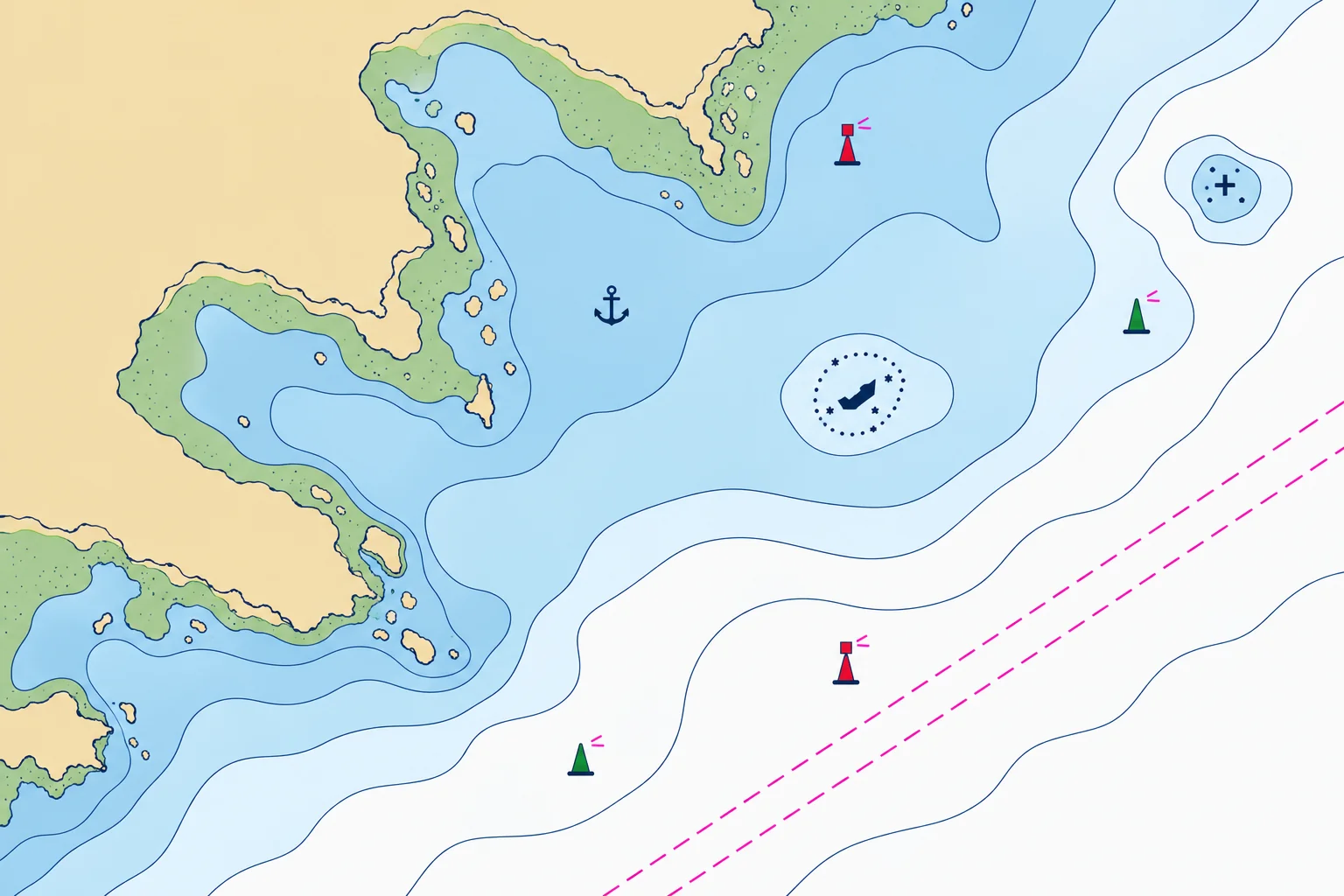
On paper charts land is usually buff or yellow, areas that dry are green, shallow water is blue and deeper water is white. Magenta marks lights, many notes, and restricted areas, cables and pipelines. How deep the blue goes varies between charts, so read the soundings and contours, not the colour alone.
Dangers
A rock awash at chart datum is a cross with a dot in each corner. A rock that covers and uncovers is drawn as a small star with its drying height. An underwater rock dangerous to surface navigation is a cross. Wreck symbols vary with exposure and known depth: a submerged wreck may be labelled Wk, with a depth or danger line; check INT 1. A danger line is a dotted boundary marking danger to surface navigation.
Seabed and areas
Letters describe the seabed: S sand, M mud, G gravel, R rock, Sh shells, Wd weed. That helps you choose where to anchor. An anchor symbol marks an anchorage. Magenta lines with notes show restricted areas, and submarine cables and pipelines, where anchoring is often prohibited.
Chart corrections
Check that you have the current paper-chart edition, then apply outstanding Notices to Mariners after its last recorded correction. Also check Temporary and Preliminary (T&P) Notices still in force. These notices report new wrecks, moved buoys and changed lights. The IALA module covers buoy and light identification.
2Key data
- Symbol key
- INT 1: NP5011 (Admiralty), US Chart No. 1
- Seabed
- S sand, M mud, G gravel, R rock, Sh shells, Wd weed
- Magenta
- Lights, notes, restricted areas, cables, pipelines
- Corrections
- Current edition; outstanding Notices after last correction
3Key points
- 1
Symbols follow the IHO key INT 1 (NP5011, US Chart No. 1).
- 2
Buff land, green drying areas, blue shallows, white deep water, magenta lights and notes.
- 3
A dotted danger line round a rock or wreck means it matters to surface vessels.
- 4
Seabed letters (S, M, G, R, Sh, Wd) help you choose an anchorage.
- 5
Use the current edition; apply outstanding Notices to Mariners after its last correction; check T&P Notices in force.
4Frequent mistakes
Wrong: White water on the chart is always safe.
Right: White only means deeper than the chart's shading limit. Read the soundings and look for danger symbols.
Wrong: A new-looking chart needs no corrections.
Right: Check that it is the current edition, then apply outstanding Notices to Mariners after its last recorded correction.
Wrong: Anchor anywhere the depth suits you.
Right: Check the seabed letters and the magenta notes: cable, pipeline and restricted areas often forbid anchoring.
5Practice case & exam keys
For a lunch stop you compare two bays. Bay A: 4 m, S, an anchor symbol. Bay B: 5 m, R, inside a magenta cable area. Which do you choose and why?
Show the answer
Bay A. Sand gives good holding and the anchor symbol marks an anchorage. In Bay B, rock gives poor holding and can trap the anchor, and anchoring in a cable area is usually prohibited and can damage the cable. Still check the depth against the tide and the shelter from the wind.
Exam keys
- INT 1 is the international key to chart symbols (NP5011 for Admiralty charts).
- Rock awash: a cross with dots in the corners; a danger line is dotted.
- Seabed letters: S sand, M mud, G gravel, R rock, Sh shells, Wd weed.
- Use the current chart edition and apply outstanding Notices to Mariners after its last recorded correction.
Finish this unit
When you've read it, match the terms, then answer three questions. Get them all right to finish the unit; opening the page alone doesn't count.
My notes for this unit
No notes