

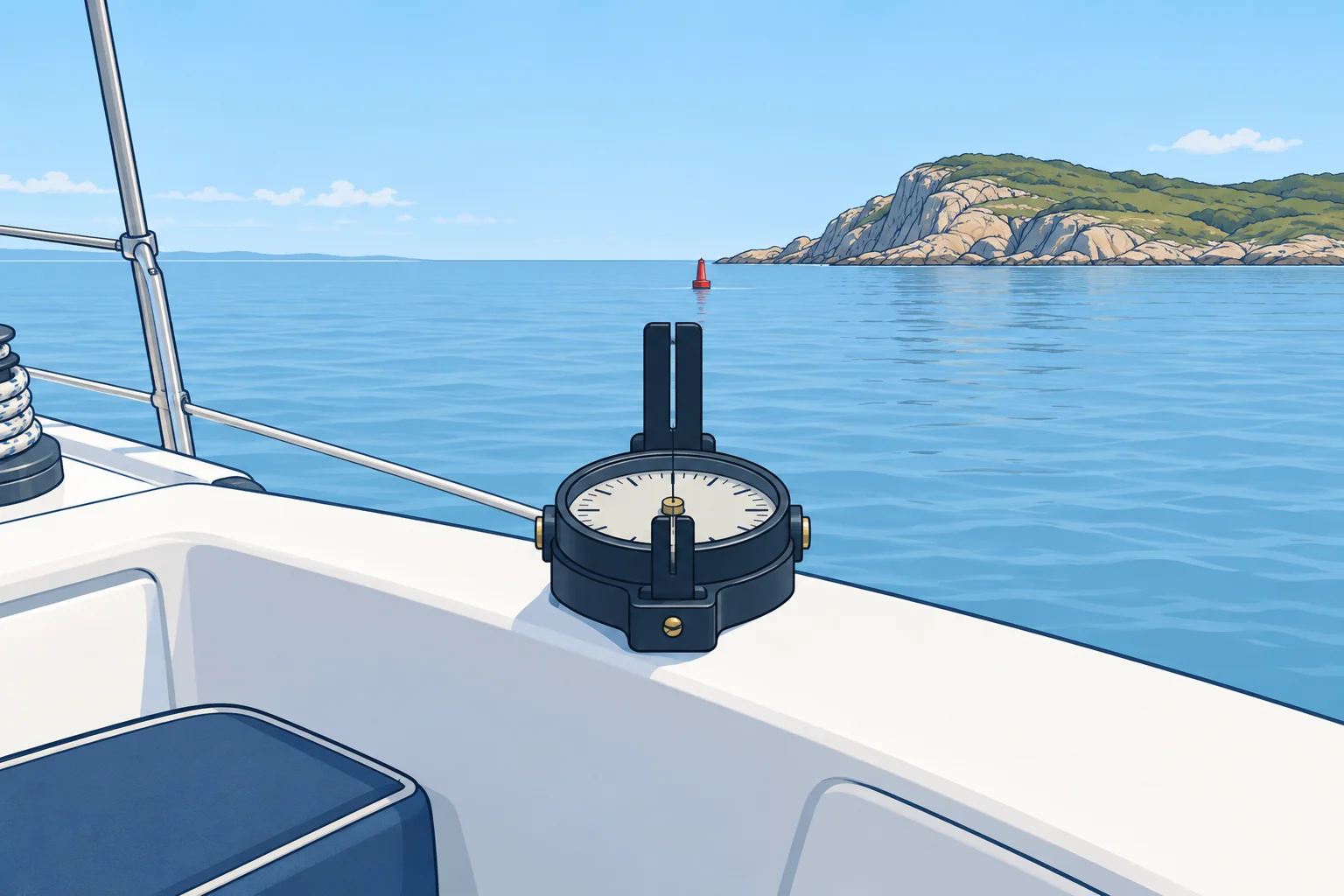
Plotting a bearing as a position line
1The lesson in plain words
A bearing gives the direction from you to an object. Convert it to true, then draw it through the object: you are somewhere on that line.
From bearing to line
A bearing is the direction from you to an object. If a charted tower bears 045°T from you, then you lie in the opposite direction from the tower, 225°T, somewhere along a straight line through it. That line is a position line: a line on which your position lies. One line does not give your position; two or more crossing lines do, as the Position fixing unit shows.
Make it true
A bearing from a hand-bearing compass is magnetic (°M). Convert it to true before plotting: with 3°W variation, 048°M becomes 045°T. Used well away from steel and electronics, a hand-bearing compass is normally taken to have no deviation, so only variation applies. A bearing read across the steering compass also needs that compass's deviation. The Compass course unit covers the conversion.
Drawing it
Set the plotter to the true bearing with its direction arrow pointing towards the object, north–south grid lines along a meridian and rose north towards chart north. Slide it until its edge passes through the charted object. Draw the line only near your likely position, not across the whole chart, and write the time on it.
Relative bearings
A relative bearing is measured from the bow, not from north: an object "45° on the starboard bow" lies 45° to the right of the heading. To plot it, turn it into a true bearing: add a starboard relative bearing to the true heading, or subtract a port one. Keep the result within 000°–359°: if it is 360° or more, subtract 360°; if it is negative, add 360°. Spanish courses call it a marcación.
Writing it
Note the object, the bearing with its reference and the time: "tower 048°M 14:20". Plot it soon after taking it. Without the time, you cannot reliably relate it to your other position records.
2Key data
- Magnetic to true
- Add east variation, subtract west
- Example
- 048°M with 3°W variation = 045°T
- Relative to true
- True heading + starboard, − port relative bearing
- Spanish terms
- Demora (bearing), marcación (relative bearing)
3Key points
- 1
A bearing gives a position line: you are somewhere on it, not at one point.
- 2
Convert a magnetic bearing to true before you plot it.
- 3
Draw the line through the charted object, only near your likely position.
- 4
True bearing = true heading + a starboard relative bearing, or − a port one.
- 5
Write the time on every position line.
4Frequent mistakes
Wrong: Plot the magnetic bearing straight onto the chart.
Right: Convert it to true first. With 5°W variation, an unconverted bearing puts the line 5° out.
Wrong: One bearing gives your position.
Right: One bearing gives a line. You need a second line crossing it for a fix.
5Practice case & exam keys
Heading 080°T, a beacon is 60° on your port bow. A crew member labels its position line 020°M and marks an exact position somewhere on it. What must you correct?
Show the answer
The bearing is 080 − 60 = 020°T, because the heading is true. Label the line 020°T through the beacon and record its time. One bearing gives a position line, not an exact position; the marked point is unsupported.
Exam keys
- One bearing gives a position line, not a complete position.
- Magnetic to true: add east variation, subtract west.
- True bearing = true heading ± relative bearing (starboard +, port −).
- Every position line carries its time.
Finish this unit
When you've read it, match the terms, then answer three questions. Get them all right to finish the unit; opening the page alone doesn't count.
My notes for this unit
No notes