

ENCs: S-57, S-101, cells, updates and permits
1The lesson in plain words
An ENC is a database, not a picture. Know which cells you have, whether they are up to date and licensed, and what changes as S-101 arrives.
ENC or RNC
An ENC is vector data: chart features, such as lights, buoys and depth areas, are stored as objects with details such as depth or light colour. ECDIS can read these details to highlight a safety contour, answer a cursor query and alert you to dangers. An RNC is a scanned image of a paper chart.
Cells and bands
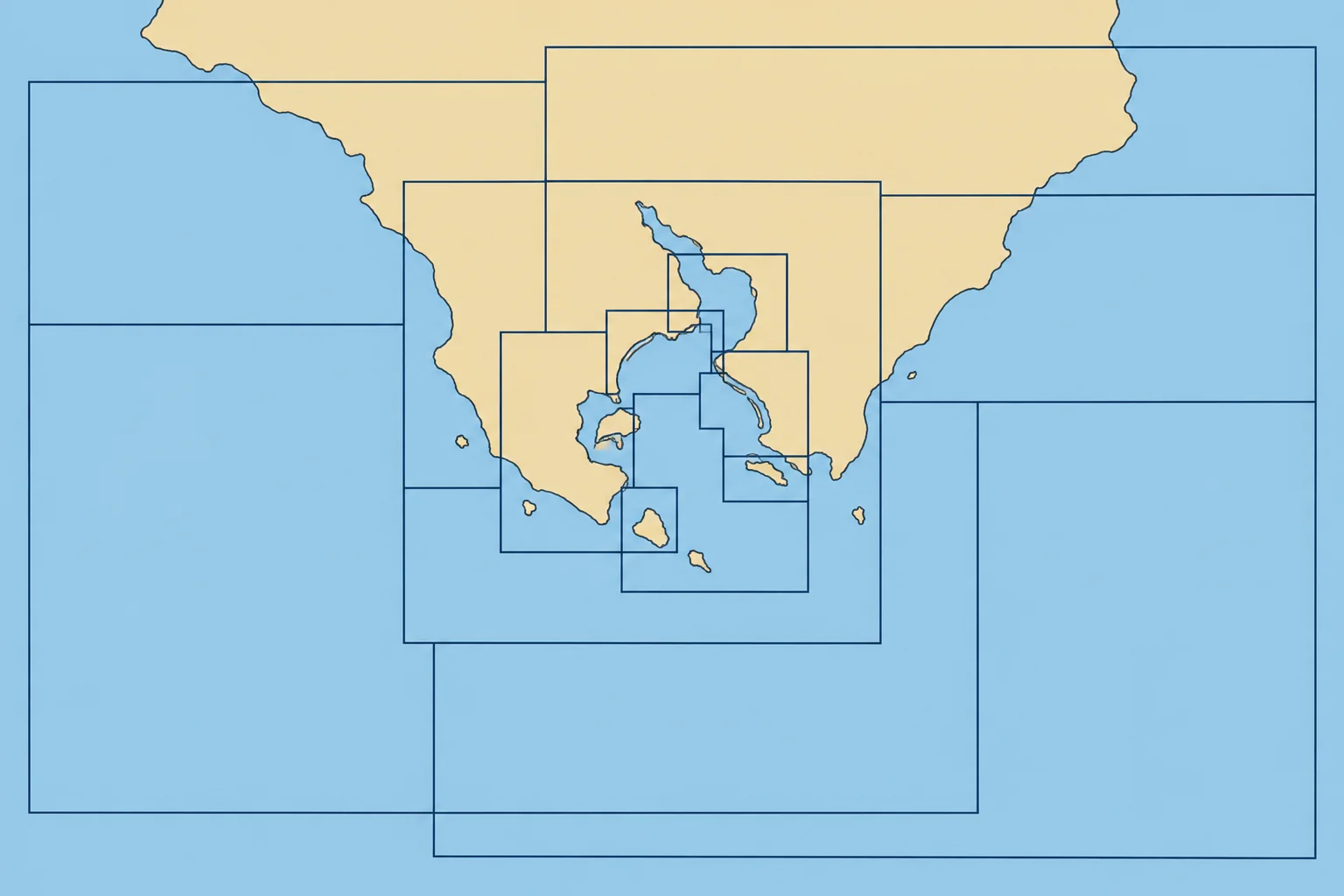
ENCs come in cells, each covering a defined geographic area. An S-57 cell name has eight characters: the producer code, a usage band digit and five more, for example GB401892. Bands describe intended use: 1 overview, 2 general, 3 coastal, 4 approach, 5 harbour, 6 berthing. Check the actual scale and use the largest-scale ENC available for the area. Many ECDIS load the best cell automatically if auto-load is on; verify the loaded cell.
Updates
An ENC is kept current by update files applied in sequence, and replaced by a new edition when the producer reissues it. Most services issue updates weekly. SOLAS V/27 requires charts to be adequate and up to date, so check the update status of every cell on the route before sailing. Temporary and preliminary notices and navigational warnings may still need checking separately, depending on the service.
Permits
Most ENCs are encrypted under the IHO S-63 scheme. A cell permit unlocks each cell for a licence period. When it expires, the data may still display, but it no longer receives updates and the system warns you. Order cells for the whole voyage, contingencies included, in good time. The ECDIS software must also stay current with IHO display standards.
S-101
S-101 is the new ENC standard in the IHO S-100 framework. It looks much like S-57 but encodes more clearly and replaces usage bands with display scales. Other S-100 layers can follow: S-102 detailed bathymetry, S-104 water levels and S-111 surface currents. S-101 cover will start in selected areas. S-57 has no planned end date, so S-100 ECDIS will use both, the dual-fuel period.
2Key data
- S-57 usage bands
- 1 overview, 2 general, 3 coastal, 4 approach, 5 harbour, 6 berthing
- Data protection
- IHO S-63: encrypted cells, cell permits
- Up to date
- SOLAS V/27: charts adequate and up to date
- S-100 layers
- S-101 ENC, S-102 bathymetry, S-104 water level, S-111 currents
- S-57 withdrawal
- No planned date; used alongside S-101 (dual fuel)
3Key points
- 1
An ENC is vector data the system can read; an RNC is only a picture.
- 2
Use the largest-scale ENC available; its band describes intended use. Verify the loaded cell even with auto-load on.
- 3
Check updates and permits for every cell on the route before sailing.
- 4
S-101 joins S-57 in a dual-fuel period. S-57 has no planned end date.
4Frequent mistakes
Wrong: If a cell displays, it must be up to date.
Right: An expired permit or a missed update still displays. Check the update status of each cell on the route.
Wrong: S-57 ENCs stop working when S-101 arrives.
Right: There is no planned end date for S-57. S-100 ECDIS will use S-57 and S-101 side by side.
5Practice case & exam keys
Planning a passage, you find the approach cell for your arrival port shows an update status two weeks behind and its permit expires the day before arrival. The rest of the route is current. What do you do?
Show the answer
Apply the missing updates and renew the permit before departure. Check that all route cells remain licensed and current for the voyage, and check current navigational warnings. If coverage cannot be obtained, tell the master before sailing. Use paper charts only within an arrangement accepted by the flag State that meets the ship's carriage and backup requirements; otherwise revise the plan before sailing. One corrected paper chart is not automatically enough.
Exam keys
- ENC = vector objects with attributes; RNC = raster image without readable depth data.
- S-57 usage bands 1–6; cell name includes the band digit; use the largest scale available.
- S-63 permits; weekly updates; S-101 in the S-100 family; dual fuel with S-57.
Finish this unit
When you've read it, match the terms, then answer three questions. Get them all right to finish the unit; opening the page alone doesn't count.
My notes for this unit
No notes