

What ECDIS is: carriage, performance standards and backup
1The lesson in plain words
ECDIS is a type-approved chart system. With official, up-to-date ENCs and an independent backup, it replaces paper charts under SOLAS.
More than a plotter
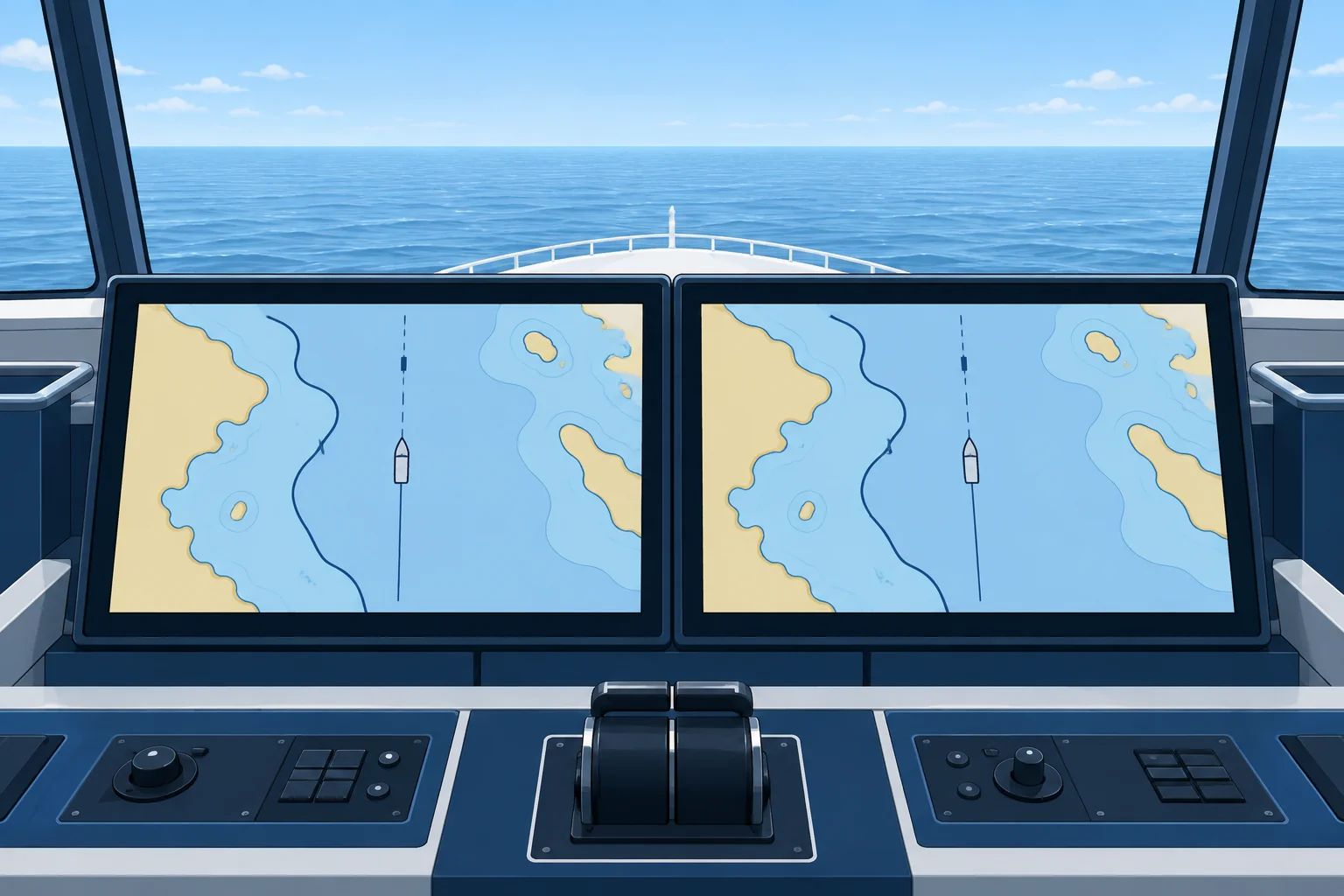
ECDIS, the electronic chart display and information system, shows official charts with your position from the ship's sensors. It plans and checks routes, monitors the ship against them and gives alerts. SOLAS regulation V/18 requires it to be type-approved: tested against IMO performance standards. A chart plotter, however good, is not an ECDIS.
When it counts as charts
SOLAS V/19 accepts ECDIS as meeting the chart carriage requirement when it uses up-to-date official ENCs (electronic navigational charts) and has adequate, independent backup arrangements. Its carriage was phased in from 2012 to 2018 for ships on international voyages: passenger ships of 500 gross tonnage (GT, a measure of enclosed volume) and upwards, tankers of 3,000 GT and upwards, new cargo ships of 3,000 GT and upwards and existing cargo ships of 10,000 GT and upwards.
Three standards
Units installed from 1996 to 2008 meet resolution A.817(19); those installed from 2009 meet MSC.232(82). The revised standard, MSC.530(106), adopted in November 2022 and revised in 2024 for route exchange, adds S-100 data. From 1 January 2026 a new installation may meet either standard. From 1 January 2029 every new installation, including a retrofit, must meet MSC.530(106). Existing units need not be replaced.
Check type approval
The UK Hydrographic Office's late-2025 estimate put type-approved S-100 ECDIS around 2028; that forecast does not establish current availability. Before installation, check the type-approval certificate for the actual hardware and software configuration against the required IMO standard and your flag's rules. "S-100 ready" alone is not approval.
Raster mode
Where no ENC exists, some ECDIS can show official raster charts (RNCs), scanned images of paper charts. This is raster chart display system (RCDS) mode. A raster chart has no depth data the system can read, so it cannot draw your safety contour or alarm for it. Use RCDS mode only with an appropriate portfolio of up-to-date paper charts.
Backup
The backup must let you take over safely if ECDIS fails and finish the voyage safely. It is usually a second ECDIS with separate power and a connection to the ship's positioning system, or an appropriate folio of up-to-date paper charts. Keep it updated. Assess shared-sensor failures. IMO recommends a second independent positioning source whenever possible; a separate global navigation satellite system (GNSS) receiver for each ECDIS is not a universal requirement.
2Key data
- Type approval
- SOLAS V/18
- Chart carriage
- SOLAS V/19: official, up-to-date ENCs plus independent backup
- Installed from 2009
- MSC.232(82)
- 1 Jan 2026 – 31 Dec 2028
- New installs: MSC.232(82) or MSC.530(106)
- From 1 Jan 2029
- New installs and retrofits: MSC.530(106), S-100 capable
3Key points
- 1
ECDIS is type-approved (SOLAS V/18) and meets chart carriage only with official, up-to-date ENCs and a backup.
- 2
From 1 January 2029 every new ECDIS installation must meet MSC.530(106) and handle S-100 data.
- 3
In RCDS mode with raster charts there is no safety contour alarm. Use paper charts alongside.
- 4
The backup must allow a safe takeover and a safe finish to the voyage, and be kept up to date.
4Frequent mistakes
Wrong: From 2026 every ship must replace its ECDIS with an S-100 unit.
Right: Existing units may stay. From 1 January 2029, new installations and retrofits must meet MSC.530(106).
Wrong: A raster chart in ECDIS gives the same protection as an ENC.
Right: Raster charts carry no depth data the system can read, so there are no safety contour alarms. Use paper charts alongside.
Wrong: The backup ECDIS can be updated when it is needed.
Right: The backup must be kept as up to date as the main system, so it can take over at any moment.
5Practice case & exam keys
Your ship's single ECDIS is the primary means of navigation. A second, identical unit is on the same power supply and takes position from the same GNSS receiver. The superintendent calls this a full backup. Do you agree?
Show the answer
Not as described: a shared power failure can remove both displays. Check that the flag-approved backup has separate power, current charts and safe takeover arrangements. Assess shared-sensor failures too. IMO recommends a second independent position source whenever possible; a separate GNSS receiver for each ECDIS is not a universal requirement.
Exam keys
- SOLAS V/18 type approval; V/19 carriage with ENCs plus adequate independent backup.
- MSC.232(82) from 2009; MSC.530(106) optional from 1 Jan 2026, mandatory for new installs from 1 Jan 2029.
- RCDS mode: no safety contour or depth alarms; use with an appropriate folio of paper charts.
Finish this unit
When you've read it, match the terms, then answer three questions. Get them all right to finish the unit; opening the page alone doesn't count.
My notes for this unit
No notes