

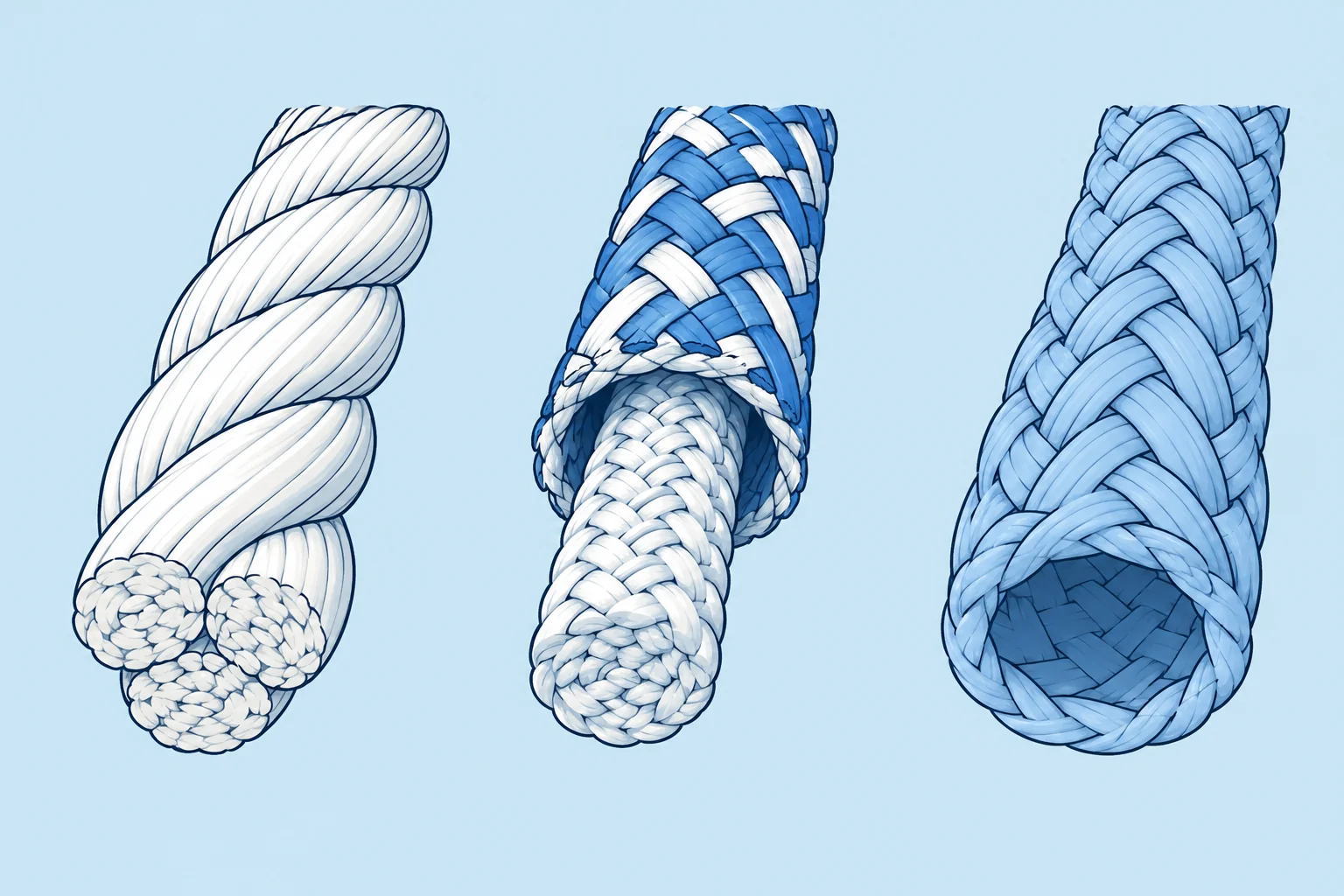
How a rope is made: laid and braided
1The lesson in plain words
Choose a rope construction that suits the job and the fittings that grip it.
Three-strand
Three-strand laid rope has three strands twisted together. Most is right-hand laid: the strands spiral like a right-hand screw. It is cheap, stretchy, resists chafe (wear from rubbing) and is easy to splice by hand, so it is common for anchor and mooring lines. It can untwist under load.
Double braid
Braid-on-braid, or double braid, has a braided core inside a braided cover. In polyester double braid, both carry substantial load. With an HMPE core and protective polyester cover, the core usually carries most; the cover protects it and gives grip. Check the maker’s design. If the cover wears through, unload the rope and assess it: an intact-looking core does not prove it is safe.
Single braid
Single braid, often 12-strand, is one braided layer with no cover. In HMPE it is very strong, light and easy to splice, used for halyards and strops (short rope loops for attaching gear). Without a cover, wear reaches the load-bearing strands directly, and grip in rope clutches (fittings that clamp a line) may be poor.
Size
Ropes are sized by diameter in millimetres. Choose the size by load first, then for handling: a thin rope may be strong enough but hurt hands or slip in a rope clutch or winch (a drum that helps you haul a line) made for a bigger one.
2Key data
- Three-strand
- Cheap, stretchy, chafe-resistant, easy to splice
- Braid-on-braid
- Core and cover share load according to the rope design
- 12-strand single braid
- Light, strong in HMPE, easy splicing; no cover
3Key points
- 1
Three-strand: cheap, stretchy, easy to splice; good for anchor and mooring.
- 2
Double braid: polyester core and cover both carry load; an HMPE core usually carries most.
- 3
12-strand HMPE: light, strong, easy to splice, but slippery and uncovered.
- 4
Size for load, then check it fits clutches, winches and hands.
4Frequent mistakes
Wrong: Only the core carries load in every double-braid rope.
Right: Polyester core and cover both carry load. An HMPE core usually carries most; check the maker’s design.
Wrong: Thinner is always better if it is strong enough.
Right: A rope too thin for the clutch or winch slips, and is hard to hold.
5Practice case & exam keys
You replace a 12 mm polyester halyard with equally strong 8 mm uncovered HMPE. Your rope clutch accepts 10–14 mm rope. The new line slips and is uncomfortable to hold. Why?
Show the answer
Strength alone is not enough. The 8 mm line is outside the clutch’s diameter range. Uncovered HMPE can also be slippery and uncomfortable to hold. Choose a suitable covered rope with enough strength and a diameter approved for your fittings.
Exam keys
- Three-strand: easy hand splicing, stretchy, chafe-resistant.
- Double braid: load sharing depends on construction.
- 12-strand HMPE: strong, light, slippery.
- Check rope diameter against clutches and winches.
Finish this unit
When you've read it, match the terms, then answer three questions. Get them all right to finish the unit; opening the page alone doesn't count.
My notes for this unit
No notes