

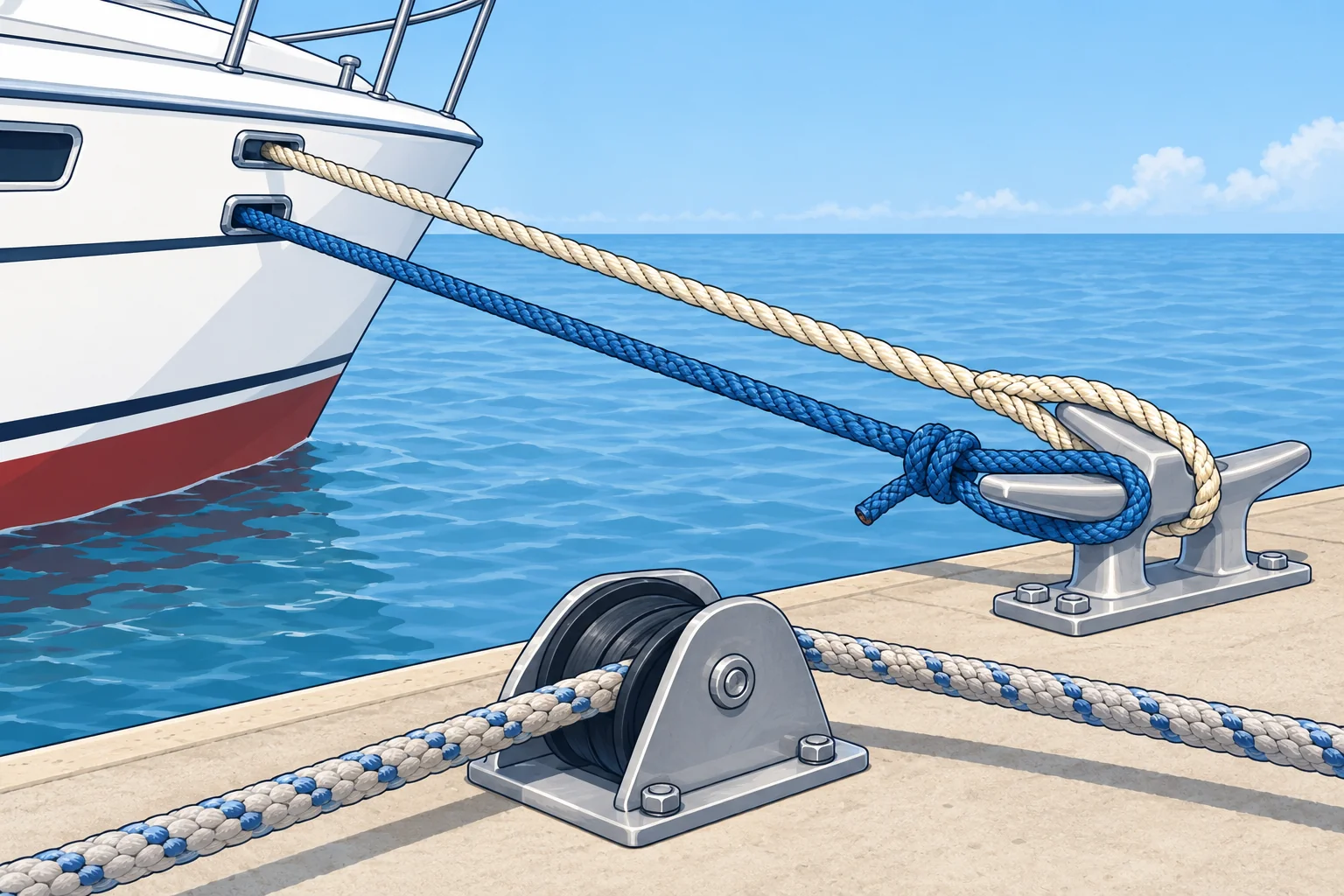
Breaking load, working load and what weakens a rope
1The lesson in plain words
A breaking-load rating describes new rope under stated test conditions. Knots, bends and wear can reduce it. Work below it as the maker specifies.
Breaking load
The minimum breaking load (MBL) is the maker’s specified minimum breaking force for new rope under stated test conditions. Some ratings include spliced eyes. It is a test figure, not a safe load. Check what the rating includes: do not deduct splice loss again if it already includes that splice. Different makers test differently, so compare figures with care.
Working load
For a calculation, divide the relevant breaking strength by the specified safety factor to find the working-load allowance. In use, follow the maker’s working-load guidance for the rope, termination and job. A factor of 5 is an example, not a universal permission to load a rope.
Knots and splices
A knot bends rope sharply and reduces its breaking strength. The loss depends on the fibre, construction and knot. A correctly made splice usually retains more strength, but its efficiency also varies. Use rope-specific test data and the maker’s instructions.
Bends
A rope bent round a small radius is weakened on the outside of the bend. Lead loaded lines round sheaves (pulleys) and fairleads (rope guides) that are several times the rope's diameter, as the maker advises, and avoid sharp edges.
Ageing
Sunlight (UV), chafe (wear from rubbing), heat from friction, salt crystals and repeated loading all reduce strength. A five-year-old line that has lived in the sun may be far weaker than its label. Shock loads, such as a snatching anchor, can be many times the steady load.
2Key data
- MBL
- Specified minimum breaking force for new rope under stated tests
- Working load
- Relevant breaking strength ÷ specified safety factor; follow maker
- Bowline
- Reduces strength; loss depends on fibre, construction and knot
- Good splice
- Retention depends on rope and splice; check maker’s data
3Key points
- 1
MBL is a test figure for new rope, not a safe load.
- 2
Working-load calculation: relevant breaking strength ÷ specified safety factor; follow the maker in use.
- 3
Knots weaken rope; correctly made splices generally retain more strength.
- 4
Sun, chafe, heat and tight bends reduce strength. Shock loads can exceed the working-load allowance and damage rope.
4Frequent mistakes
Wrong: The rope’s breaking-load rating tells me its safe working load.
Right: That is a new-rope test figure, not a working load. Follow the maker’s guidance for the job.
Wrong: A knot is as strong as the rope.
Right: Knots reduce strength by a variable amount. A correctly made splice usually retains more; check the maker’s data.
5Practice case & exam keys
A new, unspliced rope has an MBL of 30 kN (kilonewtons). Assume a bowline retains two-thirds and an eye splice 90%, with a safety factor of 5. A friend says either meets a 4.5 kN steady working load. Do you agree?
Show the answer
No. Bowline: 30 × 2/3 ÷ 5 = 4 kN. Splice: 30 × 0.90 ÷ 5 = 5.4 kN. Only the splice meets 4.5 kN under these assumptions. For real use, follow the maker’s guidance for the rope, termination and job. Do not deduct splice loss again if the published rating already includes it.
Exam keys
- MBL: specified minimum breaking force for new rope under stated tests.
- Working-load calculation: relevant breaking strength ÷ specified safety factor.
- Correctly made splices generally retain more strength than knots.
- UV, chafe, heat and tight bends reduce strength; shock loads can overload rope.
Finish this unit
When you've read it, match the terms, then answer three questions. Get them all right to finish the unit; opening the page alone doesn't count.
My notes for this unit
No notes