

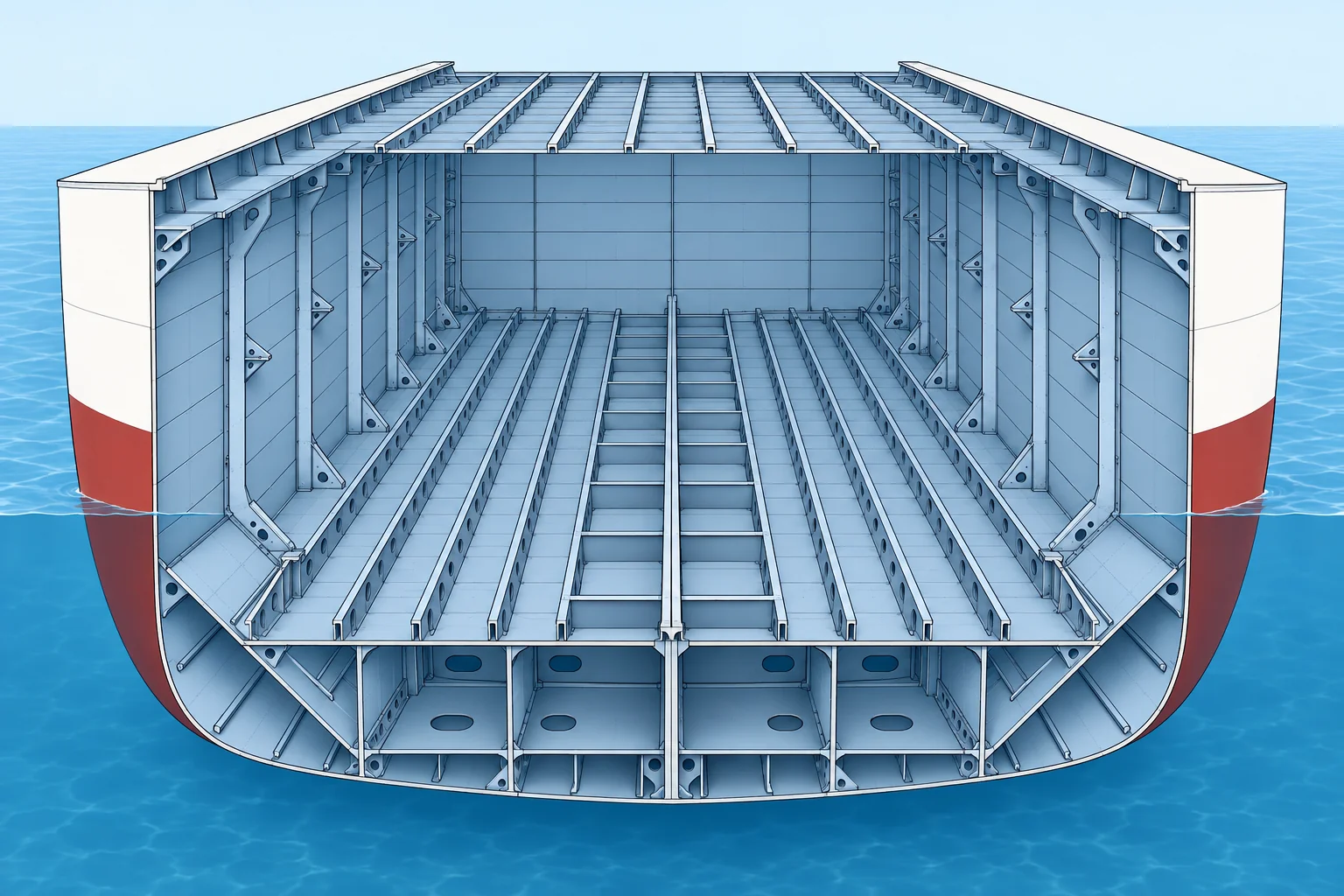
The hull girder, framing systems and the main members
1The lesson in plain words
A ship's hull is a long hollow beam of plating supported by stiffeners. Their direction, across or along the hull, defines its framing system.
The hull as a girder
Think of the hull as one long hollow beam, the hull girder. Bottom, sides and strength deck are its walls. Plating keeps the sea out and carries load. Stiffeners welded to it stop the thin plates from buckling. Plates are laid in long rows called strakes: the keel plate on the centreline, the garboard strake next to it, the bilge strake at the turn of the bilge and the sheer strake at the top of the side.
Transverse framing
In transverse framing the main stiffeners run across the ship. Floors stiffen the bottom, frames the sides and beams the deck. They are closely spaced and joined by brackets (triangular plates at the corners). It suits shorter ships and holds that need few deep members. For long hulls, transverse framing alone is less efficient at supporting plating against longitudinal compression.
Longitudinal framing
In longitudinal framing many light stiffeners called longitudinals run fore and aft along the bottom, the deck and often the sides. Deep web frames spaced a few metres apart support them. Longitudinals share longitudinal loads and support plating against buckling, making the arrangement efficient for long hulls. Large tankers use it throughout. The price is deep webs that take space and are harder to clean and inspect.
Combined framing
Combined framing puts longitudinals in the bottom and deck, where bending stress is highest, and transverse frames in the sides. Many bulk carriers and general cargo ships are built this way. Container ships have a double skin and a heavy box-shaped structure along the top of each side, because their wide hatch openings leave little deck to carry the load.
Girders, pillars and frame numbers
Fore-and-aft girders support beams and floors. The centre girder in the double bottom is the ship's backbone. Pillars carry deck loads down to the structure below. Use these names to report damage exactly: compartment, side, frame number and member. Frame numbers usually start near the rudder and count forward, and they are marked on the plans and in the structure.
2Key data
- Transverse framing
- Floors, frames and beams across the ship, closely spaced
- Longitudinal framing
- Longitudinals fore and aft, carried by deep web frames
- Combined framing
- Longitudinal bottom and deck, transverse side frames
- Strakes, keel upwards
- Keel plate, garboard, bottom, bilge, side, sheer strake
3Key points
- 1
The hull is a hull girder: plating carries load, stiffeners stop it buckling.
- 2
Transverse framing suits shorter ships; longitudinal framing gives strength along long hulls.
- 3
Combined framing: longitudinals in bottom and deck, transverse frames in the sides.
- 4
Report damage by compartment, side, frame number and the member's name.
4Frequent mistakes
Wrong: Plating only keeps the water out; the frames carry all the load.
Right: Plating is part of the hull girder and carries much of the bending load. The stiffeners keep it from buckling.
Wrong: Longitudinal framing has no transverse members at all.
Right: The longitudinals are supported by deep transverse web frames and by the bulkheads.
5Practice case & exam keys
During a routine hold inspection on a bulk carrier you find a 20 cm crack at the lower end of a side frame, where its bracket meets the hopper tank plating. How do you report it?
Show the answer
Give the exact position: hold number, port or starboard, frame number and member (lower bracket of the side frame, hopper plating). Note the crack's length, direction and whether it goes through the plate, and take photos with a scale. Mark the crack ends. Tell the master and chief engineer, and through them the company, which informs class, the classification society. Do not weld it without class approval. Follow their assessment and monitoring instructions.
Exam keys
- Framing systems: transverse, longitudinal and combined, with their members.
- Strakes: keel plate, garboard, bilge and sheer strake.
- Longitudinal framing adds to longitudinal strength and saves steel weight.
- Locate damage by frame number, side and member.
Finish this unit
When you've read it, answer three questions. Get all three right to finish the unit; opening the page alone doesn't count.
My notes for this unit
No notes