

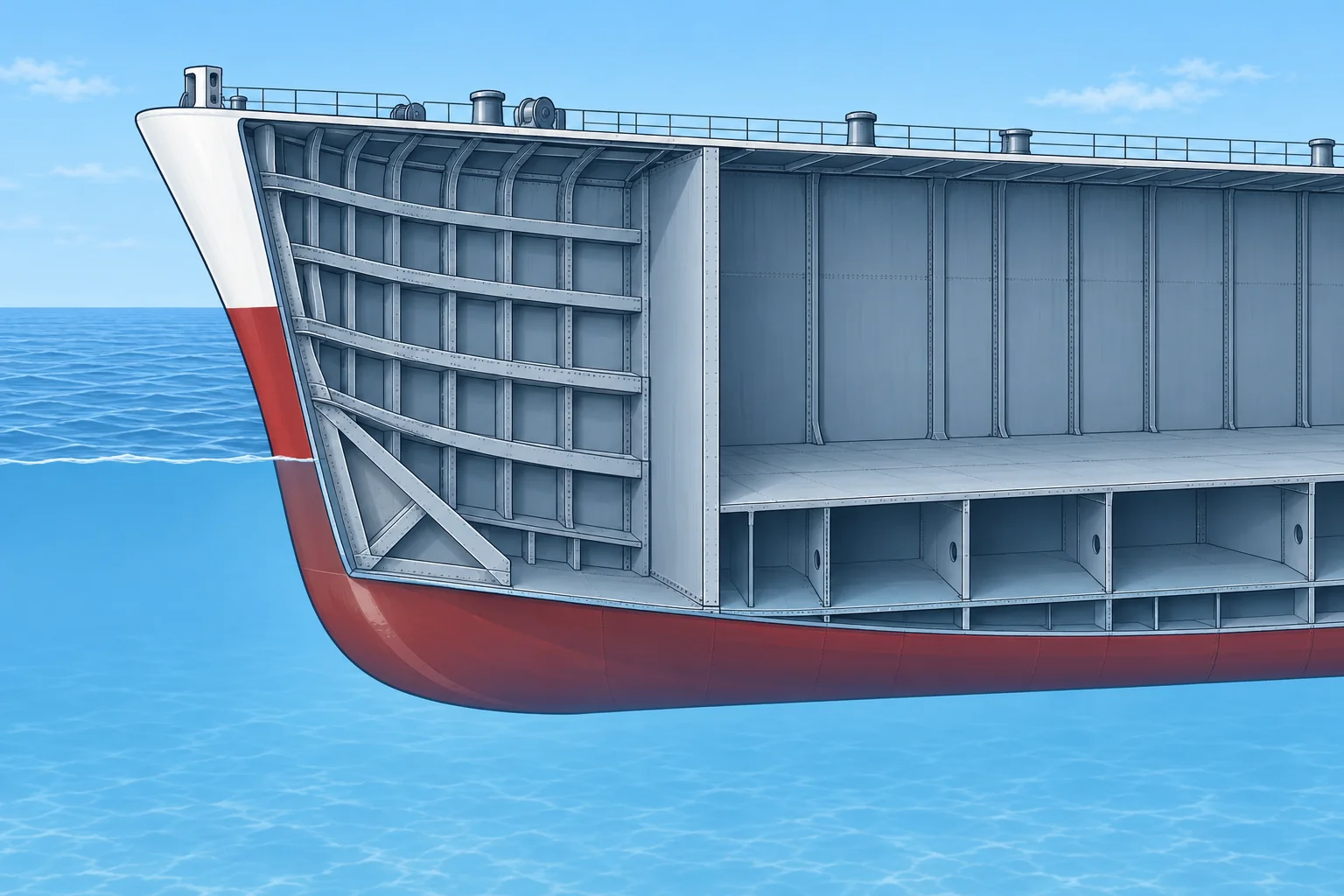
The double bottom, the collision bulkhead and the strengthened ends
1The lesson in plain words
The double bottom and collision bulkhead limit flooding when their boundaries remain intact. Extra strengthening helps the ends resist panting and pounding.
The double bottom
A double bottom is a second watertight skin, the inner bottom or tank top, above the bottom shell. If the inner bottom remains intact, grounding damage can leave flooding confined between the skins. Its tanks hold ballast, fuel or fresh water. SOLAS II-1/9 sets requirements for passenger ships and cargo ships other than tankers. Its height is at least B/20, where B is the breadth, and never less than 760 mm, but it need not exceed 2 m.
Inside the double bottom
The space between the skins is divided by floors (transverse plates) and fore-and-aft girders, with the centre girder on the centreline. Solid floors have holes for access and to save weight. Watertight floors close the ends of tanks. Some ships have a duct keel, a centreline tunnel for pipes. These tanks are enclosed spaces: enter only with a permit.
The collision bulkhead
The collision bulkhead is the foremost watertight bulkhead. In cargo ships it reaches the freeboard deck, from which freeboard is measured; in passenger ships, the bulkhead deck. In cargo ships, its standard position is between 0.05L or 10 m (whichever is less) and 0.08L or 0.05L + 3 m (whichever is greater) aft of the forward perpendicular. L is the SOLAS-defined length. Projecting bows have special reference rules: check the approved plan. An intact bulkhead limits flooding from bow damage.
Collision-bulkhead openings
No doors, manholes or ventilation openings are permitted below the relevant deck. Normally one forepeak-liquid pipe may pass through, with the prescribed shut-off valve operable from above that deck. Two pipes may be approved for a divided forepeak carrying different liquids. Passenger- and cargo-ship requirements differ; follow SOLAS II-1/12 and the approved arrangement.
Panting and pounding
As the ship pitches, changing water pressure makes the bow plating flex in and out: panting. Panting beams, side stringers and breasthooks (horizontal plates in the bow) stiffen the fore peak against it. When the bow lifts clear and slams down, the flat forward bottom takes pounding or slamming, so it gets thicker plate and closer stiffening. If she slams, slow down or alter course: the damage builds up blow by blow.
The stern
The aft peak bulkhead forms a watertight boundary near the stern. The stern tube, where the propeller shaft leaves the hull, has a watertight enclosure, not necessarily the aft peak tank: check the approved plan. The stern frame or a cast rudder horn supports the rudder and resists propeller vibration. The aft peak is usually a ballast tank, stiffened against panting.
2Key data
- Double-bottom height (SOLAS II-1/9)
- B/20, at least 760 mm, need not exceed 2,000 mm
- Collision bulkhead, cargo ship (SOLAS length L)
- 0.05L or 10 m (lesser) to 0.08L or 0.05L + 3 m (greater)
- Measured from
- Normally the forward perpendicular; special bow rules apply
- Openings below required deck
- Normally one forepeak-liquid pipe; approved exceptions apply
3Key points
- 1
An intact inner bottom can confine flooding after grounding; double-bottom tanks hold ballast and fuel.
- 2
An intact collision bulkhead limits bow flooding; no doors or manholes below its required watertight deck.
- 3
Panting beams, stringers and breasthooks resist panting; thicker forward bottom resists pounding.
- 4
Slow down or alter course when she slams; pounding damage accumulates.
4Frequent mistakes
Wrong: A manhole in the collision bulkhead is fine if it is bolted tight.
Right: Doors, manholes and ventilation openings are prohibited below the relevant deck. Forepeak piping must follow the approved SOLAS arrangement.
Wrong: Slamming is only uncomfortable; the structure is designed for it.
Right: Repeated slamming can buckle the forward bottom. Reduce speed or change heading until it stops.
5Practice case & exam keys
Your loaded general cargo ship is heading into a short, steep head sea at full speed. The bow lifts clear and lands with heavy shudders every few waves. The master asks what is happening to the structure.
Show the answer
This is pounding, or slamming. Each blow loads the flat forward bottom and the plating can dent or the stiffeners buckle, while the shudder (whipping) also stresses the hull girder. Reduce speed and, if needed, alter course so the bow stops leaving the water. Later, inspect the fore peak and forward double-bottom tanks for dents, cracks and leaks, and report any damage.
Exam keys
- Double bottom: purpose, members (floors, girders, duct keel) and minimum height B/20, at least 760 mm.
- Collision bulkhead position and the rule on openings.
- Panting and pounding: where, why and the strengthening against each.
- Aft peak bulkhead and the watertight enclosure of the stern tube.
Finish this unit
When you've read it, answer three questions. Get all three right to finish the unit; opening the page alone doesn't count.
My notes for this unit
No notes