

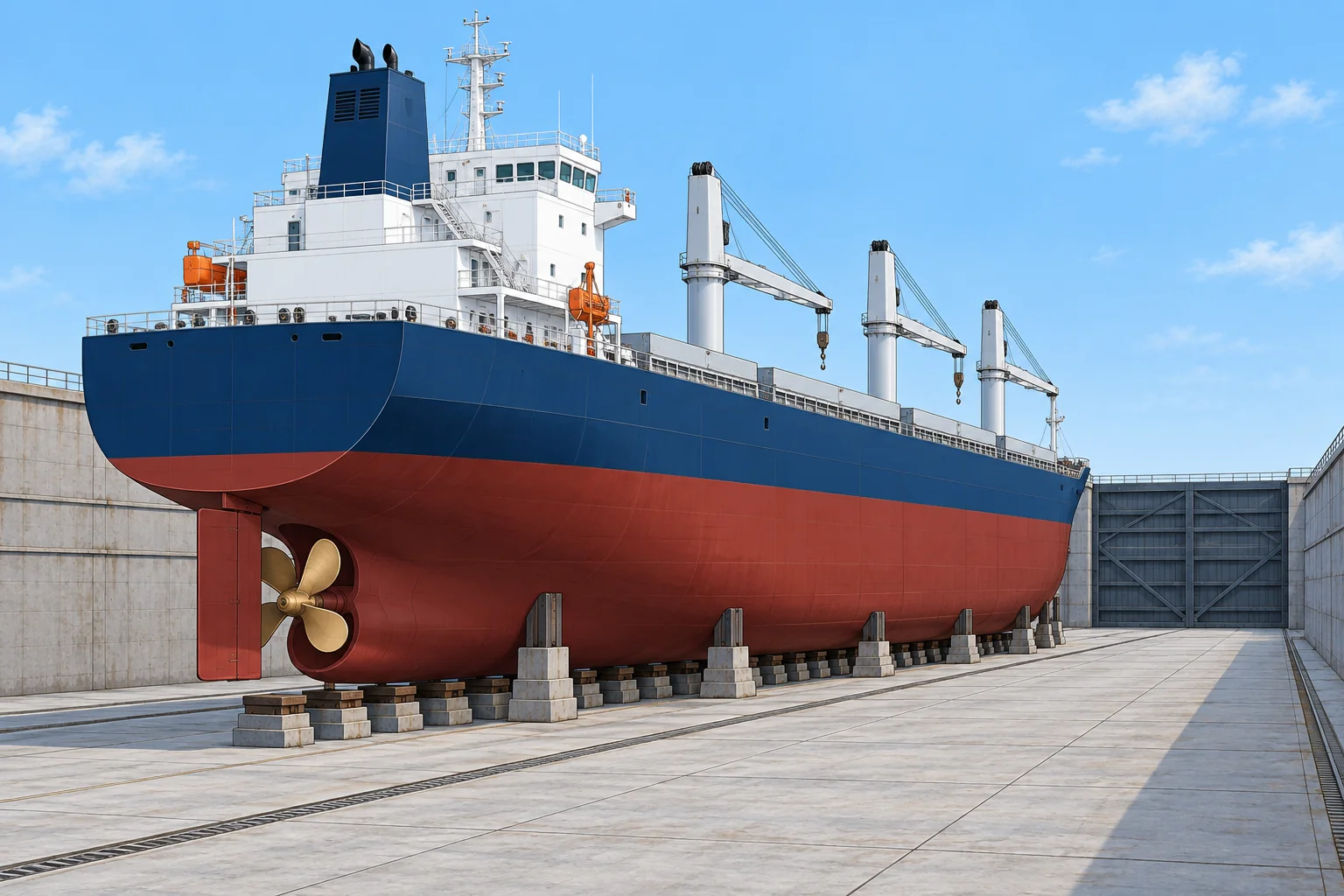
Dry-docking: docks, blocks and the critical instant
1The lesson in plain words
A docked ship rests on a row of blocks under her keel. Getting her onto them safely needs the right plan, the right trim and enough stability.
Types of dock
A graving dock is a gated shore basin pumped dry around the ship. A floating dock sinks by ballasting, receives the ship, then pumps out ballast to rise. A ship lift raises a supporting platform vertically. A slipway hauls the ship ashore on a cradle along an inclined track. Keel blocks and side supports must match the approved docking plan; support layouts differ between facilities.
The docking plan
The yard sets the blocks from the ship's docking plan. It shows the keel line, the bottom shape and every fitting that must not land on a block: drain plugs, sea chests, echo-sounder and log transducers. Send it early and check it matches the ship, including any changes since she was built. A block under a transducer or a plug means damage and extra docking time.
Arriving at the dock
Bring the ship upright, with the small stern trim agreed with the dockmaster, enough stability and as few slack tanks, partly filled tanks, as possible. Record every tank sounding, a measurement of liquid depth, and track all weight changes for the refloating stability check. Close tank valves and secure loose weights. Agree any movement while on the blocks with the dockmaster.
The critical instant
With agreed stern trim, the aft keel touches first. During the critical period, buoyancy and the stern-block reaction P share the weight. P reduces effective metacentric height (GM), a measure of initial stability, as though the centre of gravity rose. The critical instant is just before full keel landing, while support is concentrated aft. Effective GM must meet the approved docking requirement then. Total block reaction continues increasing as buoyancy is lost. Surveys and dry-docking covers the calculation.
2Key points
- 1
Graving docks pump out; floating docks lift the ship by pumping out ballast.
- 2
The docking plan shows plugs and transducers that must not land on a block.
- 3
Arrive upright, slightly trimmed by the stern, with few slack tanks and every sounding recorded.
- 4
Before full keel landing, stern-block reaction reduces effective GM; check the approved margin at the critical instant.
3Frequent mistakes
Wrong: Bring the ship in with a big stern trim so she settles gently.
Right: A large trim makes P larger and the loss of GM greater. Use the small trim the dockmaster agrees.
Wrong: Transfer ballast in the dock to correct a small list.
Right: Do not move liquids while she is on the blocks. Agree any change with the dockmaster and keep the soundings record.
4Practice case & exam keys
Your ship is due in a floating dock tomorrow. The dockmaster asks for a trim of no more than 0.5 m by the stern, upright. At present she trims 1.8 m by the stern and two double-bottom tanks are half full. What do you plan?
Show the answer
Before arrival, agree ballast changes that give the requested trim and keep the ship upright. Fill completely or empty partly filled tanks as the approved docking condition requires. Confirm the required stability margin at the critical instant. Record tank soundings, secure valves and weights, and provide the docking plan and arrival condition to the dockmaster.
Exam keys
- Graving dock, floating dock, ship lift and slipway.
- Purpose of the docking plan.
- Arrival condition: upright, small stern trim, no slack tanks, soundings recorded.
- Stern-block reaction P reduces effective GM; critical instant just before full keel landing.
Finish this unit
When you've read it, answer three questions. Get all three right to finish the unit; opening the page alone doesn't count.
My notes for this unit
No notes