

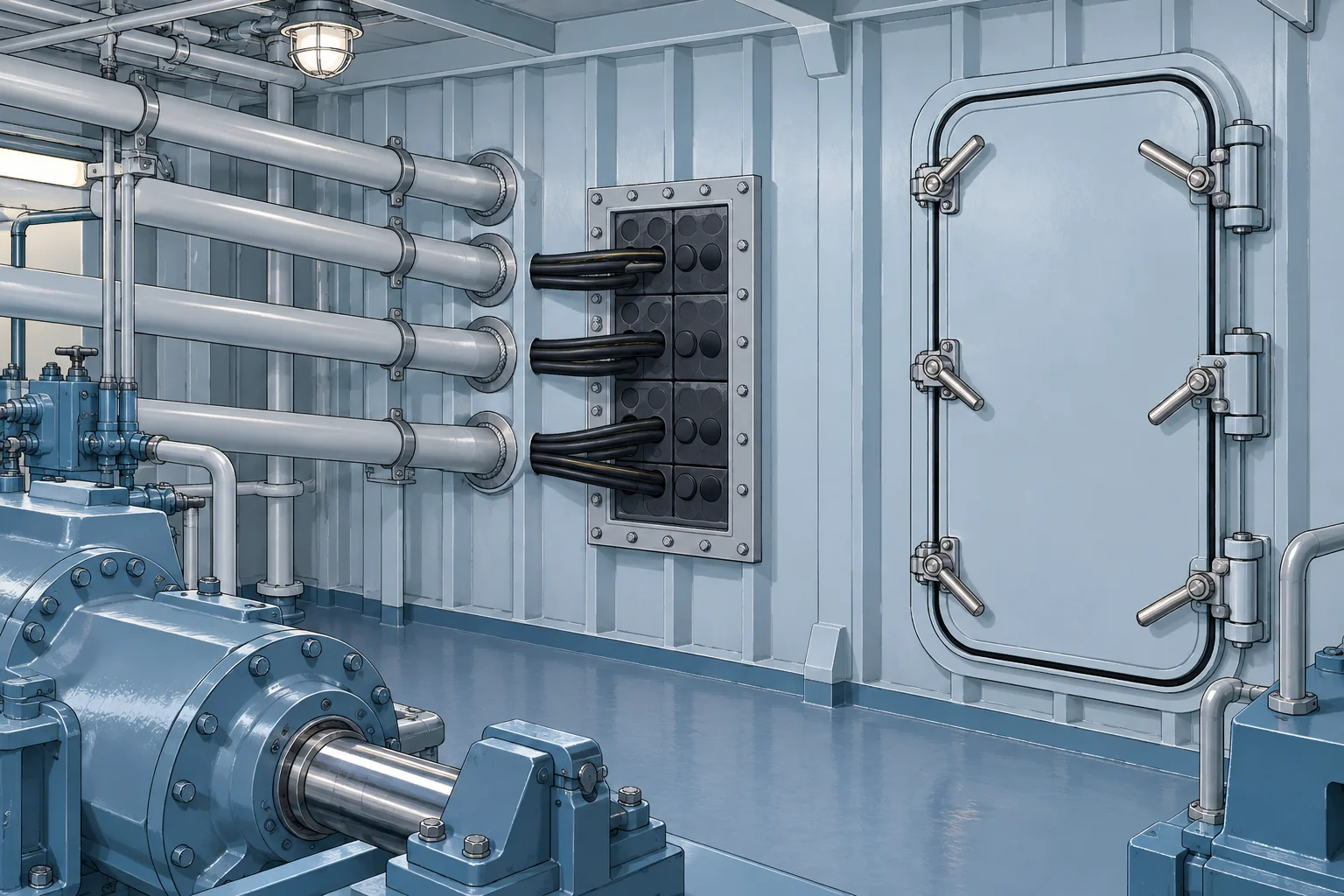
Bulkheads, watertight integrity and closing openings
1The lesson in plain words
Bulkheads only save the ship if every opening and penetration in them is closed and tight. Most of that is kept, or lost, by the crew.
Watertight and weathertight
Watertight means water cannot pass in either direction under the specified design head. A head of water is the depth producing that pressure. Weathertight means water cannot enter in any sea conditions; it does not certify resistance to a damage-water head. Subdivision bulkheads and decks must be watertight. Exposed hatch covers and superstructure access doors normally need weathertight closures, as the applicable rules require.
Bulkheads
Transverse watertight bulkheads limit the spread of flooding; they cannot guarantee survival of every flooded compartment. Required boundaries include the collision bulkhead, aft peak bulkhead and machinery-space boundaries. Some boundaries may coincide, so these names do not always mean four separate bulkheads. Flat bulkheads use stiffeners. Corrugated bulkheads use folded plating for stiffness and have fewer exposed stiffeners, making them easier to clean. Follow the approved structural plan.
Penetrations
Every pipe, cable or duct through a watertight bulkhead or deck must pass through an approved penetration: a welded sleeve, a gland or a cable transit. A cable pulled through after a repair and left unsealed is a hole between two compartments. Check penetrations after any work, insist that contractors restore the seal and the fire insulation, and report anything missing.
Openings and fittings
Air pipes let tanks breathe in and out; their approved closing arrangements keep seawater out. Sounding pipes let you measure tank contents and have approved closures, such as screw caps or self-closing devices. Scuppers, which drain decks, and overboard discharges need closing arrangements appropriate to their position and service. Non-return valves prevent reverse flow. Check the approved arrangement and maintain seals, valves and closures. Deck machinery covers watertight-door operation.
Testing
Class specifies the test for each new or repaired boundary. A hydrostatic test uses a water head to test strength and tightness. Approved low-pressure air tests check leakage; they are not automatically substitutes for structural tests. A hose test directs water at seams and closures. Ultrasonic leak testing checks seals without water. A leaking hose test can wet the hold or cargo. Record defects and restore the required integrity before sailing.
2Key data
- Watertight
- No water passes in either direction under the specified design head
- Weathertight
- No water enters in any sea conditions
- Required boundary functions
- Collision, aft peak and machinery-space boundaries; some may coincide
- Tightness tests
- Specified structural tests and approved leakage tests
3Key points
- 1
Watertight withstands its specified water head; weathertight prevents ingress in any sea conditions.
- 2
Every unsealed penetration is a hole between two compartments.
- 3
Maintain approved air-pipe closures, sounding-pipe closures, non-return valves and hatch seals.
- 4
A failed tightness test is a defect to fix before sailing.
4Frequent mistakes
Wrong: A weathertight door is good enough in a watertight bulkhead.
Right: Weathertight approval does not certify resistance to a damage-water head. Subdivision boundaries need closures approved for their specified water pressure.
Wrong: Contractors will restore the cable seals after their work.
Right: Check every penetration yourself after any work. Unsealed transits destroy the subdivision and the fire boundary.
5Practice case & exam keys
After an electrician's visit in port you inspect the steering gear room. A new cable passes through the watertight bulkhead to the engine room through an open hole with no transit. The ship sails in four hours.
Show the answer
The bulkhead is no longer watertight: flooding of one space could spread to the other, and fire and smoke could too. Report it to the chief engineer and the master at once. The penetration must be closed with an approved transit and tested before sailing, or the ship's sailing is at risk. Record the defect and the repair, and inform class if the repair needs approval.
Exam keys
- Definitions of watertight and weathertight.
- Required watertight boundaries; flat and corrugated bulkheads.
- Penetrations, air pipe heads, sounding pipes and non-return valves.
- Specified structural tests; air, hose and ultrasonic leakage tests.
Finish this unit
When you've read it, answer three questions. Get all three right to finish the unit; opening the page alone doesn't count.
My notes for this unit
No notes