

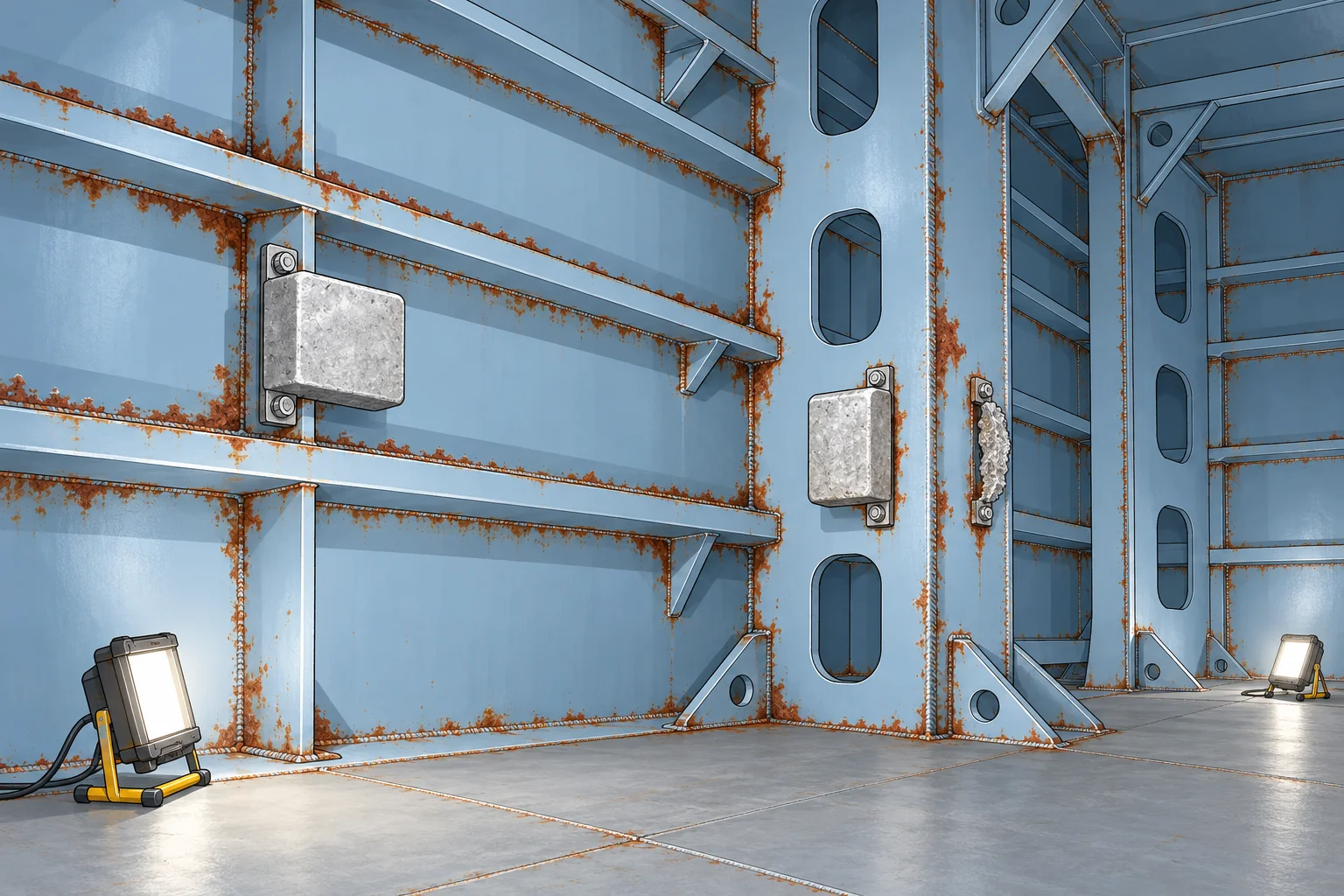
Corrosion, coatings and cathodic protection
1The lesson in plain words
Metal loss can weaken plating and stiffeners. Coatings and cathodic protection slow corrosion; your inspections find damage that needs assessment.
Why steel corrodes
Steel in seawater works like a battery. Some areas become anodes and lose metal; others act as cathodes and are protected. Warmth, oxygen, salt and repeated wetting and drying speed it up. Ballast tanks, deckheads under a sun-heated deck, and holds that carry wet or acidic cargoes such as some coals and sulphur suffer most.
Forms of corrosion
General corrosion thins plating evenly under loose scale. Pitting makes deep local holes, often on tank and hold bottoms, and can perforate a plate that looks sound. Grooving runs along welds and stiffener edges. Galvanic corrosion attacks the less noble metal where two metals touch in seawater, such as steel near a bronze propeller. Erosion-corrosion occurs when flowing water removes protective films and accelerates corrosion. Microbial corrosion involves microorganisms and can occur in stagnant tanks.
Coatings
Paint is the first defence. Under the PSPC (IMO Performance Standard for Protective Coatings), dedicated seawater ballast tanks of new ships of 500 GT and above get a coating system with a target useful life of 15 years. Surveyors rate coatings GOOD (minor spot rusting), FAIR (local breakdown, edges and welds) or POOR (general breakdown over 20 % or more of the area, or hard scale on 10 % or more). On ESP bulk carriers and tankers, a ballast-tank coating below GOOD brings annual examination of that tank.
Cathodic protection
Cathodic protection makes the steel the cathode. Sacrificial anodes of zinc or aluminium, welded or bolted to the hull and in ballast tanks, corrode instead of the steel; they are renewed when worn to the limit in the maintenance plan. Impressed current cathodic protection (ICCP) drives a small direct current from anodes on the hull; check its readings and report alarms. Never paint over an anode.
Measuring wastage
Class-approved ultrasonic thickness gauging measures remaining steel. Compare it with the applicable renewal limits. In the traditional definition, substantial corrosion exceeds 75 % of allowable wastage but remains within acceptance limits. This is not automatically 75 % of a design corrosion addition. Ships under Common Structural Rules use their rule-specific thickness criteria. Ask class which criteria apply. Report photos, member names and frame positions.
2Key data
- PSPC ballast-tank coating target
- 15 years useful life (new ships of 500 GT and above)
- Coating POOR
- Breakdown over ≥ 20 % of area or hard scale on ≥ 10 %
- Substantial corrosion
- Traditional definition: >75 % of allowable wastage, within limits
- Sacrificial anode metals
- Zinc or aluminium alloy
3Key points
- 1
Ballast tanks, hot deckheads and holds with acidic cargo corrode fastest.
- 2
Pitting can perforate a plate that looks sound; look at tank and hold bottoms.
- 3
Coating rated GOOD, FAIR or POOR; below GOOD in an ESP ballast tank means annual examination.
- 4
Anodes and ICCP protect the steel; never paint over an anode.
4Frequent mistakes
Wrong: A plate with only light scale is in good condition.
Right: Scale can hide deep pits. Record suspect areas and request ultrasonic gauging.
Wrong: Painting over the hull anodes protects them for longer.
Right: A painted anode cannot supply its designed protective current. Report painted or heavily consumed anodes for corrective action.
5Practice case & exam keys
Inspecting a topside ballast tank on a 14-year-old bulk carrier, you find the coating broken down over roughly a quarter of the tank's internal surface area, with hard scale in places, and two anodes almost gone. What do you report?
Show the answer
Rate the coating POOR: breakdown covers over 20 % of the tank assessment area. Give the tank, frame positions, affected members, extent in per cent and photos. Report hard scale and almost-consumed anodes. Recommend thickness gauging of affected members and anode renewal. Send findings to the company for class assessment of coating repairs and any further thickness measurements. Unless restored to GOOD, this tank will be examined at each annual survey.
Exam keys
- Forms of corrosion: general, pitting, grooving, galvanic, erosion-corrosion, microbial.
- Coating condition ratings GOOD, FAIR and POOR.
- Sacrificial anodes and ICCP.
- Substantial corrosion and ultrasonic thickness gauging.
Finish this unit
When you've read it, answer three questions. Get all three right to finish the unit; opening the page alone doesn't count.
My notes for this unit
No notes