

Hull stresses: bending, racking, torsion, local loads and fatigue
1The lesson in plain words
The hull bends along its length, distorts across it and twists in quartering seas. Know where each load acts and where the cracks will start.
Bending along the hull
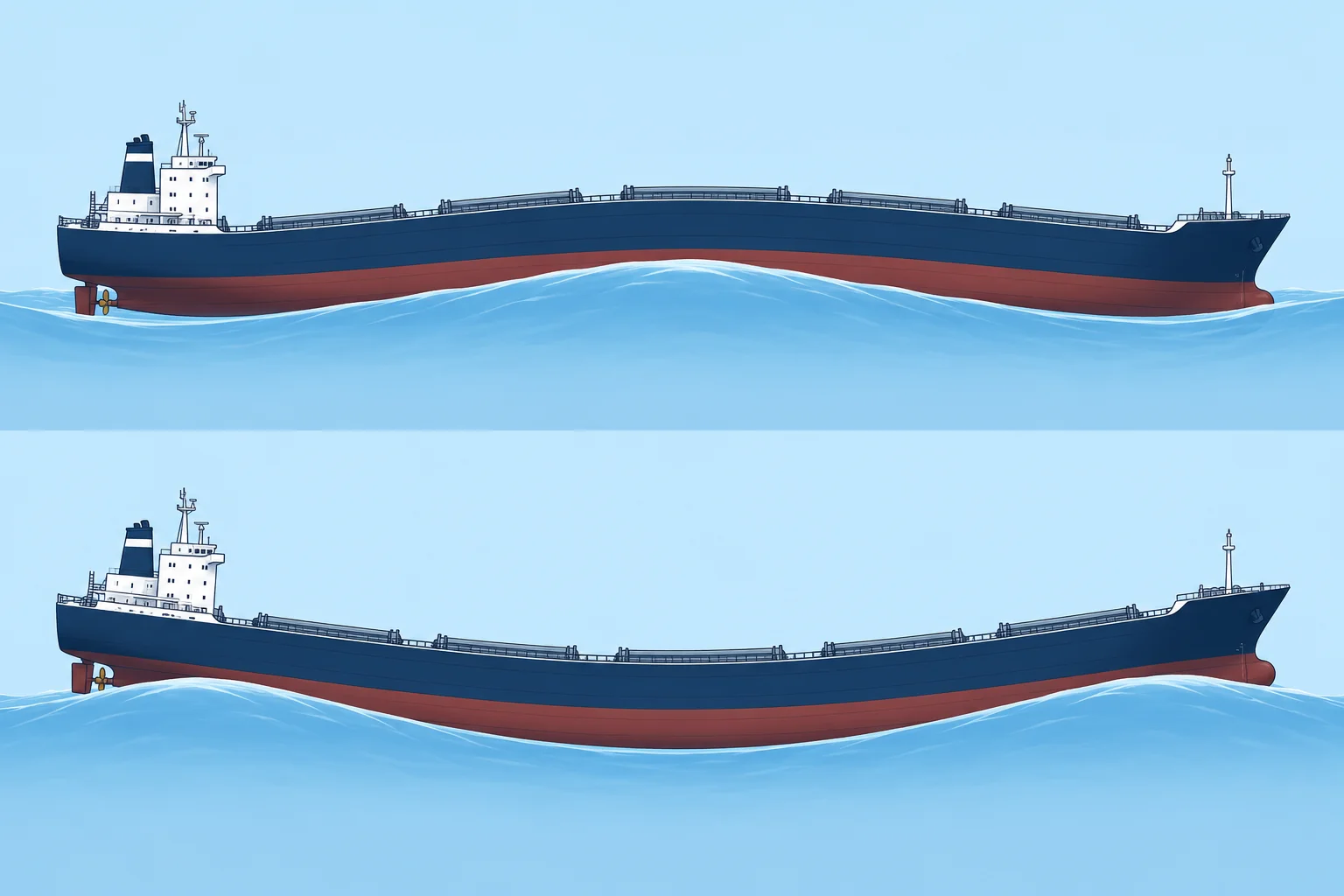
Weight and buoyancy are never spread the same way along the ship, so the hull girder bends. In hogging the middle rises and the ends droop: the deck is stretched and the bottom compressed. Sagging is the opposite. Waves add to it. The numbers, the loading manual and the loading instrument are taught in Stability: stress tables and partial loss of buoyancy.
Racking
When a ship rolls, the mass of her structure and cargo pushes each cross-section sideways, trying to turn the rectangle into a parallelogram. This is racking. Transverse bulkheads, web frames and the brackets joining frames to beams resist it. It is worst in heavy rolling and in ships with few transverse bulkheads, such as car carriers.
Torsion
In oblique seas the bow and the stern meet the waves differently, so the hull twists: torsion. Ships with very wide hatches, above all container ships, are weak in torsion because their deck is mostly openings. They get torsion boxes along the deck edges. Hatch corners are rounded and thickened, because cracks start there.
Local loads
Some loads act on a small area: heavy cargo on the tank top, water pressure in a full tank, grabs and bulldozers in a bulk hold, ice, and machinery vibration. The loading manual gives the limits, such as tonnes per square metre on the tank top and the maximum cargo per hold. Keep within them, and keep tanks full or empty where the manual asks, because liquid sloshing in a slack tank can damage it.
Fatigue
Every wave loads the steel a little. After millions of cycles, small cracks grow at stress concentrations, places where local stress is higher: hatch corners, bracket toes, holes cut in the structure and poor welds. This is fatigue. Cracks can remain hidden or grow quickly. Inspect known hot spots and report every crack promptly; inspection does not guarantee early detection.
2Key points
- 1
Hogging stretches the deck; sagging compresses it. Waves add to the still-water bending.
- 2
Racking distorts the cross-section when rolling; bulkheads and brackets resist it.
- 3
Wide-hatch ships are weak in torsion; hatch corners are crack hot spots.
- 4
Keep within tank-top and hold limits; look for fatigue cracks at stress concentrations.
3Frequent mistakes
Wrong: If total cargo weight is within the hold limit, the tank top cannot be overloaded.
Right: A concentrated load can exceed the tank-top limit even when total hold weight is acceptable. Check the load per square metre.
Wrong: Hairline cracks in brackets are cosmetic.
Right: Fatigue cracks grow with every wave cycle. Record, mark and report them so class can decide on repair.
4Practice case & exam keys
A container ship meets a long swell on the quarter and rolls and pitches together. On the next inspection the bosun reports a crack starting from a hatch corner on the upper deck. Why there, and what do you do?
Show the answer
The quartering sea twists the hull. Stress concentrates at hatch corners, where fatigue cracks can start. Report the crack immediately to the master with hatch, side, frame number, length and photos. Mark its ends. The master must obtain company and class assessment and follow any operating restrictions. Monitor as directed; monitoring alone does not establish that continued service is safe.
Exam keys
- Hogging and sagging, and which part of the hull is in tension or compression.
- Racking and torsion: causes and the structure that resists them.
- Local loads: tank-top limits, slack-tank sloshing, grabs.
- Fatigue cracks start at stress concentrations.
Finish this unit
When you've read it, answer three questions. Get all three right to finish the unit; opening the page alone doesn't count.
My notes for this unit
No notes