

Battery types, state of charge and battery banks
1The lesson in plain words
Lead-acid batteries like to stay full; lithium batteries need their own management. Keep a separate battery for starting the engine.
Lead-acid types
Flooded batteries need distilled-water top-ups and release hydrogen during charging. AGM (absorbed glass mat) and gel are valve-regulated types: they need no water top-ups but can still vent gas. Ventilate every lead-acid battery compartment. Use the maker’s charging settings. Avoid routinely taking lead-acid batteries below about half charge.
Lithium (LiFePO₄)
Lithium iron phosphate batteries are about a third of the weight, accept fast charging and can use most of their capacity. A battery management system (BMS) protects the cells and disconnects the battery if voltage or temperature goes out of range. Most makers block charging near or below freezing. Have a marine electrician check the installation against the maker’s instructions and applicable marine standards.
State of charge
After resting without charging or loads for the maker’s recommended time, a 12 V lead-acid battery reads about 12.7 V full and 12.2–12.4 V at half charge; check its chart. A shunt, a current-measuring sensor, lets a monitor count amp-hours in and out. Set it up correctly, capture all battery current and synchronise as instructed; estimates can drift. Lithium’s flat voltage makes voltage-only estimates unreliable.
Separate banks
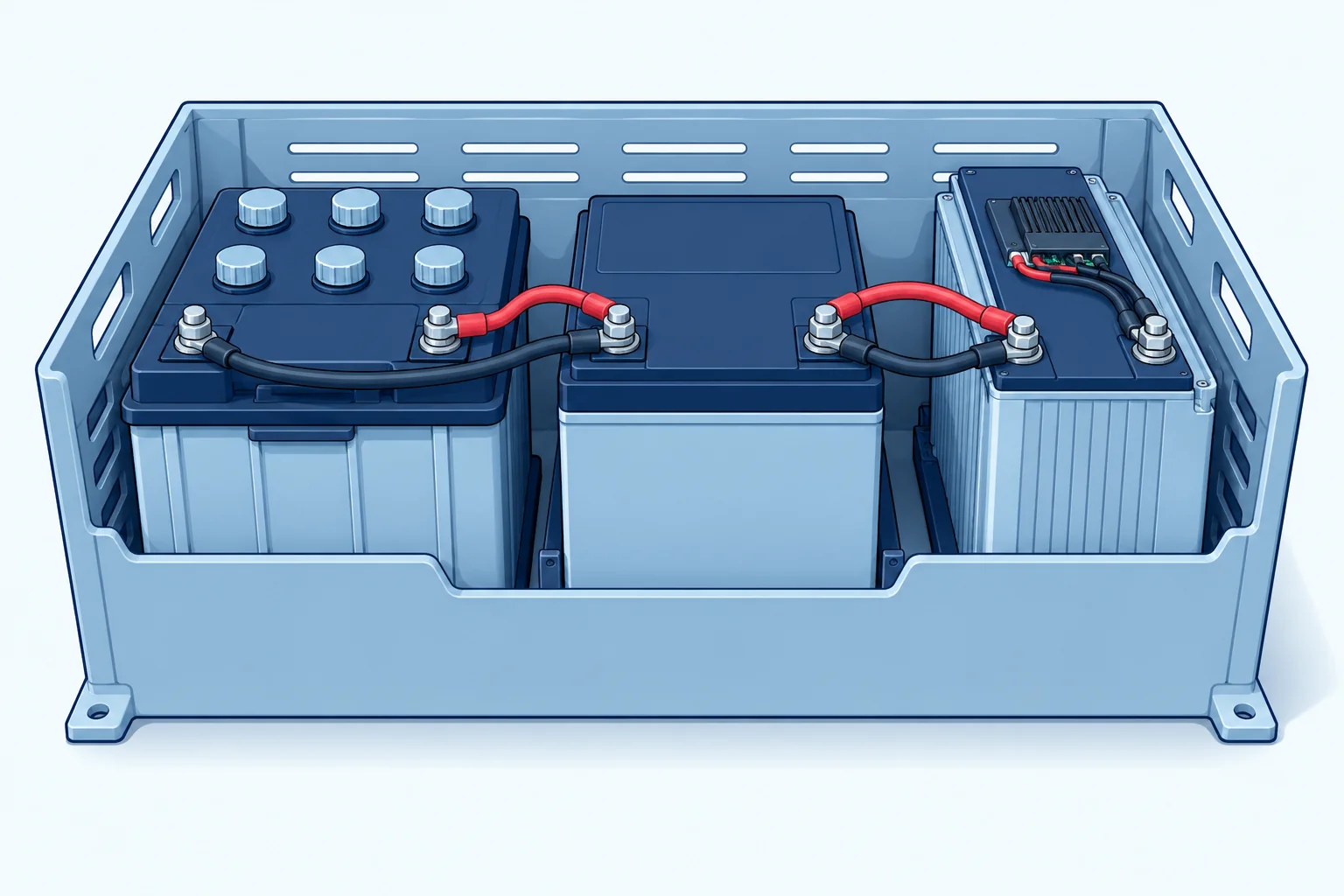
Keep a start battery for the engine, separate from the house bank for domestic equipment. This preserves starting capacity when house loads run the house bank down. A voltage-sensitive relay can link compatible lead-acid banks automatically for charging. A lithium house bank needs a compatible DC-DC charger, which controls charging between direct-current circuits, or a managed charging system.
2Key data
- Lead-acid, rested
- About 12.7 V full; about 12.2–12.4 V at half
- Lead-acid use
- Rarely below about 50 % for long life
- LiFePO₄
- 12.8 V nominal; most capacity usable; BMS required
- Flooded charging
- Gives off hydrogen: ventilate the battery box
3Key points
- 1
Flooded: water top-ups. AGM/gel: no top-ups. All need ventilation.
- 2
Lead-acid lasts longest kept above about half charge.
- 3
LiFePO₄ needs a BMS and compatible charging; no charging below its cold limit.
- 4
Read rested lead-acid voltage or use a correctly set and synchronised battery monitor.
- 5
Keep a separate start battery.
4Frequent mistakes
Wrong: Swap lead-acid batteries for lithium and keep the same charging gear.
Right: Lithium needs compatible charge settings and usually a DC-DC charger or managed alternator. The BMS can cut off charging suddenly.
Wrong: 12.4 V while the engine is charging shows a full battery.
Right: Voltage under charge or load is misleading. Read it after resting, or use a battery monitor.
5Practice case & exam keys
Your monitor shows the shared start/house bank is nearly flat after two days at anchor. You plan to run the fridge overnight before leaving at dawn. What should you change now and for future trips?
Show the answer
Reduce optional loads and arrange charging before departure. House loads can leave too little charge to start the engine. For future trips, keep a separate start battery isolated from house loads, with charging suited to both banks. Monitor house-bank charge.
Exam keys
- Flooded / AGM / gel / LiFePO₄ (with BMS).
- Lead-acid: keep above about 50 %; rested 12.7 V ≈ full.
- Separate start and house banks; charging arrangement must suit both battery types.
- All lead-acid batteries need ventilation; AGM and gel can also vent gas.
Finish this unit
When you've read it, answer three questions. Get all three right to finish the unit; opening the page alone doesn't count.
My notes for this unit
No notes