

The 12 V DC system
1The lesson in plain words
Most boats run on 12 volts DC from batteries. Volts, amps, watts and amp-hours are all you need to plan your power.
Volts, amps, watts
Voltage (V) is the electrical pressure; current (A, amps) is the flow. Power in watts is volts × amps: a 60 W fridge on 12 V draws 5 A. Most yachts use 12 V DC (direct current, one direction); larger boats often 24 V, which halves the current for the same power.
Amp-hours
Battery capacity is in amp-hours (Ah). A load of 5 A for 10 hours uses 50 Ah. Add up every load over 24 hours to get your daily use: fridge, lights, instruments, autopilot, phone charging. This power budget tells you how much battery and charging you need.
The circuit
Current flows from the battery’s positive terminal through a fuse or breaker, the switch and the load, and back through the negative to the battery. A boat’s DC negative is a wire back to the battery, not the hull. The engine block is usually connected to it.
The layout
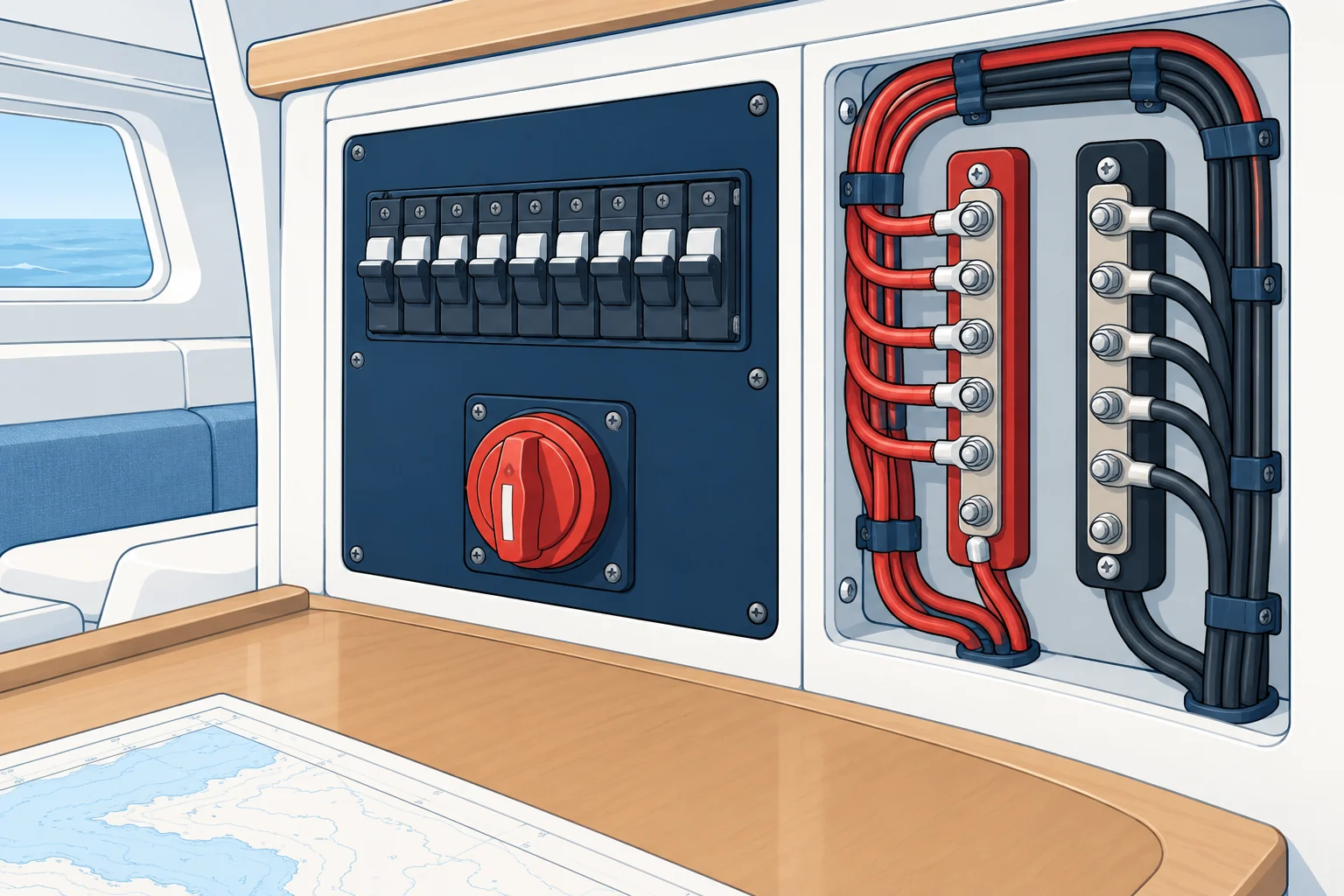
A battery isolator switch disconnects circuits wired through it. Separately fused bilge pumps and alarms may bypass it; charging sources can also leave wiring live. The distribution panel has breakers or fuses for each circuit. Bus bars, metal connection strips, gather positive or negative wires. Label every circuit.
Resistance
Resistance, measured in ohms (Ω), opposes current. Ohm’s law is V = I × R: voltage drop (V) equals current (I, in amps) times resistance (R, in ohms). Loose or corroded joints add resistance, causing voltage loss and heating. Check connections early when tracing a fault.
2Key data
- Power
- Watts = volts × amps
- Ohm’s law
- Voltage drop (V) = current (A) × resistance (Ω)
- Charge used
- Amp-hours = amps × hours
- Example
- 60 W fridge at 12 V = 5 A; 12 h running = 60 Ah
3Key points
- 1
Watts = volts × amps; on 12 V, 60 W is 5 A.
- 2
Plan with a daily amp-hour power budget.
- 3
Current returns through a negative wire, not the hull.
- 4
Most faults are loose or corroded connections.
4Frequent mistakes
Wrong: A 24 V system needs thicker wire than 12 V for the same equipment.
Right: For the same power, 24 V carries half the current. A smaller cable may be suitable, but check current capacity and voltage drop.
Wrong: Turning off the panel breakers isolates the battery.
Right: Panel breakers do not isolate battery cables. The isolator may leave bypass circuits live. Before electrical work, identify and isolate every supply to the circuit and verify it is dead. Keep automatic bilge protection powered when leaving the boat.
5Practice case & exam keys
Your daily loads use: fridge 48 Ah, anchor light 10 Ah, instruments 12 Ah and phones 6 Ah. Charging replaces only 60 Ah a day. Can you keep this routine for several days?
Show the answer
You use 76 Ah but replace only 60 Ah, leaving a 16 Ah daily shortfall. Reduce optional use or arrange more charging. Keep essential lights and instruments supplied. The battery will steadily discharge if you continue unchanged. Plan charging to replace use plus charging losses.
Exam keys
- P (watts) = V (volts) × I (amps); V = I × R (ohms); Ah = A × h.
- Daily power budget: add load current × hours; charging must replace use plus losses.
- DC circuit: positive via fuse, switch, load; negative wire back to battery.
- Isolator switch, distribution panel, bus bars.
Finish this unit
When you've read it, answer three questions. Get all three right to finish the unit; opening the page alone doesn't count.
My notes for this unit
No notes