

Charging sources: alternator, shore, solar and wind
1The lesson in plain words
Every amp-hour you use must go back in. Alternator, shore charger, solar and wind each need the right regulator for your batteries.
Alternator
The engine’s alternator charges while you motor. Its built-in regulator usually charges at a fixed voltage and fills a lead-acid bank slowly. An external smart regulator adjusts charging in stages. A DC-DC charger controls charging between DC circuits. For lithium, have a marine electrician specify a suitable charger or managed alternator, limiting demand to what the alternator can safely supply and providing for BMS disconnection.
Charge stages
A typical lead-acid smart charger uses bulk (full current), absorption (held voltage while current falls) and float (a lower voltage to keep the battery full). Use the maker’s profile for each battery type; lithium may not need float.
Shore charger
On shore power, a battery charger fed from 230 V or 120 V AC (alternating current, which reverses direction) charges the banks. Many boats have an inverter-charger that also makes AC from the batteries at sea.
Solar
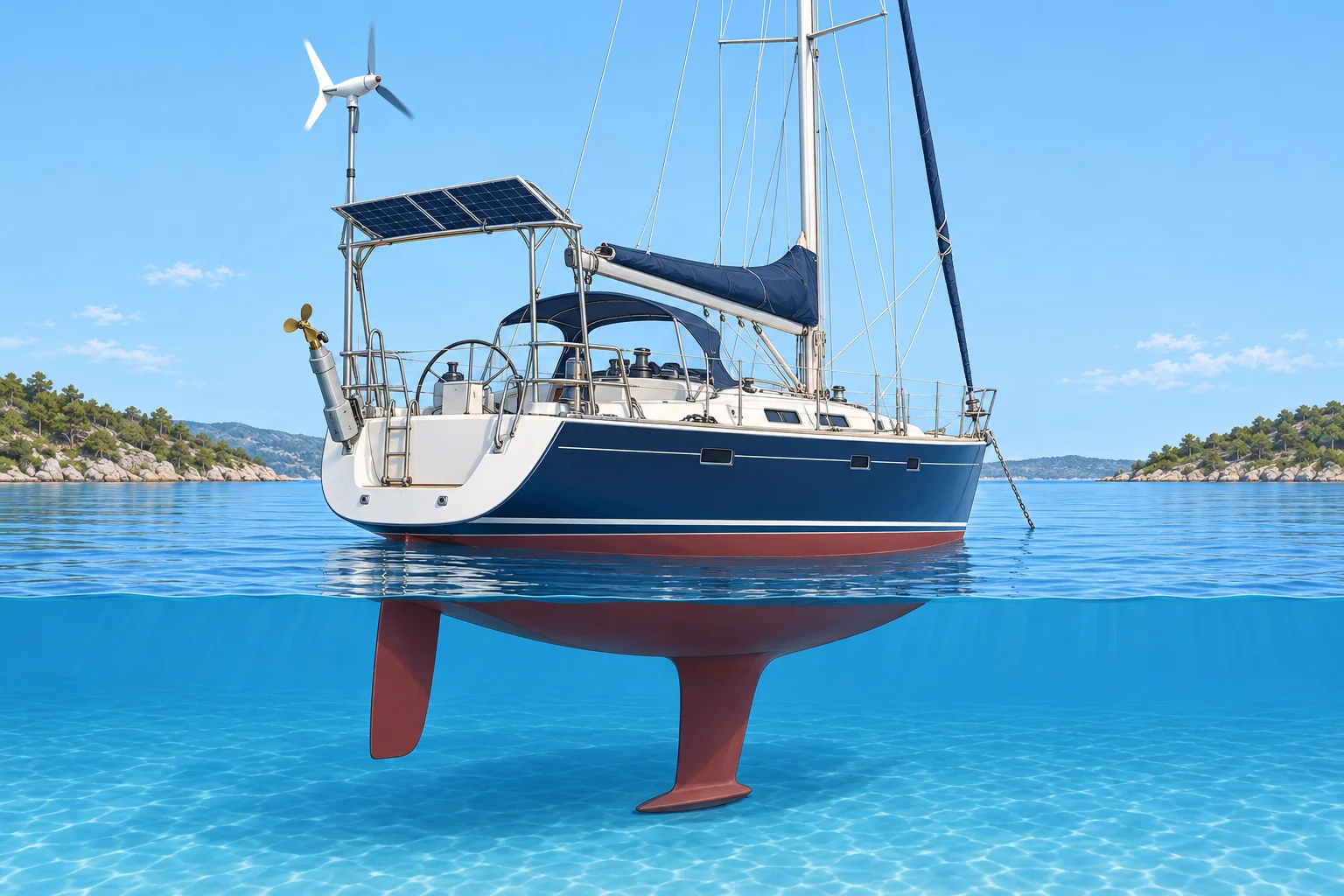
Solar panels charge in daylight through a charge controller. MPPT (maximum power point tracking) finds the panel’s best operating point and converts its output to battery-charging voltage. PWM (pulse-width modulation) switches the panel connection on and off; the panel operates near battery voltage while connected. MPPT can improve charging, depending on conditions. Partial shade can sharply reduce output; avoid boom and rigging shadows.
Wind and water
A wind generator charges in sufficient wind. Its controller uses a dump load to absorb surplus power or a brake to slow the rotor, as the maker specifies. A hydrogenerator turns a propeller in the water as you sail, useful on long passages.
2Key points
- 1
Set every charger to the battery type.
- 2
Typical lead-acid stages: bulk, absorption, float.
- 3
Lithium: compatible charging, safe alternator current and temperature, and BMS disconnect protection.
- 4
Solar needs a controller; avoid shade. MPPT can improve charging.
- 5
Wind needs a controller with a dump load or brake.
3Frequent mistakes
Wrong: Charge a gel battery with the flooded setting; they are both lead-acid.
Right: Use the gel maker’s profile. Some flooded settings, especially equalisation (a deliberate higher-voltage charge), can damage gel batteries.
Wrong: A little shade on one corner of a panel hardly matters.
Right: Partial shade can cut a panel’s output by much more than its shaded area. Mount panels clear of shadows.
4Practice case & exam keys
You replace the house bank with LiFePO₄ batteries. The engine has a standard alternator wired directly to the house bank. During the first engine run, the alternator gets very hot, and later the BMS cuts out while charging.
Show the answer
When safe for navigation, stop the engine; do not open the battery isolator while the alternator is running. Have the installation checked before reuse. Lithium can overload an alternator, and a BMS disconnect can cause a damaging voltage surge. A marine electrician must confirm compatible charging, safe current and temperature limits, and protection against sudden battery disconnection.
Exam keys
- Charging sources: alternator, shore charger, solar, wind, hydrogenerator.
- Typical lead-acid stages: bulk, absorption, float; follow the maker’s battery profile.
- Lithium: safely limited DC-DC or managed alternator; temperature and BMS disconnect protection.
- Solar: MPPT/PWM controller; avoid shade.
Finish this unit
When you've read it, answer three questions. Get all three right to finish the unit; opening the page alone doesn't count.
My notes for this unit
No notes