

Fuses, breakers, wire size and voltage drop
1The lesson in plain words
A supply fuse primarily protects its cable. Size wire for current and circuit length, then check voltage drop.
Fuses protect wires
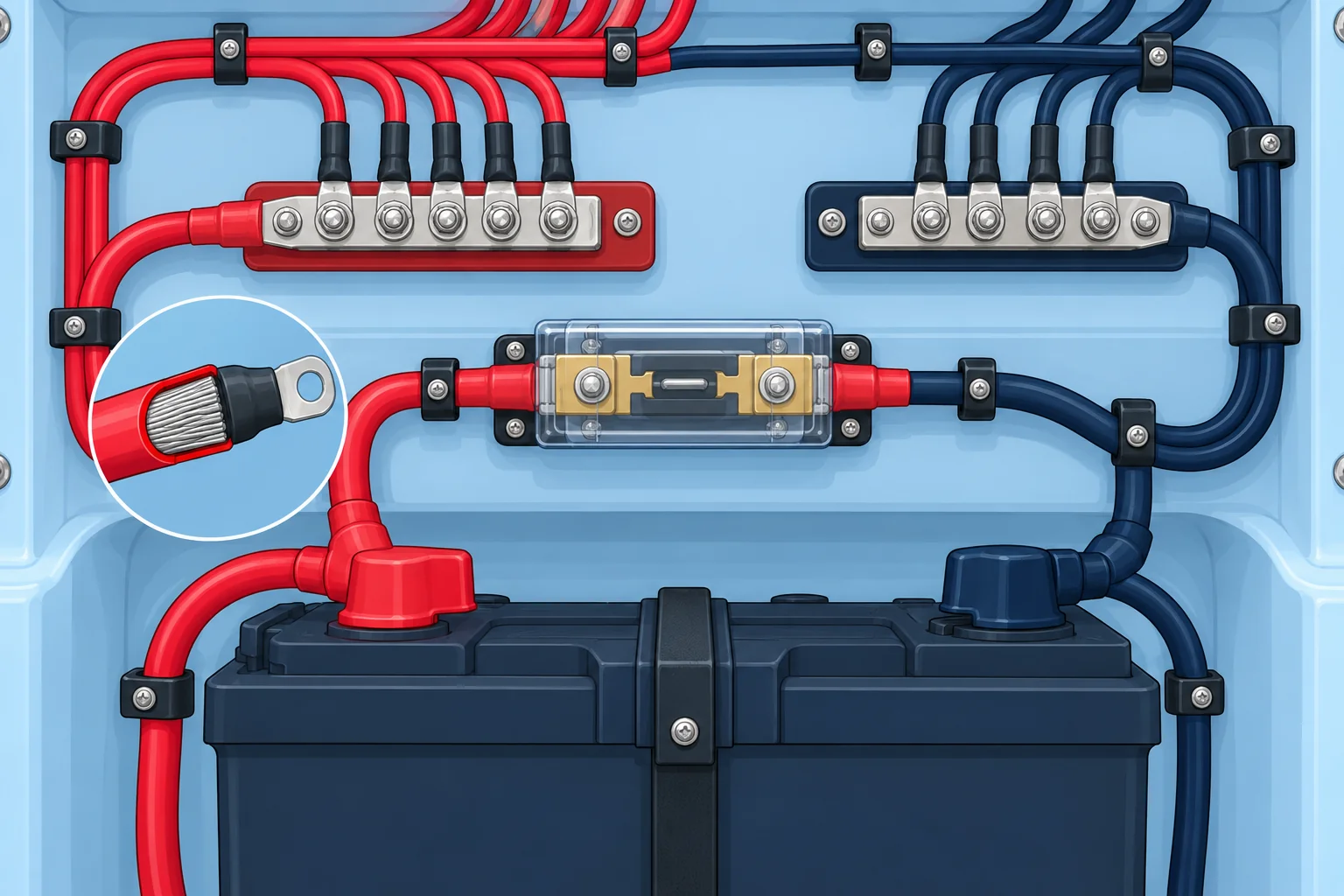
A fuse or circuit breaker stops a short circuit from overheating a wire and starting a fire. Its rating must suit the wire, so the wire cannot overheat. Fit it close to the power source: the main battery fuse within a short distance of the battery. Never replace a fuse with a bigger one.
Main battery fuse
Batteries can deliver thousands of amps into a short circuit. The fuse’s current rating must protect the cable. Its breaking capacity, the fault current it can safely interrupt, must suit the battery bank, especially lithium. Have a marine electrician select a suitable fuse, fitted in the positive cable close to the battery.
Marine wire
Use tinned, finely stranded marine cable: its copper strands have a tin coating to resist corrosion and are flexible enough to tolerate vibration. Crimp terminals by compressing them onto the wire with the correct tool. Seal joints with heat-shrink tubing, support cables and route them clear of bilge water.
Voltage drop
Wire has resistance, so long, thin cables lose volts. The usual limits (ABYC) are 3 % for critical circuits such as navigation lights, electronics, bilge blowers and panel feeders, and 10 % for less critical loads. Count the length out and back.
Sizing the wire
For copper at 20 °C, estimate A (mm²) = 2 × L × I × 0.0175 ÷ ΔV. L is one-way length (m), I is current (A), and ΔV is allowed drop (V). Round up to a standard size. Check voltage drop at operating temperature, current capacity with heat and cable grouping, and losses through connections and switches.
2Step by step
Worked example: wire for a 10 A load 8 m away
- 1
Allowed drop for a critical load: 3 % of 12 V = 0.36 V.
Navigation lights and electronics need nearly full voltage.
- 2
A = 2 × 8 × 10 × 0.0175 ÷ 0.36 = 7.8 mm².
The 2 counts the cable out and back.
- 3
Choose the next standard size: 10 mm².
Then verify operating-temperature drop and allow for connections.
- 4
Fuse it for the cable, near the source.
The fuse must blow before the cable overheats.
3Key data
- Voltage drop limits
- 3 % critical loads; 10 % non-critical (ABYC)
- 3 % of 12 V
- 0.36 V
- Copper resistivity
- About 0.0175 Ω·mm²/m at 20 °C
- Wire size
- A = 2 × L × I × 0.0175 ÷ ΔV
4Key points
- 1
The fuse protects the wire: rate it for the cable.
- 2
Main battery fuse close to the battery.
- 3
Tinned, stranded marine cable; proper crimps.
- 4
Voltage drop: 3 % critical, 10 % non-critical; length out and back.
5Frequent mistakes
Wrong: The fuse keeps blowing, so fit a bigger one.
Right: A blowing fuse means a fault or overload. Find it; a bigger fuse lets the wire overheat.
Wrong: Measure only the length from the battery to the device.
Right: Include both conductors once: use one-way length with a formula containing 2 × L, or total loop length with a formula that does not.
6Practice case & exam keys
A new anchor windlass draws 80 A at the bow, 9 m from the batteries. The installer used the thin cable left over from a light circuit, and the windlass is weak and the cable warm.
Show the answer
Stop using the windlass and isolate its circuit safely. The thin cable is dropping voltage and overheating. Have it replaced with marine cable sized for 80 A, the 18 m total circuit and the maker’s voltage-drop limit. Check current-carrying capacity, connections and suitable fuse or breaker protection near the source before reuse.
Exam keys
- Fuse/breaker rated to protect the cable, close to the source.
- Main battery fuse near the battery.
- Voltage drop 3 % critical / 10 % non-critical; length out and back.
- A = 2 × L × I × 0.0175 ÷ ΔV (mm², metric).
Finish this unit
When you've read it, answer three questions. Get all three right to finish the unit; opening the page alone doesn't count.
My notes for this unit
No notes