

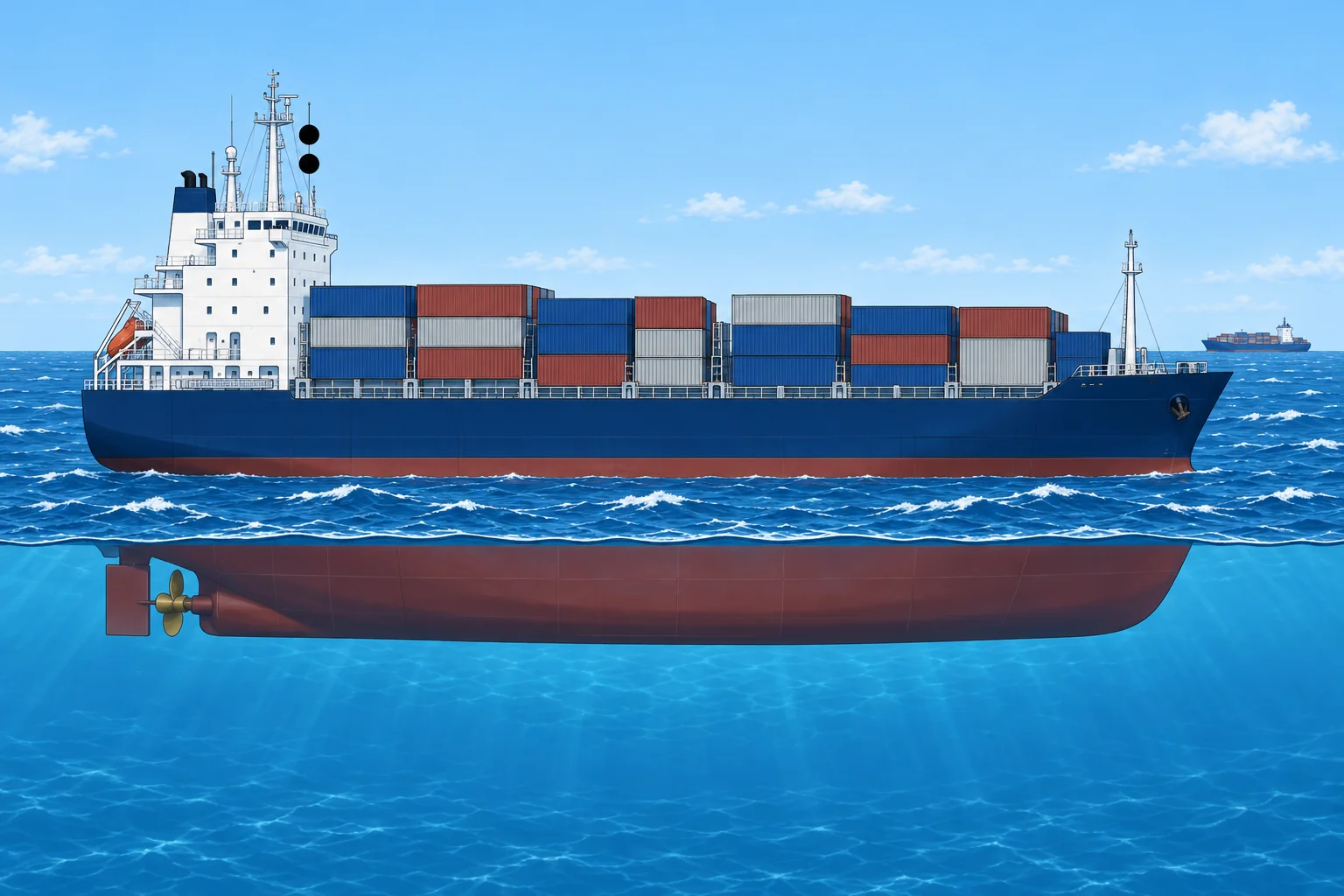
Blackout at sea: the first minutes and the recovery
1The lesson in plain words
In a blackout the ship goes dark and quiet and starts to lose way. Keep her steering while she can, tell the world, and let the engineers restore power in order.
What a blackout looks like
When main power fails, lights, auxiliaries and main-fed steering pumps may stop; propulsion may trip. The emergency source supplies designated safety services. Alternative steering power, where required, may come from that source or an independent supply. Check what is running. An uninterruptible power supply (UPS) or battery keeps only its connected equipment powered without a break. Check displays, sensors and communications. A VDR reserve supply may record bridge audio rather than every sensor.
What she will still do
If steering remains available, use the ship's remaining way through the water to steer clear of traffic and dangers. Her heading and drift depend on the ship, wind and sea; do not assume she will lie beam on. Find out quickly the depth, distance to danger and rate of drift. Assess anchoring suitability against equipment limits and holding conditions as well as depth.
Restoring power
Engineers restore a main generator, reconnect essential services and restart propulsion under the ship's blackout-recovery procedure. Confirm steering as early as possible. Restore loads in stages within available generating capacity. Do not ask for full power or the bow thruster as soon as the lights come back: a big load can cause another blackout. Agree with the chief engineer what you will have and when.
Prevention
Many blackouts start with fuel: dirty filters, water in the fuel, or changeover to compliant low-sulphur fuel at an emission control area. Others come from overload during manoeuvring or a wrong switch. Finish fuel changeovers well before the boundary or the pilot station. Arrange the generating capacity and standby readiness required by the ship's manoeuvring procedures, and test standby starts as the plan requires.
2Step by step
Blackout: the first minutes on the bridge
- 1
Check whether steering power is available. Check the ship's actual alternative supply and use the approved checklist to restore control.
Remaining way helps you steer only if steering control and power are available.
- 2
Call the master and the engine room; note the time and position.
The engineers need to start at once, and the record matters later.
- 3
If the failure leaves you unable to manoeuvre as the collision rules (COLREGs) require, show not-under-command (NUC) signals and set the automatic identification system (AIS) status accordingly.
NUC depends on the loss of control, not on the blackout alone.
- 4
Warn ships nearby and VTS by very high frequency (VHF) radio; use urgency or distress traffic as warranted.
Early warning gives others time to keep clear.
- 5
Assess depth, drift and dangers; prepare anchors if depth, equipment limits and holding conditions permit.
A suitable anchoring option may help prevent grounding; depth alone does not establish suitability.
- 6
Coordinate staged restoration under the ship's procedure with the engineers; preserve VDR data.
Rushing loads can cause a second blackout; the data shows what happened.
3Key points
- 1
Emergency power supplies designated services; confirm steering and navigation equipment availability.
- 2
If steering remains available, use remaining way; assess drift, depth, dangers and anchoring suitability.
- 3
If unable to manoeuvre as the COLREGs require, show NUC signals; warn others and assess anchoring.
- 4
Restore loads in order with the engineers; rushed loads cause a second blackout.
4Frequent mistakes
Wrong: Wait for the engine before telling anyone, as it will be back in a few minutes.
Right: Warn nearby ships and VTS at once. If power takes longer, they are already keeping clear.
Wrong: Ask for full ahead as soon as the lights return.
Right: Wait until the engineers report the plant ready. Loading one generator too quickly can black her out again.
5Practice case & exam keys
In a coastal traffic lane at 12 knots, the ship blacks out. The emergency generator starts. The coast lies 4 miles downwind, the depth is 40 m, wind force 6 onshore, and a ship is overtaking 1 mile astern. What do you do?
Show the answer
Confirm steering power; if available, use remaining way towards assessed safe water, checking traffic. Call the master and engineers. If unable to manoeuvre as required, show NUC signals and set AIS accordingly. Warn the overtaking ship and VTS; use urgency or distress traffic as warranted. Assess drift; prepare anchors if depth, equipment limits and holding conditions permit. Coordinate recovery and preserve VDR data.
Exam keys
- What is lost and what the emergency source keeps in a blackout.
- First bridge actions: confirm steering, call, assess NUC status, warn, assess drift and anchoring suitability.
- Ship-specific, staged restoration of essential services and propulsion.
- Common causes: fuel changeover, overload, filters.
Finish this unit
When you've read it, answer three questions. Get all three right to finish the unit; opening the page alone doesn't count.
My notes for this unit
No notes