

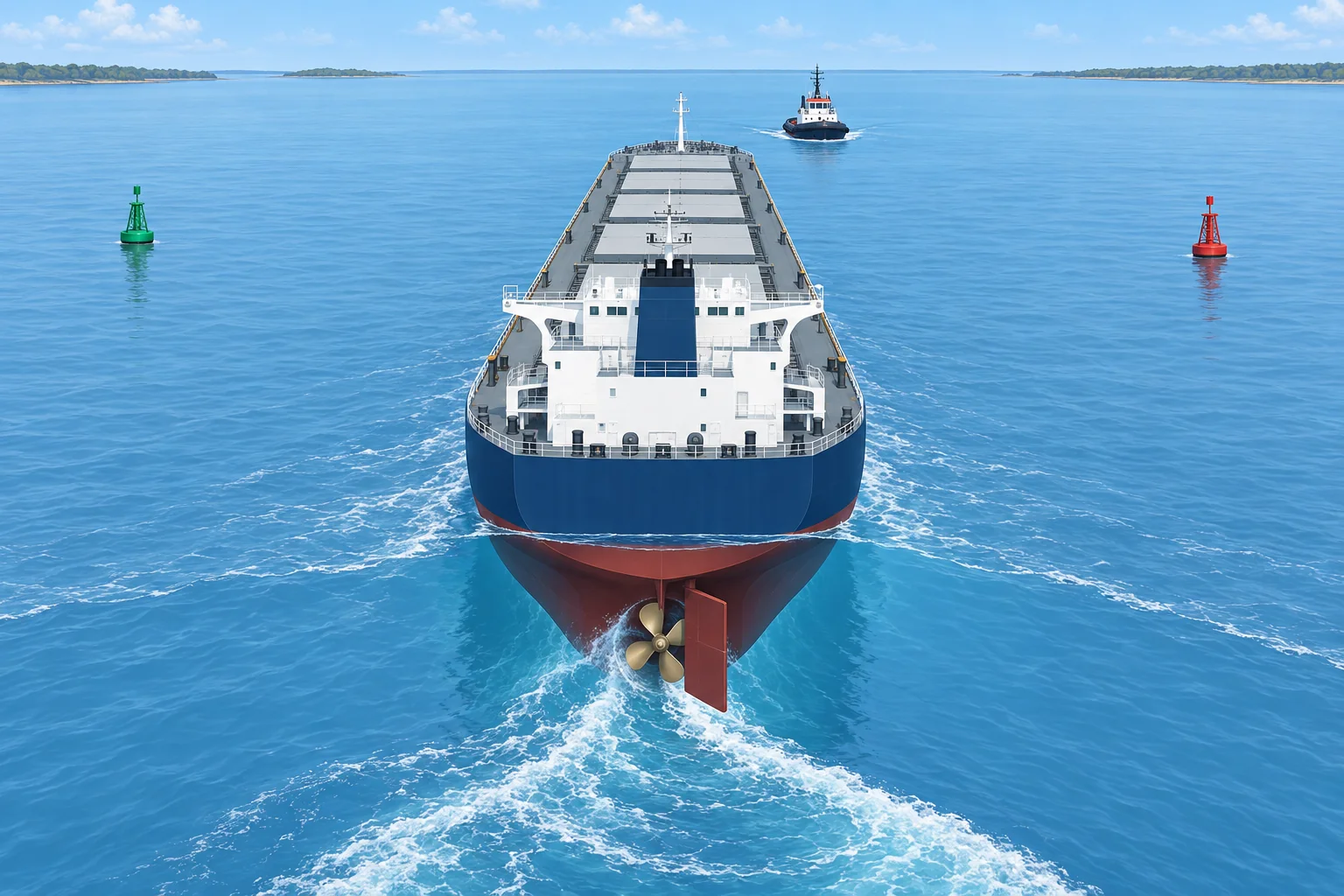
Steering and propulsion failures, and the engine-room link
1The lesson in plain words
A steering or propulsion failure can demand immediate action. Reduce the danger, call for help and use your ship's recovery procedure.
Steering failure
Steering alarms can indicate a power, control or hydraulic fault. Assess rudder response, reduce danger and call the master and engineers. Warn nearby traffic immediately. Follow the ship's posted failure and changeover instructions; arrange local steering if needed and maintain communications with that team. Show not-under-command (NUC) signals if unable to manoeuvre as the collision rules require. See Steering gear for changeover and drills.
Using the engine to steer
With a jammed rudder, reduce propulsion as conditions require to limit the uncontrolled turn. Reducing speed usually reduces the rate of turn and gives more reaction time; monitor track and sea room. Control is not assured. A single CPP controls thrust but does not independently steer. Differential thrust, meaning different thrust on twin screws, may help. Thrusters may help at suitable low speed, within their effective operating limits. Effectiveness depends on the ship, speed and rudder position. Request tug assistance early where available.
Propulsion failure
Ask the engine room the cause and expected restart time. If steering remains, use remaining way towards safe water. Warn others at once; show NUC signals if unable to manoeuvre as the rules require. In confined waters assess anchoring or call a tug. Passenger ships and cargo ships of 500 GT and above carry emergency towing procedures. Tankers of 20,000 dwt (deadweight) and above have towing arrangements at both ends; new non-tankers of 20,000 GT and above need them from 1 January 2028.
The bridge and engine room link
SOLAS requires at least two independent means of passing orders from the bridge to the engine room, one of them an engine telegraph. Report clearly: standby engines, full away, and finished with engines. Give the engine room early warning of manoeuvring and of planned changes in speed. The engineers, in turn, warn you before any work that reduces power or availability.
Tests before arrival and departure
Before departure, steering is tested as SOLAS V/26 requires (see Steering gear). Test the engine ahead and astern, the telegraphs and the communications before arrival and departure, as company orders say. A failure found in open water is a nuisance; at the pilot station it is a hazard.
2Key points
- 1
Steering failure: reduce danger, call for help, follow posted instructions and maintain local-steering communications.
- 2
Reducing speed usually reduces the rate of turn and gives reaction time; monitor the track and sea room.
- 3
Propulsion loss: assess control, warn traffic, consult engineers and consider anchoring or tug assistance.
- 4
At least two independent means of engine orders; tests before arrival and departure.
3Frequent mistakes
Wrong: Keep full speed after a steering failure to keep steerage way.
Right: Reduce propulsion as conditions require. Less speed usually reduces the rate of turn and gives reaction time; monitor the track and remaining sea room.
Wrong: Wait for the engineers to report before warning traffic.
Right: Warn others as soon as control is lost. The engineers' report can follow.
4Practice case & exam keys
At 14 knots in a buoyed channel, the steering alarm sounds and the rudder-angle indicator shows the rudder stuck at 10° starboard. The rudder does not respond to bridge commands. There is an inbound ship 2 miles ahead.
Show the answer
Reduce propulsion as conditions require; call the master and engineers. Follow posted failure instructions; arrange local steering if needed with tested communications. Warn the inbound ship and VTS. Show NUC signals if unable to manoeuvre as the rules require. Use propulsion cautiously; a thruster may be ineffective at 14 knots. Monitor track and sea room; assess anchoring suitability and tug assistance.
Exam keys
- Steering failure: assess response, reduce danger, follow posted instructions and maintain communications.
- Engine and thruster use with a jammed rudder.
- Propulsion loss: assess NUC status, warnings, anchoring suitability, tugs and emergency towing requirements.
- At least two independent means of engine orders; arrival and departure tests.
Finish this unit
When you've read it, answer three questions. Get all three right to finish the unit; opening the page alone doesn't count.
My notes for this unit
No notes