

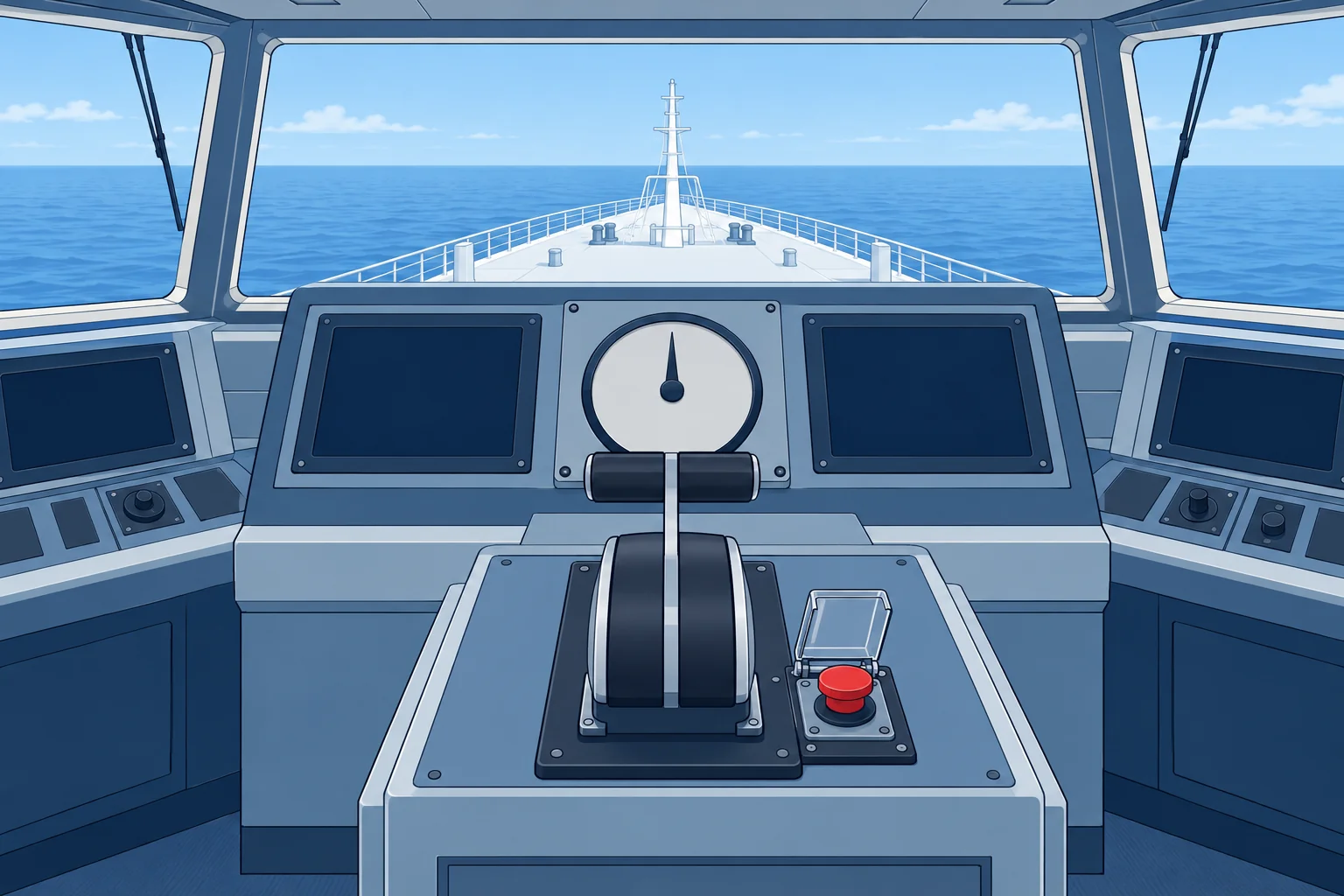
Bridge control of the main engine
1The lesson in plain words
On most ships the bridge runs the main engine with one lever. Know what that lever does for you, what it will not do, and how to hand control back.
Who controls the engine
SOLAS II-1/49 asks that, under all sailing conditions, the speed, the direction of thrust and, with a controllable-pitch propeller (CPP), the pitch can be fully controlled from the bridge. One control lever per independent propeller does the rest automatically: starting air, fuel, reversing, and limits that prevent overload. Control can also be in the engine control room (ECR) or at the local control stand on the engine itself.
One place at a time
Only one location controls the engine at a time, and each shows which one it is. Transfer between the bridge and the machinery spaces is made in the machinery space or the ECR, with the receiving side accepting. The system must stop the thrust changing much at the moment of transfer, so match lever positions and agree by phone before you change over.
Indicators and the emergency stop
The bridge shows propeller speed and direction of rotation (fixed pitch), or speed and pitch (CPP). An emergency stop on the bridge works independently of the bridge control system. Know where it is and what it does: it stops the engine, not the ship. Bridge orders are also shown in the ECR or at the local stand.
Load programme and limits
The control system protects the engine. A load programme raises power slowly above a set level, for example when going from manoeuvring to sea speed. Barred speed ranges, where shaft vibration is dangerous, are passed through quickly and not used for steady running. The number of automatic start attempts is limited to save starting air, and an alarm warns of low starting-air pressure while starts are still possible.
When remote control fails
A failure of the bridge control system gives an alarm. Where practicable the last speed and direction are kept until local control takes over. Orders then go by the engine telegraph or a second independent means of communication to the ECR or the local stand. Practise this changeover in port and in drills, not for the first time at a pilot station.
2Key data
- Bridge control (SOLAS II-1/49)
- Speed, thrust direction and pitch from the bridge
- Control locations
- One at a time; transfer made in the machinery space or ECR
- Emergency stop
- On the bridge, independent of the bridge control system
- Bridge indicators
- Shaft speed and direction, or speed and pitch (CPP)
3Key points
- 1
One lever per propeller; the system handles starting, reversing and overload limits.
- 2
Only one location controls at a time; transfer is made from the machinery space or ECR.
- 3
The bridge emergency stop is independent of the remote control system.
- 4
Repeated failed starts empty the air bottles; tell the engine room at once.
4Frequent mistakes
Wrong: Keep trying to start the engine from the bridge until it fires.
Right: Each failed start uses starting air. After a failed start, call the engine room and agree what to do.
Wrong: Hold the engine at any revolutions the passage plan needs.
Right: Avoid steady running in a barred speed range. Choose revolutions above or below it.
5Practice case & exam keys
Approaching the pilot station, the bridge control alarm sounds and the main engine no longer answers the bridge lever. The engine is still running at the last setting, half ahead. The pilot is 2 miles away and there is traffic around.
Show the answer
Call the master and engine room at once. Ask engineers to take control in the ECR or at the local stand; pass orders by telegraph and phone. Keep steering and use available control to avoid traffic. Warn the pilot and vessel traffic service (VTS). Do not take the pilot on board until engine control is confirmed. Record times and actions, and preserve voyage data recorder (VDR) data.
Exam keys
- SOLAS II-1/49 bridge control requirements.
- Transfer of control and indication of the controlling location.
- Independent emergency stop on the bridge.
- Load programme, barred speed ranges and starting-air limits.
Finish this unit
When you've read it, answer three questions. Get all three right to finish the unit; opening the page alone doesn't count.
My notes for this unit
No notes