

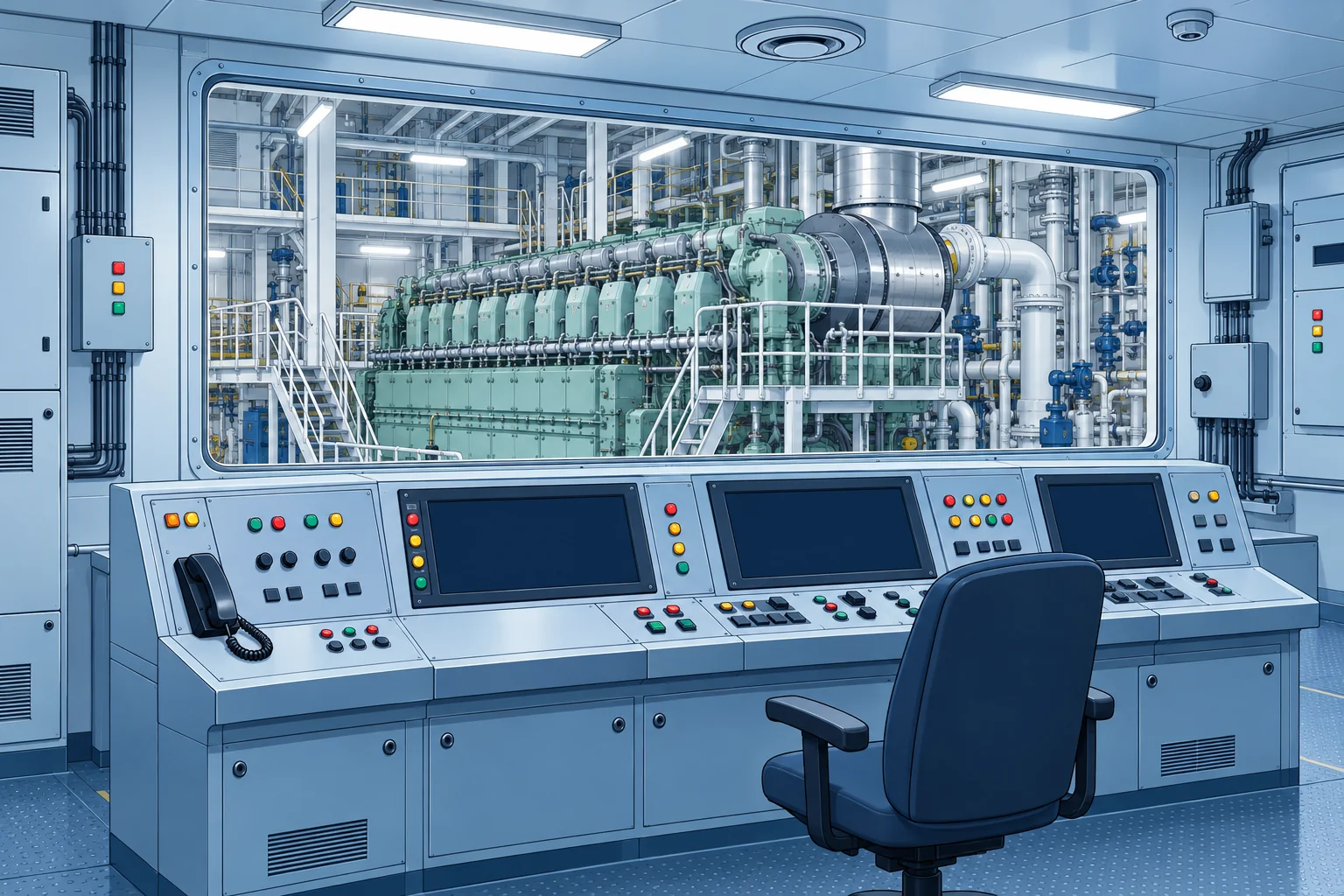
Unattended machinery spaces and the bridge watch
1The lesson in plain words
When machinery spaces are unattended, know which alarms reach the bridge, how to contact the duty engineer and when to request a manned engine room.
What UMS means
A ship with periodically unattended machinery spaces (UMS) may leave the engine room empty, usually at night. SOLAS II-1 Part E allows this only if the ship is as safe as with a manned engine room: early fire detection, bilge level alarms, automatic control of essential machinery and a full alarm system. Class confirms it with a notation, such as UMS or E0 depending on the society.
The alarm chain
A fault sounds and shows in the ECR and, through a selector switch, in the duty engineer's cabin and the engineers' public rooms. If nobody accepts it locally within a set time, the engineers' alarm sounds. Faults that need the attention of the officer of the watch (OOW) also sound on the bridge. Know which these are and what each asks of you: often it is only to call the duty engineer.
The bridge's part
Know who the duty engineer is and how to reach them at any time. An engineer going into the engine room alone reports to the bridge, and on most ships sets a dead-man alarm that must be reset at intervals. If it is not reset, the alarm sounds and you start the search and the response set out in the safety management system (SMS).
When to man the engine room
Standing orders say when UMS stops: arrival and departure, manoeuvring, narrow channels, restricted visibility, heavy traffic, heavy weather, and any persistent alarm on essential machinery. Ask for the engine room to be manned early. Engineers need time to get there and to start extra generators.
Slowdown, shutdown and override
Serious faults can trigger automatic slowdown (reduced load) or shutdown (stopping machinery), with an alarm. Automatic propulsion shutdown protects against serious damage, complete breakdown or explosion. An override bypasses only designated protections; some cannot be overridden. It must resist accidental operation and show when active. If slowing or stopping would create greater danger, the master and chief engineer assess the fitted override under shipboard procedures. It cannot cure the fault and risks machinery damage without guaranteeing continued propulsion.
2Key points
- 1
UMS needs fire detection, bilge alarms, automatic control and an alarm system; class confirms it.
- 2
Unaccepted alarms escalate to the engineers' alarm; some also sound on the bridge.
- 3
Know the duty engineer; engineers alone in the engine room use the dead-man alarm.
- 4
Ask for the engine room to be manned early: arrival, narrow waters, poor visibility, alarms.
3Frequent mistakes
Wrong: An engine alarm on the bridge panel is the engineers' problem; accept it and carry on.
Right: Acknowledge it, call the duty engineer and make sure someone answers. Log the time.
Wrong: Override a slowdown whenever the passage is late.
Right: An override bypasses only designated protections and may damage machinery without preserving propulsion. The master and chief engineer weigh navigational danger under shipboard procedures.
4Practice case & exam keys
At 02:30 in UMS mode, high cooling-water temperature causes a main-engine slowdown. You have clear sea room. The duty engineer reported entering the machinery space alone. Their dead-man alarm sounds for an overdue reset, and they do not answer repeated calls. What do you do?
Show the answer
Treat this as a possible casualty. Escalate immediately under the SMS; call the master and chief engineer. Arrange a properly equipped response team following safe-entry procedures; do not send anyone alone. Keep the bridge watch and let the slowdown protect the engine while sea room allows. Maintain contact with the team, arrange engineering response and log times.
Exam keys
- UMS: what SOLAS Part E requires.
- Alarm system, selector switch and engineers' alarm.
- Dead-man alarm and the bridge's role.
- Slowdown, shutdown and override.
Finish this unit
When you've read it, answer three questions. Get all three right to finish the unit; opening the page alone doesn't count.
My notes for this unit
No notes