

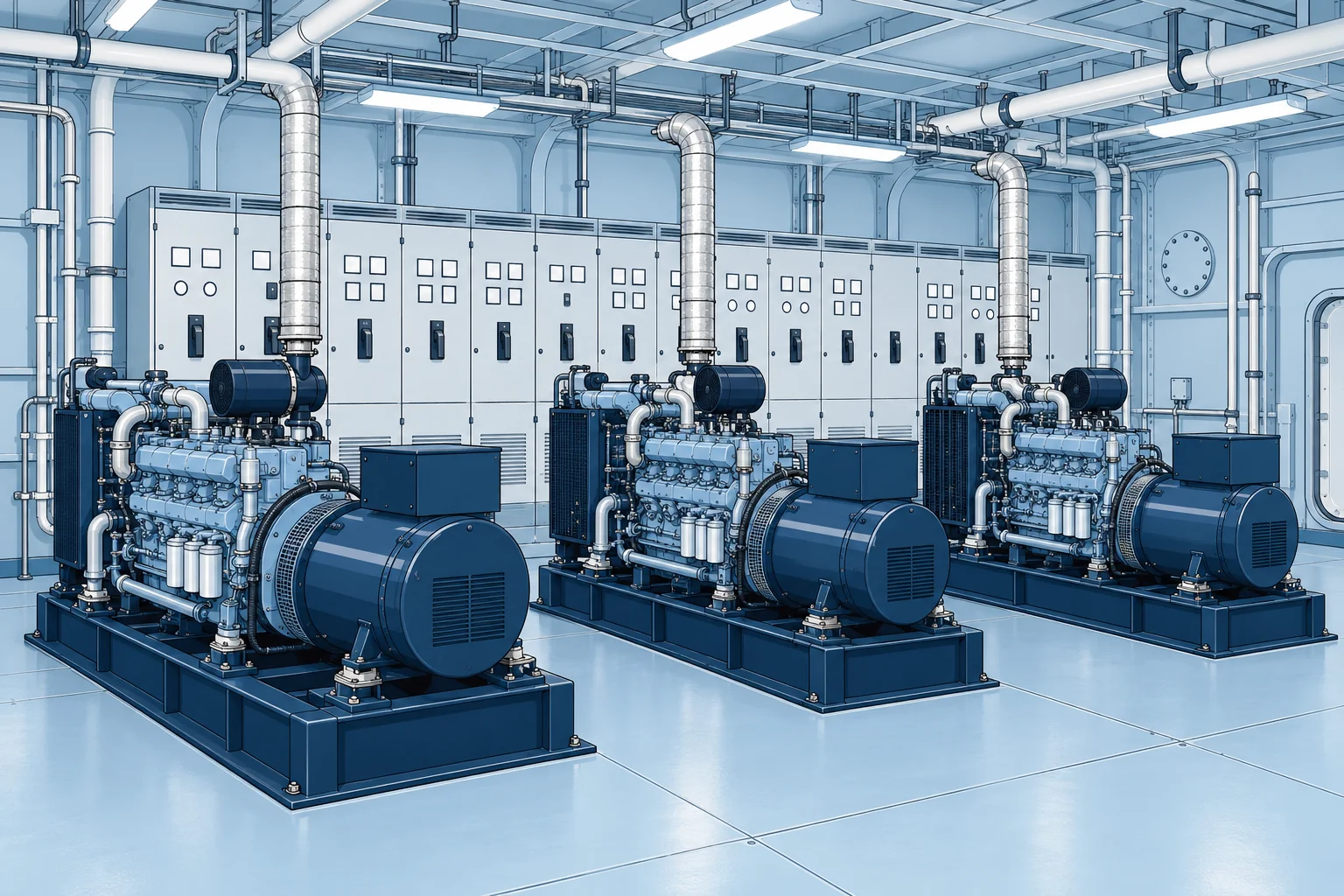
Generators, power management and the emergency switchboard
1The lesson in plain words
Propulsion and steering need electricity. Know how the plant keeps power on, what it drops first, and what the emergency generator will and will not run.
The main source
Diesel generators, and on many ships a shaft generator driven by the main engine, feed the main switchboard. A power management system starts and connects a standby generator when the load rises or a running set fails, and shares the load between sets. In UMS ships, if one generator normally carries the load, a standby set must start and connect automatically when it is lost.
Preferential tripping
On overload, preferential trips switch off non-essential consumers in stages, such as galley, air conditioning and some cargo services, so the remaining generators can keep propulsion, steering and safety. Big consumers like bow thrusters often need a second generator first. Request power before you start them and wait for the ready signal.
The emergency source
The emergency generator is above the uppermost continuous deck, with independent access and separation from the main plant. In the automatic emergency-generator arrangement, it starts and connects to the emergency switchboard within 45 seconds after main supply failure. Normal endurance for specified emergency services is 18 hours on cargo ships and 36 hours on passenger ships. Services include lighting, radio and an electrically driven emergency fire pump, where supplied from that board. Passenger ships also have a battery transitional source for 30 minutes.
Steering power
Electric steering power units use separate circuits. One may pass through the emergency switchboard. If the required rudder-stock diameter at the tiller exceeds 230 mm, excluding ice strengthening, an alternative source must connect automatically within 45 seconds. This may be the emergency source or an independent source in the steering compartment. Minimum endurance is 30 minutes at 10,000 gross tonnage (GT) and above, otherwise 10 minutes. It supplies a power unit, its controls and rudder-angle indication.
Alternative-supply performance
On that alternative supply, at the deepest seagoing draught, the gear must move the rudder from 15° on one side to 15° on the other within 60 seconds, at half maximum ahead service speed or 7 knots, whichever is greater.
Shaft generators and manoeuvring
A shaft generator is cheap power at sea speed. It may drop out when the engine slows, stops or reverses. Company orders usually require diesel generators running, often two in parallel, before manoeuvring and in confined waters.
2Key data
- Automatic emergency-generator arrangement
- On load within 45 s after main supply failure
- Normal endurance: specified emergency services
- Cargo ships 18 h; passenger ships 36 h
- Transitional source (passenger)
- Batteries for 30 min
- Required rudder stock > 230 mm at tiller, excluding ice strengthening
- Alternative supply: 45 s; ≥ 10,000 GT: 30 min; otherwise 10 min
- Steering: deepest seagoing draught; half maximum ahead service speed or 7 knots, whichever is greater
- 15° one side to 15° the other within 60 s
3Key points
- 1
The power management system starts standby sets and shares the load.
- 2
Preferential trips drop non-essential loads to keep propulsion and steering.
- 3
Automatic emergency generator: on load within 45 s; normal endurance for specified services: cargo 18 h / passenger 36 h.
- 4
Run diesel generators before manoeuvring; shaft generators can drop out.
4Frequent mistakes
Wrong: Start the bow thruster as soon as you need it.
Right: Request power first. Starting a big consumer on one generator can trip the board.
Wrong: The emergency generator runs the whole ship during a blackout.
Right: It feeds only the emergency switchboard: emergency lights, navigation lights, radio, alarms and a few essential services.
5Practice case & exam keys
Your ship runs on the shaft generator at sea speed. Two hours before arriving at a river entrance you plan to reduce speed, then use the bow thruster at the berth. What do you arrange with the engine room?
Show the answer
Ask the engineers to arrange the diesel generating capacity and standby readiness required by the ship's procedures before reducing speed, because the shaft generator may drop out as the engine slows. Confirm when they are on load. Before using the bow thruster, request power and wait for the ready signal. Agree when the engine room will be manned, and test the engine and steering before entering the river.
Exam keys
- Power management, standby start and preferential trips.
- Automatic emergency-generator arrangement: position, 45 s; specified services normally 18 h cargo / 36 h passenger.
- Steering alternative supply: required stock > 230 mm excluding ice strengthening; 45 s, 30 or 10 min; test conditions.
- Shaft generators and manoeuvring.
Finish this unit
When you've read it, answer three questions. Get all three right to finish the unit; opening the page alone doesn't count.
My notes for this unit
No notes