

Dangerous goods: the IMDG classes, labels, placards and marks
1The lesson in plain words
The IMDG Code sorts dangerous cargo into nine classes. Labels, placards and marks tell you the hazard at a glance.
The IMDG Code
The International Maritime Dangerous Goods (IMDG) Code sets how dangerous goods are packed, marked, stowed and documented when carried as cargo by sea. It is mandatory under SOLAS chapter VII. It is updated every two years; Amendment 42-24 became mandatory on 1 January 2026. The ship’s own paints and gases are ship’s stores, not IMDG cargo, but their labels still warn of the hazard.
Explosives
Class 1 has six divisions: 1.1, mass explosion; 1.2, flying fragments without mass explosion; 1.3, fire with minor blast or fragments, without mass explosion; 1.4, small hazard, mainly confined to the package; 1.5, very insensitive substances with mass-explosion hazard; 1.6, extremely insensitive articles without mass-explosion hazard.
Other classes
2 gases: 2.1 flammable, 2.2 non-flammable/non-toxic, 2.3 toxic. 3 flammable liquids. 4.1 flammable solids, self-reactive substances, solid desensitized explosives and polymerizing substances; 4.2 liable to spontaneous combustion; 4.3 release flammable gas when wet. 5.1 oxidizers, which make fires burn more fiercely; 5.2 organic peroxides, which can burn or decompose violently. 6.1 toxic; 6.2 infectious, carrying disease-causing organisms. 7 radioactive. 8 corrosive, damaging skin and materials. 9 miscellaneous, including lithium batteries.
Labels and placards
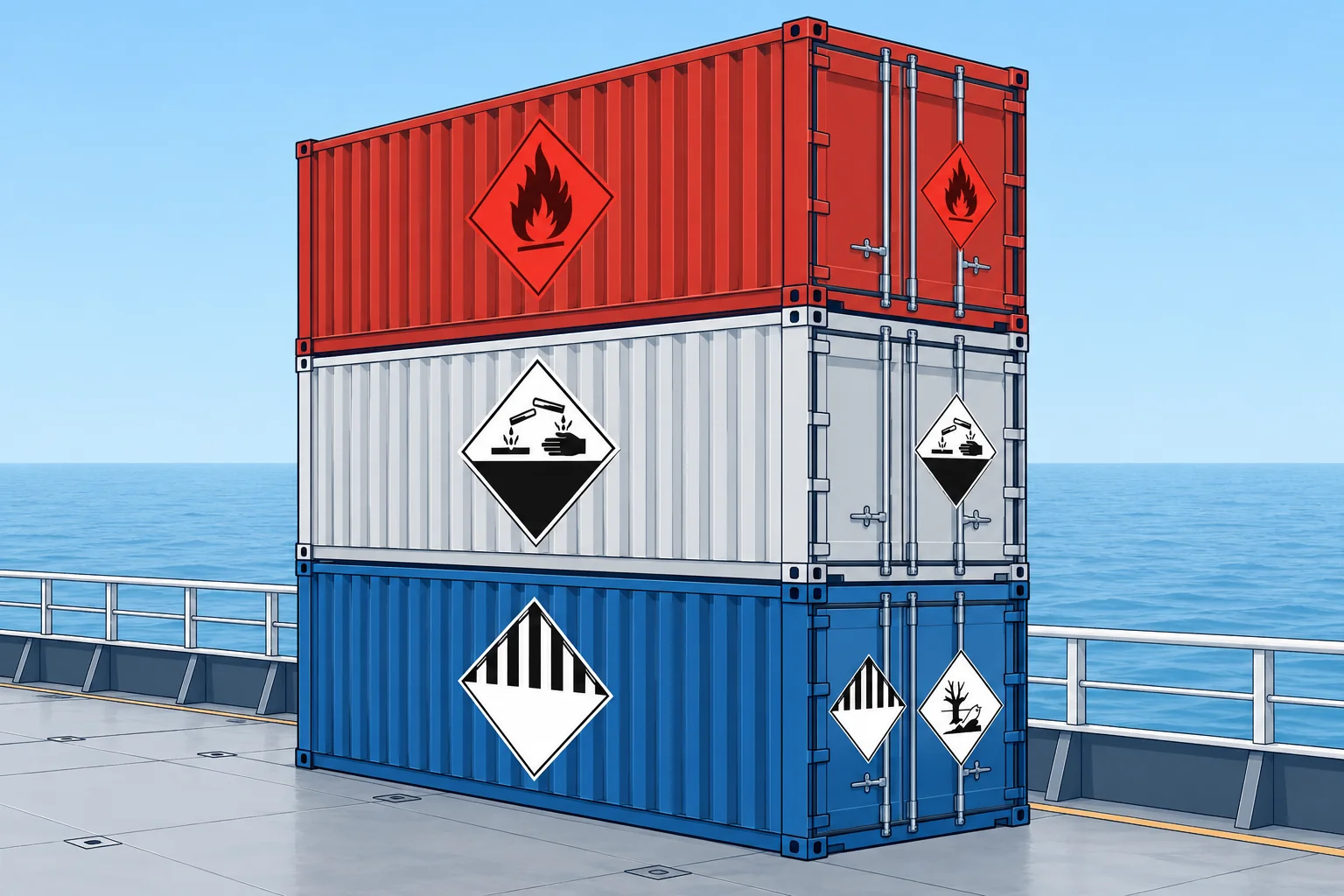
Where diamond-shaped hazard labels are required on packages, their normal minimum size is 100 mm × 100 mm. Reduced labels are permitted on some small packages under the Code. A placard is a large diamond-shaped hazard sign, at least 250 mm × 250 mm, on a cargo transport unit such as a container or tank. Where required, containers carry placards on both sides and both ends, often with the four-digit UN number that identifies the substance.
Special marks
The marine pollutant mark is a diamond showing a dead fish and a tree: the goods harm the sea. The limited quantity mark is a diamond with black top and bottom and a white middle: dangerous goods in small inner packagings, carried under relaxed rules.
What you do
Report any leaking or damaged package or container, missing placards or a strange smell, and keep upwind and clear. Never smoke near dangerous cargo. The officer uses the EmS Guide, the IMDG emergency schedules, coded F for fire and S for spillage, to decide the response.
2Key data
- Current IMDG Code
- Amendment 42-24, mandatory from 1 January 2026
- Package label
- Diamond, normally at least 100 mm × 100 mm
- Placard
- At least 250 mm × 250 mm, on containers, tanks and vehicles
- UN number
- Four digits identifying the substance
- EmS schedules
- F-codes for fire, S-codes for spillage
3Key points
- 1
The IMDG Code covers dangerous goods as cargo; Amendment 42-24 is mandatory from 1 January 2026.
- 2
Recognise the nine classes and their divisions; classes 1, 2, 4, 5 and 6 have numbered divisions.
- 3
Package labels are normally ≥ 100 mm; placards ≥ 250 mm go on containers and tanks.
- 4
Marine pollutant: dead fish and tree. Limited quantity: black top and bottom, white middle.
- 5
Report leaks or damage, keep upwind and clear; the officer uses the EmS Guide.
4Frequent mistakes
Wrong: The number in the bottom corner of a label is the UN number.
Right: The bottom corner shows the class or division. The UN number is a separate four-digit number identifying the substance.
Wrong: A limited quantity mark means the goods are not dangerous at all.
Right: They are dangerous goods in small packagings, carried under relaxed rules. Handle them with care and report damage.
5Practice case & exam keys
On a container round you see a container with a class 8 placard. Liquid is dripping from the bottom of its door and there is a sharp smell. A marine pollutant mark is fitted beside the placard.
Show the answer
Keep clear, move upwind and warn others away; do not touch the liquid. Report to the officer of the watch the container position, the class 8 corrosive placard, the marine pollutant mark and any UN number you can read from a distance. The officer uses the EmS spillage schedule to decide the response. Stay clear until instructed that it is safe.
Exam keys
- IMDG Code: dangerous goods as cargo, mandatory under SOLAS VII; Amendment 42-24 mandatory 1 Jan 2026.
- Nine classes; class number at the bottom corner of the label or placard.
- Package labels normally ≥ 100 mm; placards ≥ 250 mm on cargo transport units, where required, on both sides and both ends of containers.
- Marine pollutant mark: fish and tree. Limited quantity mark: black top and bottom. EmS: F fire, S spillage.
Finish this unit
When you've read it, answer three questions. Get all three right to finish the unit; opening the page alone doesn't count.
My notes for this unit
No notes