

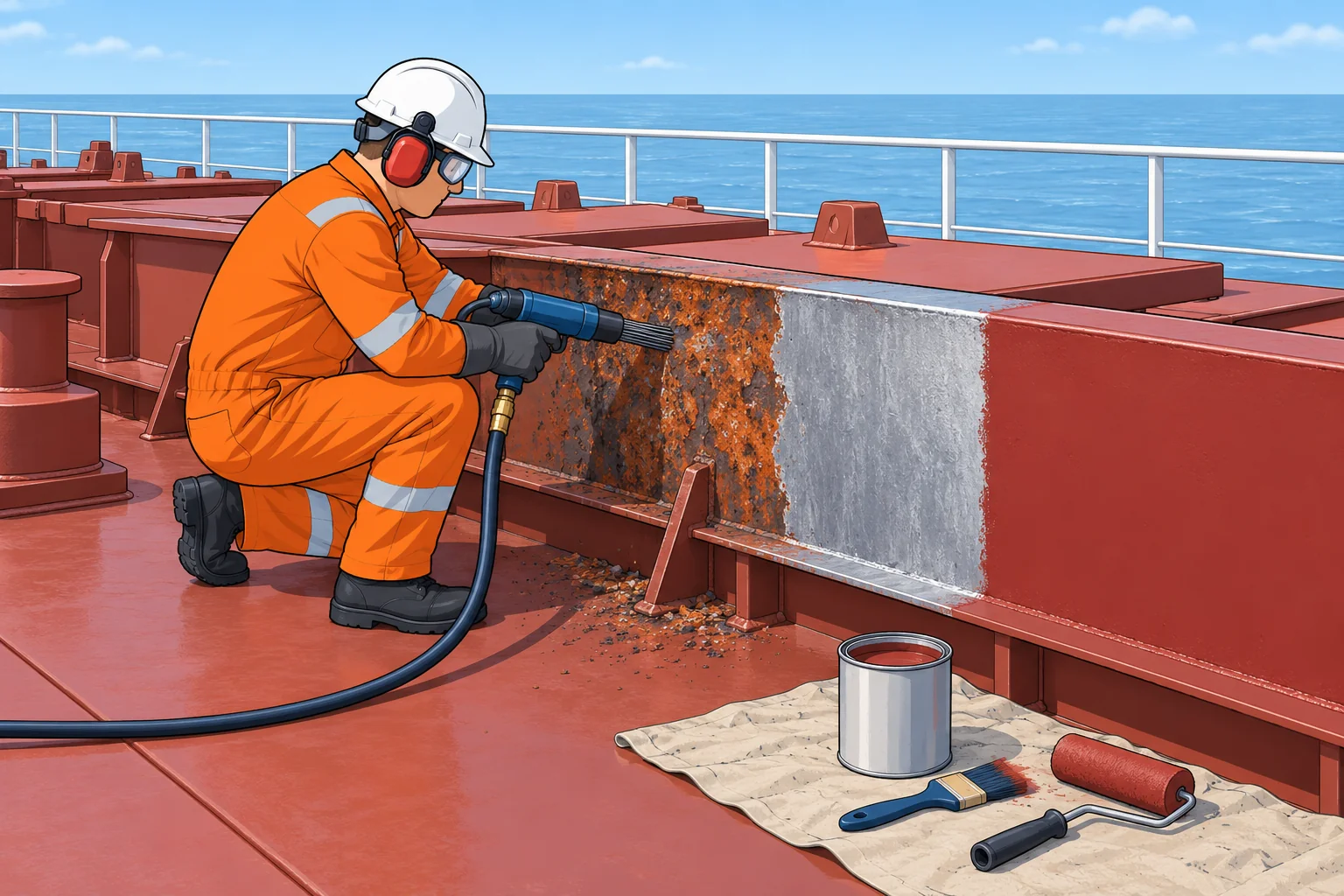
Painting: rust grades, surface preparation, coats and safety
1The lesson in plain words
Paint lasts only as long as the surface under it is prepared. Follow the data sheet, watch the weather, and treat solvents as a fire and health hazard.
Why prepare
Paint protects steel only if it sticks to clean, dry, sound metal. Most failures come from poor surface preparation: rust, salt, grease or loose old paint left underneath. Wash off salt with fresh water and remove grease with a degreaser before you start.
Rust grades
ISO 8501-1 describes uncoated steel. Mill scale is the hard oxide layer left by hot rolling. Pitting means small hollows caused by corrosion. A: mostly intact mill scale, little rust. B: rust starts and scale begins flaking. C: scale rusted away or removable, slight pitting visible. D: scale gone, general pitting.
Preparation grades
St 2 means thorough hand or power-tool cleaning; St 3 is very thorough, leaving a metallic sheen. Sa 1 is light blasting; Sa 2, thorough; Sa 2½, very thorough, with only slight stains remaining; Sa 3, visually clean steel. Follow the coating’s technical data sheet.
Tools
A wire brush or scraper removes loose rust. A needle gun, many steel needles driven by air, chips heavy rust and scale. Power discs and grinders clean smaller areas. Abrasive blasting gives the best surface, usually done by contractors. Needle guns and grinders cause hand-arm vibration; take breaks and follow the ship’s limits.
Coats and timing
Apply the primer, the first protective coat, before rust returns. Follow with the specified coats. The technical data sheet (TDS) gives minimum and maximum overcoating intervals between coats: too soon traps solvent; too late may weaken bonding. The dew point is the temperature at which moisture condenses. Keep dry steel at least 3 °C above it, with humidity within the TDS limit, often 85 %.
Health and fire
Wear goggles, gloves, overalls and hearing protection for noisy tools. Use the safety data sheet (SDS) and task assessment to choose breathing protection for dust and solvent vapour. Solvent vapour is toxic and flammable: ventilate; keep smoking and hot work away. Store paints and thinners in the paint locker, which has fire protection. For aloft, overside and enclosed-space work, see Ropes: deck safety.
2Key data
- Rust grades (ISO 8501-1)
- A (little rust) to D (general pitting)
- Preparation grades
- St 2, St 3 by hand or power tool; Sa 2½ near-white blast
- Weather limit
- Steel ≥ 3 °C above dew point; humidity often ≤ 85 %
- Overcoating
- Within the data sheet’s minimum–maximum interval
3Key points
- 1
Most paint failures come from poor surface preparation: salt, grease, rust or loose paint left under.
- 2
Rust grades A–D; preparation St 2/St 3 by tool, Sa 2½ by blasting.
- 3
Prime soon after preparation; respect the overcoating window on the data sheet.
- 4
Paint only on dry steel at least 3 °C above the dew point.
- 5
Solvents are toxic and flammable: ventilate, PPE, no hot work nearby; paint locker for storage.
4Frequent mistakes
Wrong: Paint straight over rust scale; the new coat will seal it in.
Right: Remove loose rust and scale and clean to the grade the data sheet asks for. Paint over rust soon flakes off.
Wrong: The deck looks dry at dawn, so it is fine to start painting.
Right: Check steel temperature and dew point. Require the data sheet’s margin, usually at least 3 °C, and a dry surface.
Wrong: Leave the second coat for a week to let the first coat harden well.
Right: Follow the data sheet’s maximum overcoating interval; past it, the next coat may not bond without extra preparation.
5Practice case & exam keys
The bosun asks you to touch up rust spots on a raised steel rim around a hatch at 0700. Overnight the air was humid; the steel is cold and the dew point is 14 °C. A surface thermometer reads 15 °C on the steel.
Show the answer
The 1 °C margin is too small. At the current 14 °C dew point, wait for steel at least 17 °C and check all other TDS conditions. Prepare the spots: wash off salt and remove loose rust with a wire brush or needle gun, using the eye, hearing, skin and dust protection selected for the task. Apply primer once conditions meet the TDS.
Exam keys
- Surface preparation decides paint life: fresh-water wash, degrease, remove rust and loose paint.
- ISO 8501-1: rust grades A–D; St 2/St 3 hand or power tool; Sa 2½ blast cleaning.
- Primer soon after preparation; overcoating within the data sheet’s minimum and maximum intervals.
- Steel ≥ 3 °C above dew point; PPE, ventilation, no hot work; paint locker.
Finish this unit
When you've read it, answer three questions. Get all three right to finish the unit; opening the page alone doesn't count.
My notes for this unit
No notes