

Planned maintenance, defect reports, tools and waste on board
1The lesson in plain words
The planned maintenance system says what is due; you do the job safely, record it and report defects. Sort waste as the ship’s plan says.
Planned maintenance
The ship’s planned maintenance system (PMS), paper or software, lists each job, its interval in days or running hours, and how to do it. You do the job you are given, safely, and the officer records it. Spare parts used are recorded too.
Report defects
Report anything broken, leaking, worn or missing to the officer or bosun, even if you think someone already knows: a defect not reported is not fixed. Say what, where and since when. Defects in safety equipment, steering, mooring gear, watertight doors or lifting gear are reported at once.
Hand and power tools
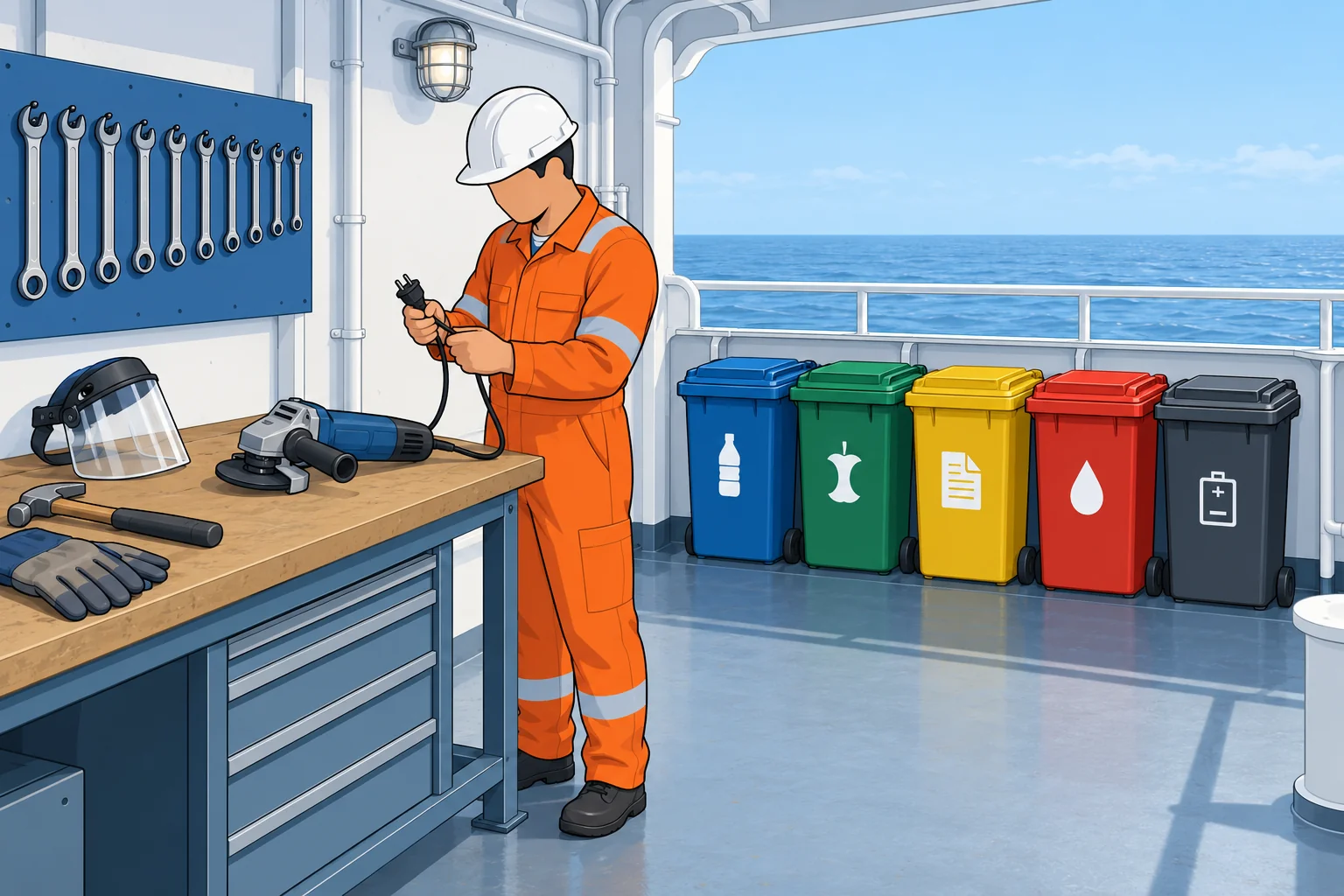
Check for cracked handles, loose heads or damaged cables. Keep grinder guards on. Use the correct disc type and size, rated for at least the grinder’s maximum speed. Only trained, authorised people should fit discs. Wear impact-rated goggles and a face shield for grinding, plus suitable gloves and hearing protection. Disconnect power before changing discs or bits. Never point compressed air at a person.
Waste on board
MARPOL Annex V is the ship-garbage part of the international pollution convention. Sort waste at source using the ship’s bins. Keep plastics, food, domestic waste, cooking oil, incinerator ash, operational waste, animal carcasses, fishing gear and e-waste separate where applicable. Cargo residues harmful to the marine environment are separate from other cargo residues. Put paint waste, thinners, oily rags and batteries in designated separate containers for shore disposal. Discharge rules are in Ocean: pollution.
2Key points
- 1
The PMS lists jobs, intervals and methods; work done and parts used are recorded.
- 2
Report every defect: what, where, since when. Safety-critical defects at once.
- 3
Check tools and guards; use the correct disc type and size, rated for at least the grinder’s maximum speed.
- 4
Disconnect power before changing discs or bits; never aim compressed air at anyone.
- 5
Sort garbage by the ship’s MARPOL Annex V categories; paints, oily rags and batteries separate.
3Frequent mistakes
Wrong: Take the guard off the grinder to reach a tight corner.
Right: Never remove the guard. Use a smaller tool or another method, and wear eye and face protection.
Wrong: Do not report a small defect; someone else will have seen it.
Right: Report it. Defects not reported are not fixed, and small ones grow.
Wrong: Plastic food wrappers can go in the food waste bin with the leftovers.
Right: Plastics go in their own bin. Food waste mixed with plastic cannot be treated as food waste.
4Practice case & exam keys
You are given a grinder to clean a rusty bracket. The disc fitted is marked for a lower speed than the grinder’s rating, the cable has tape round a cut, and the guard is loose.
Show the answer
Do not use it. An underrated disc can burst, a taped cable can give a shock, and a loose guard will not protect you. Report all three faults to the bosun or officer. Use a sound grinder with a compatible disc of the correct type, size and speed rating. Only trained, authorised people should fit discs, with power disconnected. Wear impact-rated goggles and a face shield, plus suitable gloves and hearing protection.
Exam keys
- PMS: jobs, intervals (time or running hours), methods; records of work and parts.
- Report defects at once: what, where, since when.
- Tools: guards on; correct disc type, size and speed rating; authorised fitting with power off; no compressed air at people.
- Garbage sorted by MARPOL Annex V categories; paint, oily rags and batteries separate; rules in Ocean: pollution.
Finish this unit
When you've read it, answer three questions. Get all three right to finish the unit; opening the page alone doesn't count.
My notes for this unit
No notes