

Docking stability: the upthrust P and the critical instant, worked
1The lesson in plain words
Calculate block reaction P and the GM margin at the critical instant. Use the approved docking condition and dockmaster’s limits.
Where P comes from
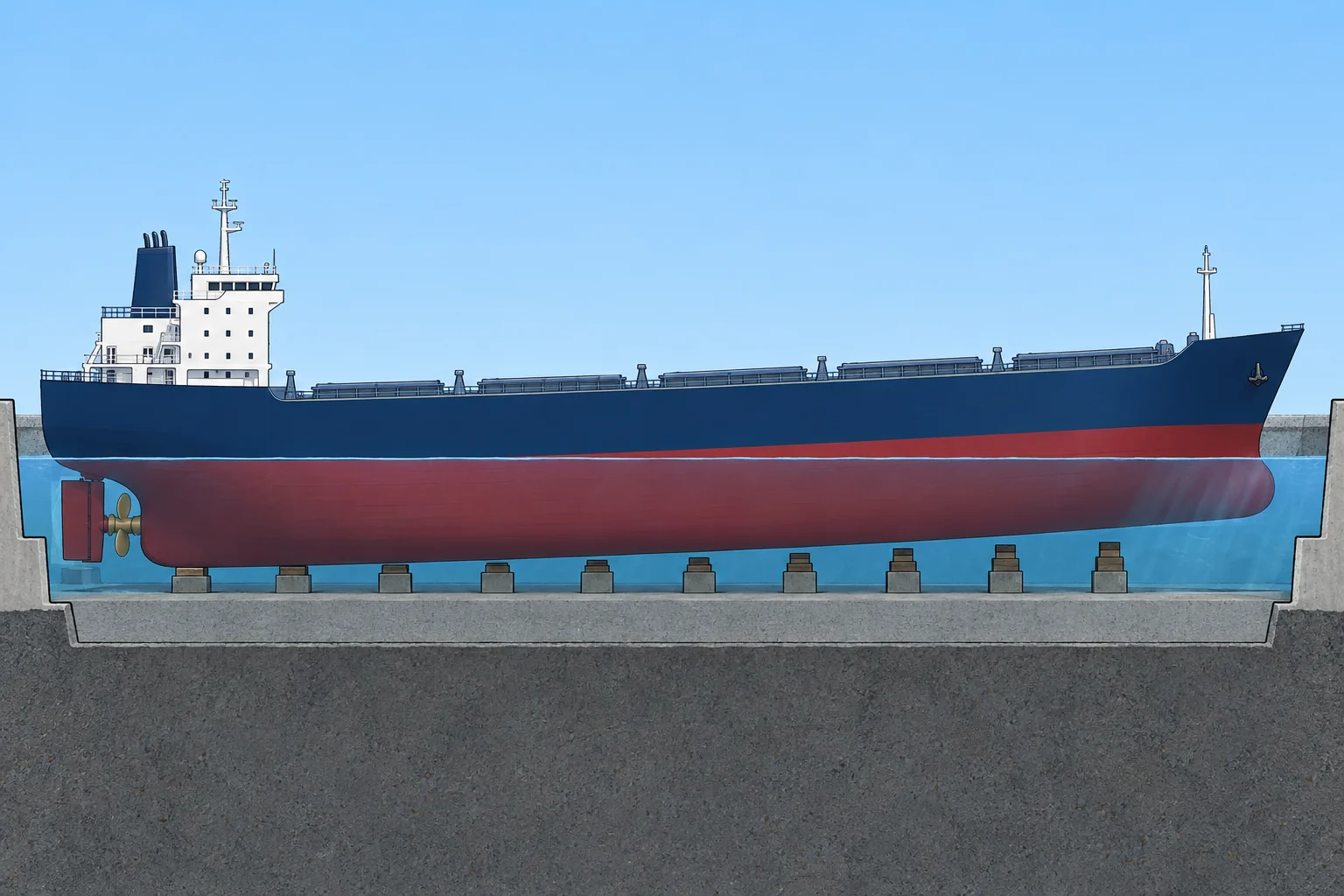
A stern-trimmed ship touches the after blocks first. As water falls, their upward reaction P removes her trim. The critical instant is just before the rest of the keel lands: P is greatest during this stern-only support. Trimming moments balance: P × l = MCTC × t. MCTC is the moment to change trim by 1 cm; t is trim removed in cm; l runs from the centre of flotation (LCF) to the after block.
Why GM falls
For small heel and fixed KM, P reduces the righting moment. Let Δ be displacement in tonnes. Method 1 subtracts P × KM ÷ Δ from starting GM, using full displacement Δ. Method 2 subtracts P × KG ÷ (Δ − P), using remaining buoyancy Δ − P. Their GM values differ but describe the same righting moment: Δ × GM₁ = (Δ − P) × GM₂. Both predict the same zero stability. State which basis defines the required minimum.
Worked example
Δ = 9,000 t; stern trim 60 cm; MCTC 150 t·m/cm; l = 72 m; KM 8.40 m; KG 7.60 m; GM 0.80 m. At the critical instant, P = 150 × 60 ÷ 72 = 125 t. Method 1: GM₁ = 0.80 − 125 × 8.40 ÷ 9,000 = 0.68 m. Method 2: GM₂ = 0.80 − 125 × 7.60 ÷ 8,875 = 0.69 m. Positive GM alone does not approve docking.
Illustrative trim limit
Using method 1, suppose the required GM₁ is at least 0.30 m at the critical instant. Allowed loss = 0.80 − 0.30 = 0.50 m. Maximum P = 0.50 × 9,000 ÷ 8.40 = 536 t. Maximum trim = 536 × 72 ÷ 150 = 257 cm, about 2.6 m by the stern. This constant-hydrostatics result is an exercise; operational trim must meet approved docking calculations and dockmaster’s limits.
Reducing the risk
Keep trim small, tanks full or empty to limit free surface, and heavy weights low. Set side blocks or shores in the sequence agreed with the dockmaster and approved docking plan; agree every ballast change. For stern-trimmed undocking, the critical stage is when the forward keel lifts and support reduces to the after blocks. P then decreases towards zero as the stern lifts clear.
2Step by step
Checking GM at the critical instant
- 1
Take Δ, trim, MCTC, LCF, KM and KG from the approved docking condition, allowing for free surface.
The answer is only as good as the condition it starts from.
- 2
Find l: the distance from the LCF to the after block where she will land.
P acts there, so l sets the size of P.
- 3
Calculate P = MCTC × t ÷ l with t in cm.
At the critical instant the whole trim has been removed by the block.
- 4
Using method 1, calculate GM₁ = starting GM − P × KM ÷ Δ.
This GM uses the original-displacement basis; method 2 uses remaining buoyancy.
- 5
Compare GM₁ with the minimum specified on the method-1 basis and check approved docking limits.
If it is too small, agree a revised condition before docking. Positive GM alone does not approve docking.
3Key data
- Upthrust
- P = MCTC × t ÷ l (t in cm, l from LCF to the after block)
- GM loss, method 1: original displacement
- P × KM ÷ Δ
- GM loss / virtual rise of G, method 2: remaining buoyancy
- P × KG ÷ (Δ − P)
- Worked example
- P = 125 t; GM₁ = 0.68 m; GM₂ = 0.69 m
4Key points
- 1
The block's upthrust P removes the trim: P × l = MCTC × t.
- 2
Method 1 loses P × KM ÷ Δ; method 2 loses P × KG ÷ (Δ − P). Use the basis specified for the minimum.
- 3
The critical instant is when the whole trim has gone, just before the keel lands fully.
- 4
Small trim limits P; low G and limited free surface improve the remaining stability margin.
5Frequent mistakes
Wrong: Measure l from midships to the after block.
Right: The ship trims about the centre of flotation, so l is measured from the LCF.
Wrong: Free surface does not matter once she sits on the blocks.
Right: Free surface reduces GM until she is fully landed, adding to the loss caused by P.
6Practice case & exam keys
A ship of Δ 6,000 t trims 0.90 m by the stern. MCTC is 80 t·m/cm, l is 50 m, KM 7.00 m and KG 6.40 m. The required minimum GM₁, using method 1, is 0.45 m. Does this condition meet the minimum for docking?
Show the answer
P = 80 × 90 ÷ 50 = 144 t. Starting GM = 7.00 − 6.40 = 0.60 m. GM₁ = 0.60 − 144 × 7.00 ÷ 6,000 = 0.432 m, below 0.45 m. Do not proceed in this condition. Agree a revised condition, such as stern trim of about 0.80 m or less using these fixed inputs, then confirm approved docking calculations and dockmaster’s limits.
Exam keys
- P = MCTC × t ÷ l with l measured from the LCF.
- GM loss by two methods: different force bases, same righting moment.
- Illustrative maximum trim for a specified minimum GM₁ using method 1.
- Stern-trimmed undocking: critical as the forward keel lifts; P then falls to zero as the stern lifts clear.
Finish this unit
When you've read it, answer three questions. Get all three right to finish the unit; opening the page alone doesn't count.
My notes for this unit
No notes