

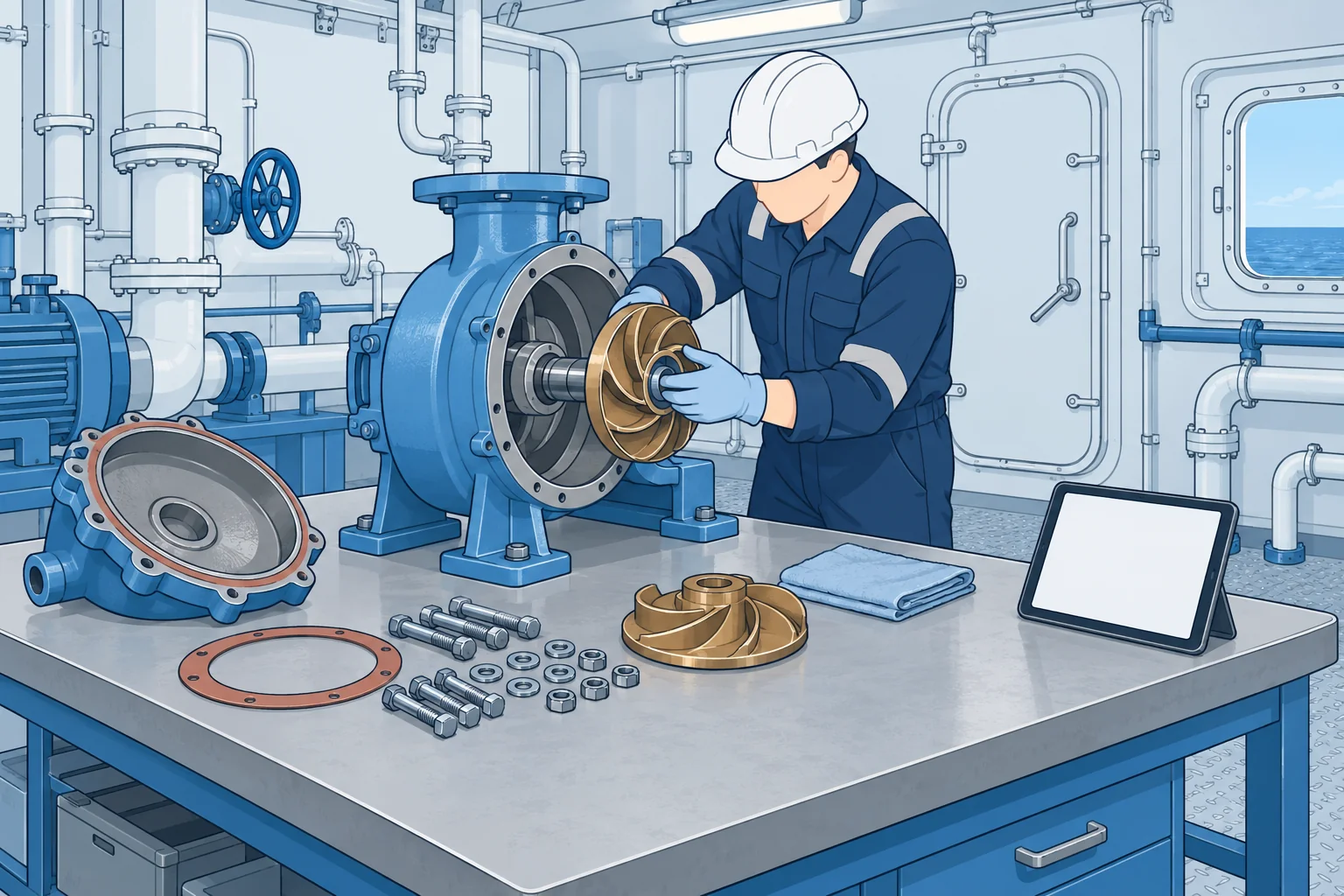
Planned maintenance and critical equipment (ISM Code section 10)
1The lesson in plain words
Maintenance is a system, not a habit. The ISM Code asks for planned work, records, reports of every defect and regular tests of the equipment you cannot do without.
What ISM asks
Section 10 of the ISM Code requires the company to keep the ship maintained to the rules and its own requirements. Inspect at set intervals. Report each non-conformity (failure to meet a requirement), with its possible cause, if known. Take corrective action and keep records. It also asks the company to identify critical equipment, whose sudden failure could cause a hazardous situation, and to test it regularly, including stand-by items not in continuous use. The ISM system as a whole is taught in Safety management (law).
The planned maintenance system
A planned maintenance system lists every item with its jobs, its intervals by calendar or running hours, the maker's instructions and the spare parts. The software issues work orders. The crew does the job and records what was found, not just that it was done. Class can accept an approved system for the continuous survey of machinery, with the chief engineer crediting items and the surveyor auditing them each year.
Three strategies
Corrective maintenance repairs a detected fault, even before complete failure. Deliberate run-to-failure suits only items whose failure consequences have been assessed as tolerable. Preventive maintenance follows fixed intervals. Condition-based maintenance uses measurements, such as vibration, oil analysis or thermal images, to decide when work is needed. Ships combine these approaches; critical equipment needs specific reliability measures.
The deck side
The chief mate runs the deck plan: mooring winches and brake tests, life-saving and fire equipment, hatch covers, watertight doors, cranes, steel and paint. Process deferrals under the ship's safety management system. Record the reason, assess the risk and obtain company approval and any required class or flag agreement. Company approval cannot extend statutory or class deadlines or authorise operation with a prohibited defect.
Spares and records
Keep the spare parts the plan requires, including the critical spares. Record every job, measurement and defect so the trend is visible. The records prove to class, the flag, port state control and the charterer that the ship is maintained.
2Key points
- 1
ISM 10: planned inspections, reports of non-conformities, corrective action and records.
- 2
Critical equipment is identified and tested regularly, including stand-by items.
- 3
Record what you found, not just that the job was done.
- 4
Assess deferrals and obtain required approvals; company approval cannot extend statutory or class deadlines.
3Frequent mistakes
Wrong: Stand-by equipment that is never used needs no maintenance.
Right: ISM 10.3 asks for regular tests of stand-by equipment and systems not in continuous use.
Wrong: Postpone a job quietly if the ship is too busy.
Right: Follow the safety management system: record the reason, assess the risk and obtain required approvals. Company approval cannot extend statutory or class deadlines or authorise a prohibited defect.
4Practice case & exam keys
The emergency fire pump failed its weekly test: it ran but did not reach pressure. The ship sails tonight on a five-day passage. The chief engineer suspects a worn impeller and has no spare on board.
Show the answer
The emergency fire pump is critical equipment and a SOLAS item, so this is a non-conformity. Report it to the master and the company, and tell the flag or RO as the defect affects a certificate. Agree with them a repair or spare delivery before sailing, or compensating measures and permission to sail. Record the defect, the actions and the approvals. Order the critical spare for the plan.
Exam keys
- ISM Code section 10 and critical equipment.
- Planned maintenance system: intervals by calendar or running hours, records.
- Corrective, preventive and condition-based maintenance.
- Deferrals: risk assessment, records and required approvals; company authority has limits.
Finish this unit
When you've read it, answer three questions. Get all three right to finish the unit; opening the page alone doesn't count.
My notes for this unit
No notes