

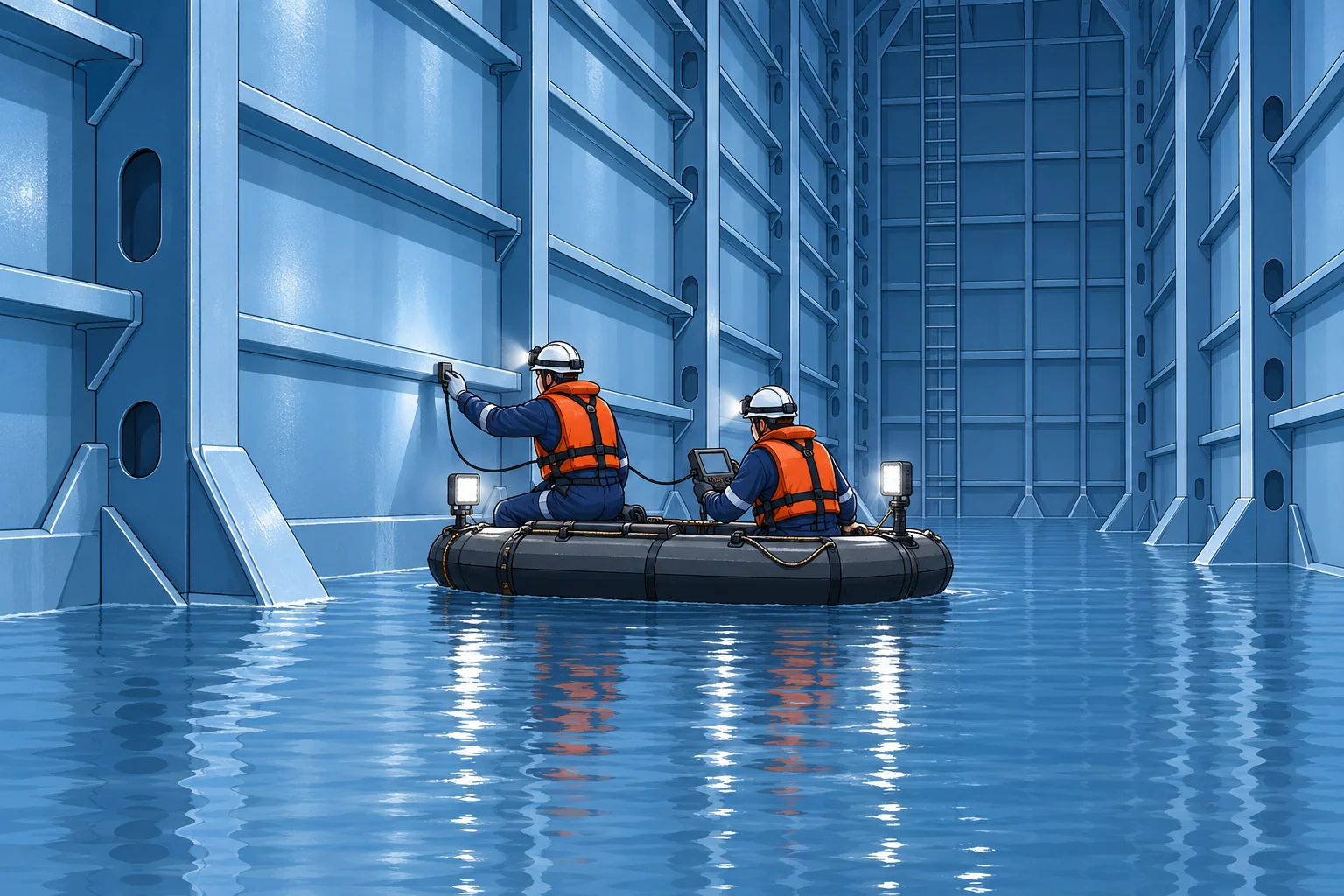
Enhanced surveys, close-up surveys and thickness measurement
1The lesson in plain words
Bulk carriers and tankers get surveys that grow with age. The ship's job is to have every space clean, safe and ready, and to know its own weak spots.
The Enhanced Survey Programme
Bulk carriers and oil tankers are surveyed under the 2011 ESP Code (resolution A.1049(27), as amended), made mandatory by SOLAS chapter XI-1. Required scope increases at specified ages and with adverse findings: more spaces, close-up surveys and thickness measurements. Before each renewal survey the owner and class agree a survey programme that lists the spaces, the access and the thickness measurements.
Overall and close-up
An overall survey checks a space's general condition and identifies suspect areas. A close-up survey examines structural details, normally within arm’s reach, using class-agreed access such as staging, rafting, a cherry-picker or rope access. Substantial corrosion remains within the applicable thickness limit but requires increased examination and gauging (thickness measurement). Steel below its allowable thickness needs repair or renewal agreed with class. In ballast tanks, a coating rated below GOOD brings annual examination.
Thickness measurement
Gauging means measuring steel thickness. A class-approved firm takes the readings with the surveyor present. The results go into the survey report file kept on board. For ESP ships it includes the condition evaluation report, which summarises the hull condition. Steel below allowable thickness needs class-agreed repair or renewal before the survey is completed.
Making spaces ready
You provide safe access. Clean and ventilate tanks and holds, arrange lighting, and confirm that the atmosphere is suitable. Follow the enclosed-space entry procedure in Deck safety. Plan which tanks are emptied in which port so cargo and ballast work allow it. Arrange class-agreed access for close-up work. A space not ready is a space not surveyed, and the survey cannot close.
Your inspections between surveys
ISM and class expect the crew to inspect ballast tanks and holds at set intervals, recording coating, anodes, cracks and leaks with photos and frame numbers. The surveyor reads these reports to decide where to look. Good reports find problems early and make the class survey shorter.
2Key data
- ESP applies to
- Bulk carriers and oil tankers (SOLAS XI-1/2, ESP Code)
- Close-up survey
- Structural details, normally within arm’s reach
- Gauging
- By a class-approved firm, surveyor present
- Kept on board
- Survey report file, condition evaluation report
3Key points
- 1
ESP surveys grow with age; plan them with class in a survey programme.
- 2
Close-up surveys examine structural details, normally within arm’s reach; class must agree any alternative method.
- 3
Prepare clean, ventilated, lit spaces with a suitable atmosphere and class-agreed safe access.
- 4
Your own tank and hold reports guide the surveyor and catch problems early.
4Frequent mistakes
Wrong: Cleaning a tank is enough preparation for a close-up survey.
Right: Cleaning does not provide close-up access. Arrange class-agreed safe access, normally within arm’s reach of the structure.
Wrong: The ship's crew can gauge the plates to save the cost of a firm.
Right: Survey gaugings must be done by a firm approved by class and attended by the surveyor.
5Practice case & exam keys
A required close-up survey is booked tomorrow. The yard offers only a view from the tank hatch and wants to close the tank today. What do you do?
Show the answer
Do not accept a hatch view as completion of the required close-up survey. Tell the office and class that access is inadequate. Agree safe access and revised timing before the tank is closed. Keep the relevant inspection reports and gauging arrangements ready.
Exam keys
- ESP Code: ships covered and why surveys grow with age.
- Overall vs close-up survey; means of access.
- Thickness measurement by approved firm; survey report file.
- Preparing spaces and arranging class-agreed safe access.
Finish this unit
When you've read it, answer three questions. Get all three right to finish the unit; opening the page alone doesn't count.
My notes for this unit
No notes