

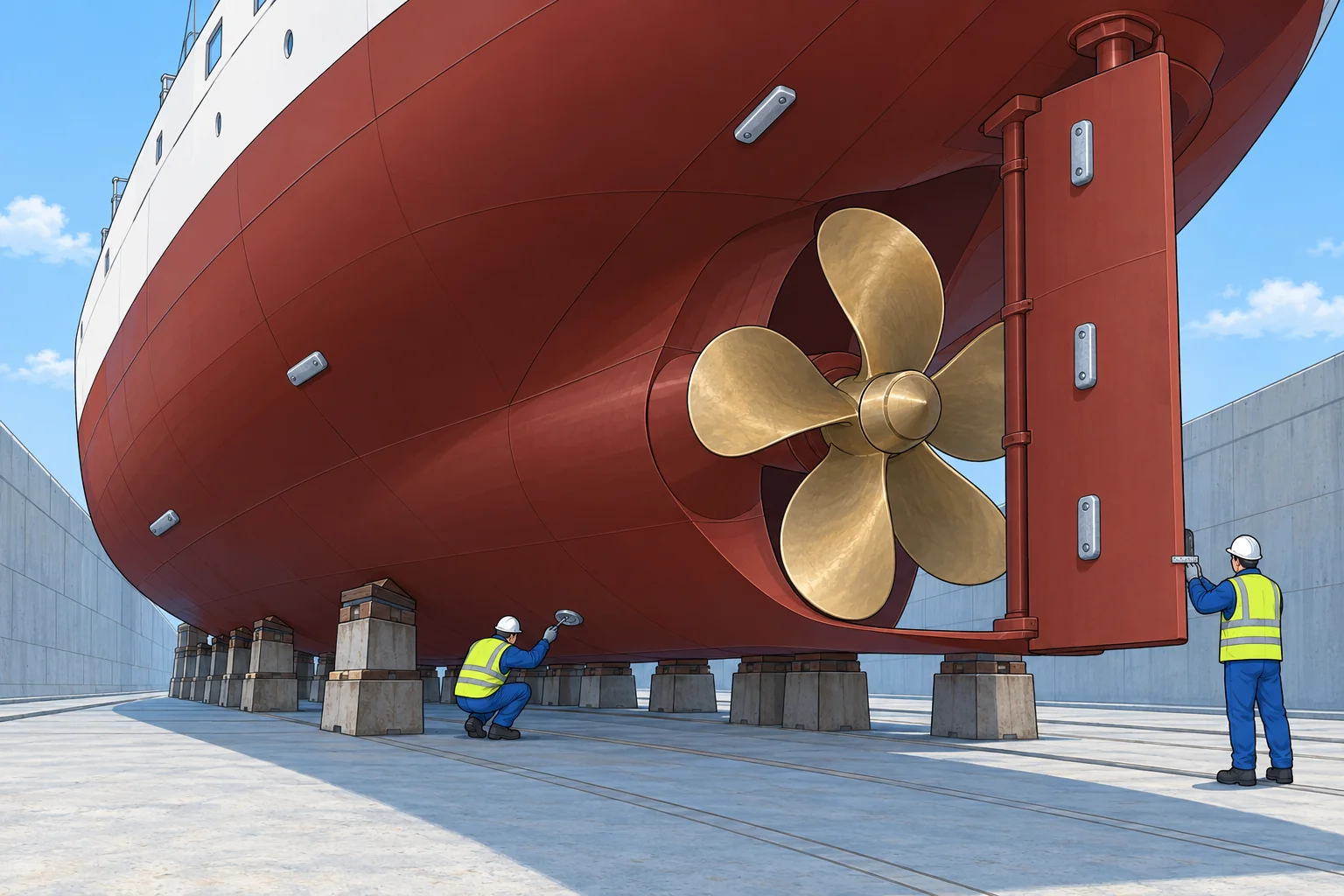
In the dock and before flooding up: the officer's checks
1The lesson in plain words
A ship in dock is cut off from the sea and full of contractors. Keep her safe while she sits there, and check every opening before the water comes back.
Safety in the dock
Sea suctions are unavailable while the hull is dry. Before isolating ship systems, agree and test shore or approved temporary supplies for fire water, cooling and power. Check the international shore connection, the standard flange connecting shore fire hoses, where used. Mark isolations and maintain alternative fire protection. Restore isolated systems promptly once work and personnel safety permit; verify them before sailing. Maintain fire patrols, hot-work controls, gas tests and contractor sign-in records.
Measurements in the dock
While the hull is dry, measure tailshaft wear-down (the drop of the shaft in its aft bearing, measured with a poker gauge or dial), rudder clearances (bearing gaps and jumping clearance: the upward travel allowed before the rudder meets its stop), propeller condition, and anode wastage. Record them with the readings from the last docking so the trend shows.
Before flooding the dock
Witness bottom plugs and sea-chest covers fitted and sealed. Secure protective grids: they exclude debris but are not watertight barriers. Check repaired hull openings, reassembled valves and connected pipework; set valves for the agreed flooding plan. Remove masking. Keep anodes bare and prepare transducers and logs exactly as their makers specify; use only permitted coatings. Compare tank soundings with arrival figures. Include changed weights or tank contents in a new stability check before refloating.
Refloating
Agree flooding stages with the dockmaster. Check for leaks from initial immersion as repaired boundaries and opened connections become submerged. Monitor opened spaces, sea connections and stern seals throughout. Hold at agreed safe stages, including a check before the critical period. Any additional pre-float hold must suit the approved stability sequence. Stop flooding and notify the master and dockmaster if leakage appears. Once afloat, check draught and list, test steering and restore required systems before sailing.
2Step by step
Checks before flooding the dock
- 1
Walk the bottom with the yard: every plug back and sealed, signed off.
A missing plug floods a tank as soon as water returns.
- 2
Check hull closures, sea valves and pipework complete, valve settings agreed, and sea-chest grids secured.
Sound closures, valves and pipework contain seawater; grids keep debris out.
- 3
Remove masking, keep anodes bare and prepare transducers and logs to maker instructions; use only permitted coatings.
Coated sacrificial anodes lose protection; masking or unsuitable coatings can impair sensors.
- 4
Compare tank soundings with the arrival figures and recalculate stability if needed.
Weights moved in dock change her stability at refloating.
- 5
Check for leaks as repaired boundaries and opened connections first submerge. Use dockmaster-agreed safe holds before the critical period and any later check before float-off.
Low openings submerge early. If leakage appears, stop flooding, notify the master and dockmaster, and investigate before continuing.
3Key points
- 1
Agree and test shore or approved temporary fire-water, cooling and power supplies; mark isolations and maintain protection.
- 2
Measure tailshaft wear-down, rudder clearances and anodes while she is dry.
- 3
Before flooding: plugs, valves, grids, anodes and transducers checked and witnessed.
- 4
Check leaks from initial immersion; use agreed safe holds before the critical period and further checks before float-off.
4Frequent mistakes
Wrong: The yard checks the plugs, so the ship need not.
Right: Walk the bottom with the yard and sign off each plug and valve yourself.
Wrong: Flood the dock straight through to save time.
Right: Check from initial immersion as repaired boundaries submerge. Use dockmaster-agreed holds at safe stages, including before the critical period. Continue monitoring through float-off.
5Practice case & exam keys
Undocking is planned for 06:00. At the final bottom walk at 04:30 you find one double-bottom drain plug missing and fresh paint on two hull anodes. The yard foreman says it can be sorted after flooding.
Show the answer
Do not agree. A missing plug floods the tank as water returns and changes stability. Have it fitted and sealed, and witness it. Remove paint from the anodes. Record both defects and tell the master and dockmaster; delay flooding as needed. Complete the checks.
Exam keys
- Agreed fire-water, cooling and power supplies; isolated systems and prompt restoration.
- Tailshaft wear-down and rudder clearances.
- Checks before flooding: plugs, valves, anodes, transducers, soundings.
- Staged refloating and leak checks.
Finish this unit
When you've read it, answer three questions. Get all three right to finish the unit; opening the page alone doesn't count.
My notes for this unit
No notes