

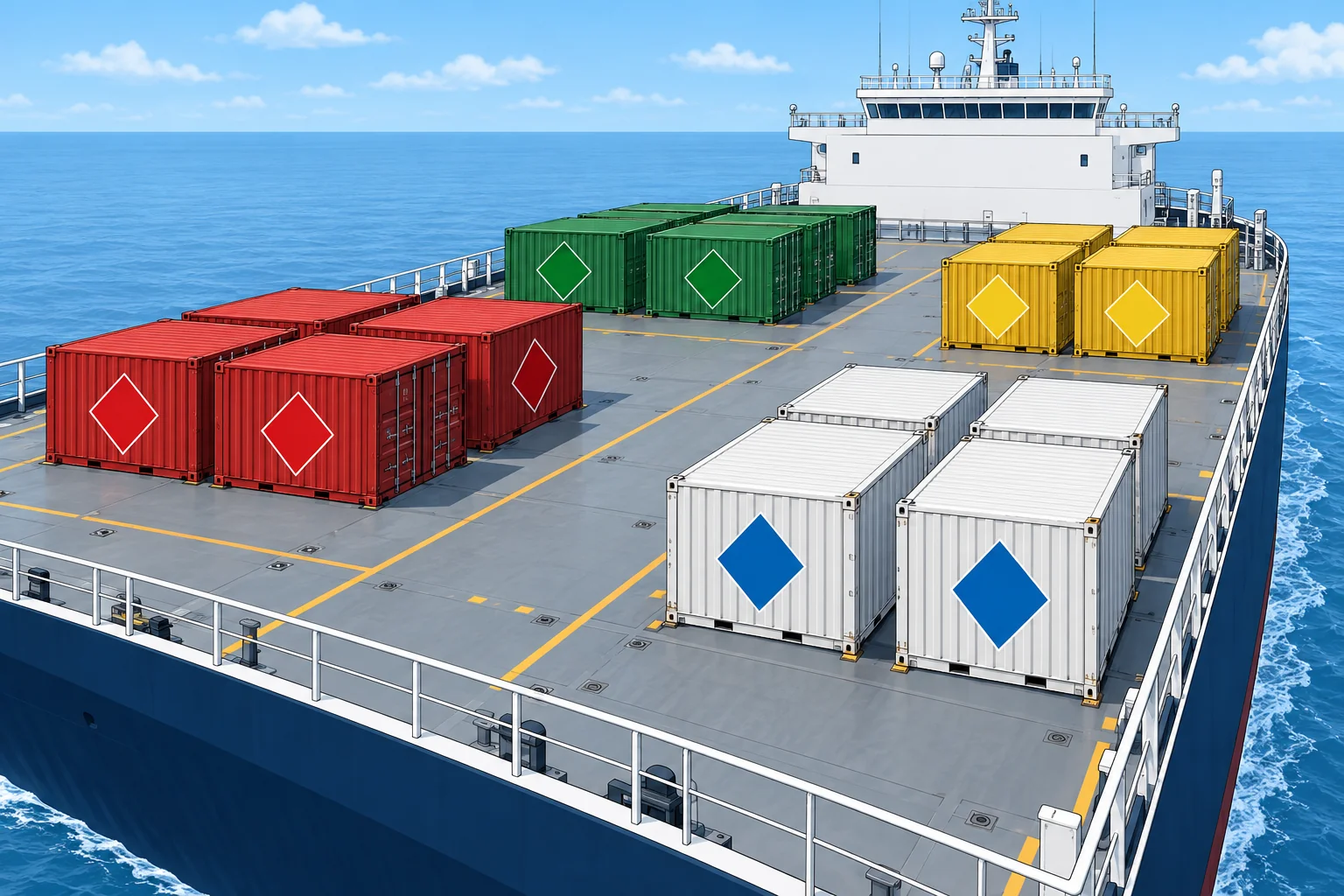
Dangerous goods on board: the IMDG Code for the watch officer
1The lesson in plain words
The IMDG Code tells you where dangerous goods may go, what they must be kept away from, and which papers and emergency schedules come with them.
The Code
The International Maritime Dangerous Goods (IMDG) Code is mandatory under SOLAS chapter VII for dangerous goods carried in packaged form. It is amended every two years: Amendment 42-24 could be used voluntarily from 1 January 2025 and has been mandatory since 1 January 2026. The nine classes, labels and placards are covered in Ship stores and maintenance; here you meet the stowage and segregation side.
The Dangerous Goods List
Chapter 3.2’s Dangerous Goods List gives, for each UN number: proper shipping name, class, packing group, where assigned (I high, II medium, III low danger), the EmS emergency schedules, the stowage category, which says whether the goods may go on deck, under deck or both for the ship type, and special stowage and segregation codes. Always check the entry: it can override the general rules.
Segregation
For conventional packages: 1, away from, at least 3 m horizontally. 2, separated from, separate compartments/holds, or 6 m on deck. 3, separated by a complete compartment or hold from, an intervening compartment/hold, or 12 m on deck. 4, separated longitudinally by an intervening complete compartment or hold from, longitudinal separation, or 24 m on deck. Qualifying fire- and liquid-resistant decks permit certain vertical alternatives under the Code.
Which provisions apply?
Containers and roll-on/roll-off (ro-ro) units have separate segregation tables; do not apply conventional-package distances to them. Check both Dangerous Goods List entries, subsidiary risks (additional hazards) and the provisions for the actual stowage. An X in the general segregation table means you must consult the relevant Dangerous Goods List entries. Follow any special segregation instructions.
Documents
The shipper gives a dangerous goods declaration; a container packing certificate confirms the container was packed correctly. The ship keeps a dangerous goods manifest or a detailed stowage plan showing the class and position of all dangerous goods (SOLAS VII), and shore authorities get a copy. Where SOLAS II-2/19 applies, check the Document of Compliance for both the dangerous-goods classes and the cargo spaces approved for them.
Emergencies
The EmS Guide gives a fire schedule (F-A to F-J) and a spillage schedule (S-A to S-Z) for each entry; the Medical First Aid Guide (MFAG) covers exposure. On watch, know where the dangerous goods stowage plan, the EmS Guide and the firefighting gear are, and which units sit near heat, accommodation or work areas.
2Key data
- In force
- Amendment 42-24, mandatory since 1 January 2026
- Packing groups
- Where assigned: I high danger, II medium, III low
- Conventional packages: terms 1–4
- On deck: 3/6/12/24 m respectively; term 4 longitudinal
- “Away from”
- Conventional packages: ≥ 3 m horizontally; check the Code
- EmS schedules
- Fire F-A to F-J; spillage S-A to S-Z
3Key points
- 1
The IMDG Code is mandatory under SOLAS VII; Amendment 42-24 has been mandatory since 1 January 2026.
- 2
The list entry gives class, packing group where assigned, EmS and stowage category.
- 3
Conventional-package terms 1–4: on deck 3/6/12/24 m; term 4 longitudinal. Containers and ro-ro use separate tables.
- 4
Check DG papers and the Document of Compliance: both the classes and cargo spaces must be approved where required.
- 5
Know where the EmS Guide, MFAG and the DG stowage plan are.
4Frequent mistakes
Wrong: Two dangerous goods of different classes can always share a hold.
Right: Check both list entries, subsidiary risks and the segregation provisions for the actual stowage. Containers and ro-ro use separate tables.
Wrong: Packing group I is the least dangerous.
Right: Packing group I is high danger, II medium and III low.
5Practice case & exam keys
On rounds you find a container placarded class 3 stowed on deck right next to one placarded class 5.1, oxidizer. The stowage plan shows them two bays apart. What do you do?
Show the answer
Report to the chief mate and master. Check both UN entries and the container segregation table against the actual stow. If alongside, arrange a safe restow and update the plan and manifest. At sea, do not attempt to shift containers: follow the master’s risk assessment, apply suitable precautions, check EmS and arrange safe restow at a suitable port.
Exam keys
- IMDG Code mandatory under SOLAS VII; 42-24 mandatory since 1 Jan 2026.
- Conventional packages on deck: terms 1/2/3/4 require at least 3/6/12/24 m respectively; term 4 requires longitudinal separation. Check special provisions; containers and ro-ro use separate tables.
- EmS: F-A–F-J fire, S-A–S-Z spillage; MFAG for exposure.
Finish this unit
When you've read it, answer three questions. Get all three right to finish the unit; opening the page alone doesn't count.
My notes for this unit
No notes