

Lashing strength: MSL, the rule of thumb and calculated strength
1The lesson in plain words
Compare securing loads with cargo weight. The rule of thumb needs reasonably even load sharing, similar lashing stretch and a separate tipping check.
MSL
Maximum securing load (MSL) is the maximum permitted securing force, in kilonewtons (kN). Compare forces: 1 t weighs 9.81 kN; 1 kN is roughly the weight of 102 kg. Without a marked MSL, use these percentages of breaking strength (force at failure): mild-steel shackles, rings, deck eyes and turnbuckles 50 %, chains 50 %, web lashings 50 %, fibre rope 33 %, wire rope 80 % single use or 30 % re-usable, steel band 70 % single use.
Weakest link
A lashing is a chain of parts: deck eye, shackle, wire or chain, tensioner, cargo lug. The lashing’s MSL is the smallest MSL in the series. A chain of 80 kN MSL on a shackle of 60 kN MSL is a 60 kN lashing.
Rule of thumb
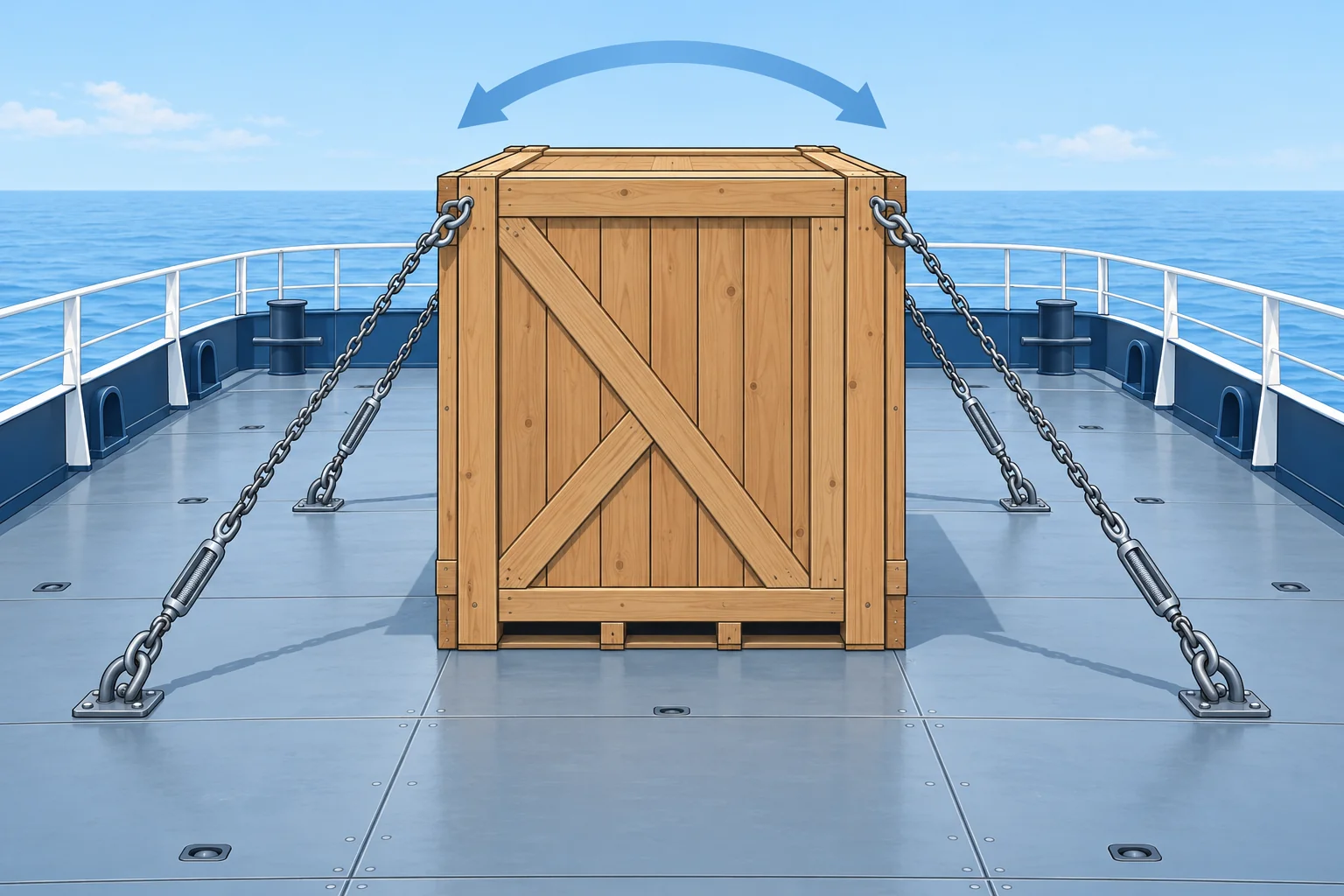
Annex 13’s quick check: the total MSL of lashings on each side must be at least the item’s weight in kN. It corresponds to 1 g sideways and disregards friction. Use it only when the arrangement distributes loads reasonably evenly between lashings with similar stretch. Do not count lashings steeper than 60° to the deck against sliding; they may help against tipping. Follow the approved manual and check other directions and tipping separately.
Calculated strength
The full Annex 13 method checks sliding and tipping using friction and lashings. Each lashing counts at calculated strength, CS = MSL ÷ 1.5, allowing for uneven loading: 60 kN MSL gives 40 kN CS. The friction coefficient μ describes grip: 0 means no friction; larger values mean more resistance to sliding for the same contact load. Typical values: timber–timber 0.4; steel–timber or steel–rubber 0.3; dry steel–steel 0.1; wet steel–steel 0. Use the manual’s approved method.
When the rule is not enough
Use the full method, or the manual’s tables, for heavy items, items stowed high or near the ends, ships with a large GM that roll violently, and whenever the rule gives a borderline answer. The rule of thumb is a check, not a design.
2Step by step
Worked example: a 24 t item with reasonably even load sharing and similar lashing stretch
- 1
Weight = 24 t × 9.81 = 235 kN.
The rule compares forces, so convert the mass to kN.
- 2
Chain breaking strength 160 kN: MSL = 50 % = 80 kN.
Chains count at 50 % of breaking strength when no MSL is marked.
- 3
Shackle breaking strength 120 kN: MSL = 50 % = 60 kN. Each lashing = 60 kN.
The weakest part of the series sets the lashing’s MSL.
- 4
Lashings per side = 235 ÷ 60 = 3.9: fit 4 each side (240 kN).
For this arrangement, each side’s total MSL must at least reach the weight; check other directions and tipping separately.
- 5
Count only lashings at 60° or less to the deck.
Steeper lashings add little against sliding; any extras are a bonus against tipping.
- 6
For the full Annex 13 method, each lashing counts as CS = 60 ÷ 1.5 = 40 kN.
The calculated strength allows for uneven sharing and imperfect fitting.
3Key data
- Weight force
- 1 t weighs 9.81 kN; 1 kN ≈ weight of 102 kg
- MSL at 50 % of breaking
- Shackles, rings, deck eyes, turnbuckles, chains, web lashings
- Other MSL values
- Fibre rope 33 %; wire 80 % single use, 30 % re-usable; band 70 %
- Rule of thumb
- Σ MSL each side ≥ weight (kN); sliding: lashings ≤ 60° to deck
- Calculated strength
- CS = MSL ÷ 1.5
- Friction μ
- Timber–timber 0.4; steel–timber 0.3; steel–steel 0.1 dry, 0 wet
4Key points
- 1
MSL is the maximum permitted securing force in kN; weight of 1 t: 9.81 kN.
- 2
A lashing is as strong as its weakest part: the smallest MSL in the series.
- 3
Rule: MSL each side ≥ weight; similar stretch, reasonably even sharing; ≤ 60° for sliding. Check tipping separately.
- 4
In the full method each lashing counts at CS = MSL ÷ 1.5.
- 5
Heavy, high or end-stowed items and stiff ships need the full calculation.
5Frequent mistakes
Wrong: A 24 t item needs 24 kN of lashings each side.
Right: Convert mass to force: 24 t × 9.81 = 235 kN. Tonnes and kilonewtons differ by almost ten times.
Wrong: The chain is rated 80 kN, so the lashing is 80 kN.
Right: Take the weakest part. With a 60 kN shackle in the series, the lashing is a 60 kN lashing.
Wrong: Count every lashing, however steep.
Right: Under the rule of thumb, lashings steeper than 60° to the deck do not count against sliding.
6Practice case & exam keys
An 18 t machine is to be secured on deck with web lashings marked MSL 25 kN, at about 45° to the deck. The stevedores fit 6 a side. Does it pass the rule of thumb? What would you ask for?
Show the answer
Weight = 18 × 9.81 = 177 kN a side. Six webs give 150 kN: not enough. Eight a side give 200 kN and meet the sideways check if they have similar stretch and share loads reasonably evenly. Check the manual, other directions and tipping separately. Block against sliding and add dunnage for friction. Ask the chief mate whether the full Annex 13 calculation is needed.
Exam keys
- MSL from breaking strength: 50 % shackles/chains/webs, 33 % fibre, 80/30 % wire, 70 % band.
- Rule of thumb: Σ MSL per side ≥ weight in kN; reasonably even loading, similar stretch, lashings ≤ 60° for sliding. Check tipping and other directions separately.
- CS = MSL ÷ 1.5; series MSL = the smallest part.
Finish this unit
When you've read it, answer three questions. Get all three right to finish the unit; opening the page alone doesn't count.
My notes for this unit
No notes