

Solid bulk and grain: IMSBC groups, TML and the Grain Code
1The lesson in plain words
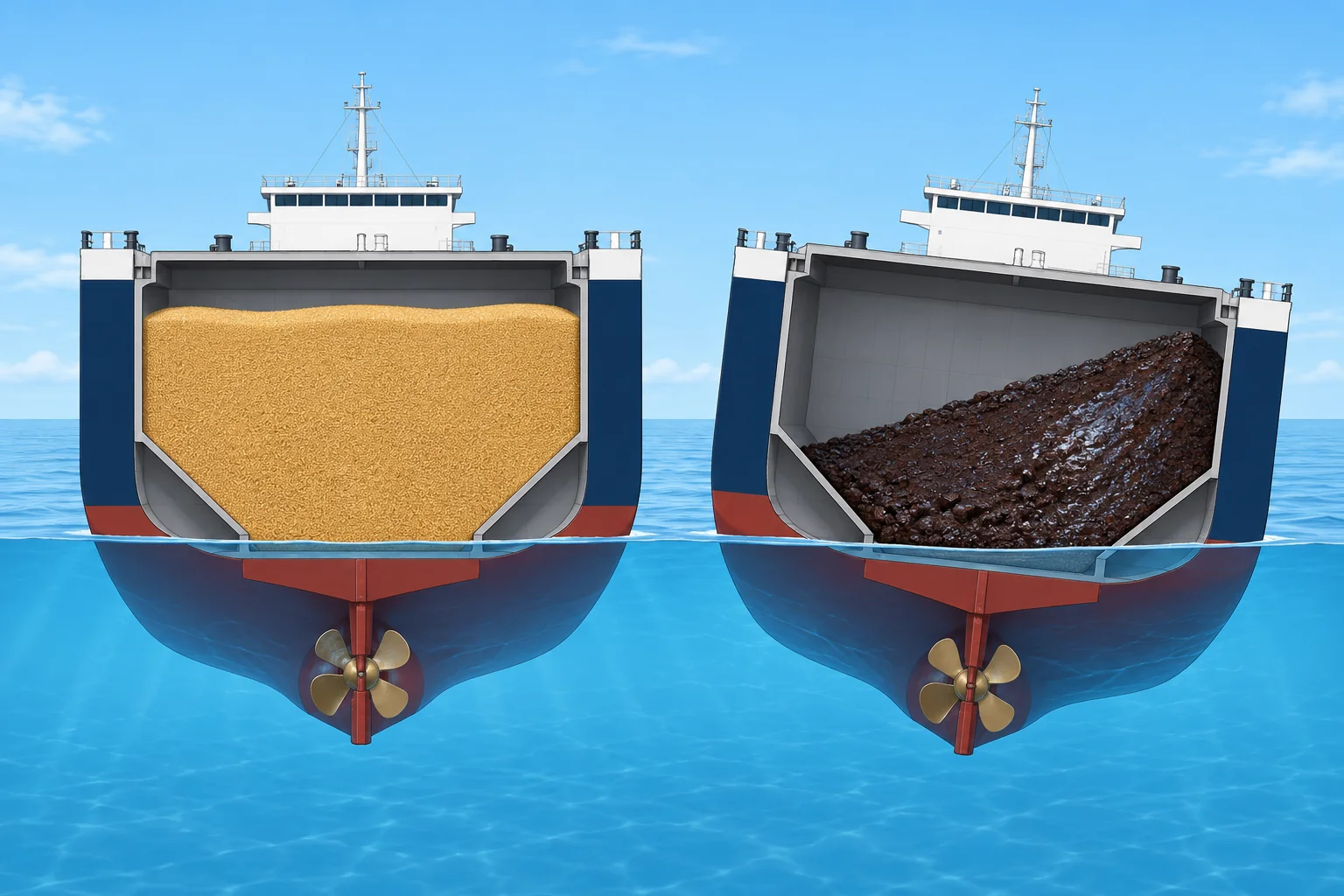
Bulk cargo can liquefy, react or shift. The IMSBC Code sorts it into groups A, B and C; the Grain Code sets the stability a grain ship must keep.
The IMSBC Code
The International Maritime Solid Bulk Cargoes (IMSBC) Code, mandatory under SOLAS, gives a schedule for each named bulk cargo: hazards, stowage, segregation and loading precautions. Before loading, the shipper must give the master the cargo information in writing, including moisture content and transportable moisture limit (TML) where they apply.
Groups A, B and C
Group A cargoes may liquefy or undergo dynamic separation above their TML. In dynamic separation, water and fine particles form a slurry above denser cargo; its movement can destabilize the ship. Examples include some mineral fines. Group B cargoes have chemical hazards, such as self-heating or gas release. Group C cargoes are neither A nor B, but may still be dense or shift. Some cargoes are both A and B.
Liquefaction
Motion can raise water pressure between wet cargo grains until the cargo loses strength and flows, risking capsize. Flow moisture point (FMP) is the moisture content at which flow occurs in a prescribed laboratory test. TML is the maximum moisture permitted for ordinary carriage; for flow-table and penetration tests it is 90 % of FMP. Require certified moisture below TML. A can test jars a sample to check for free moisture or flow: a warning check, never proof of safe moisture content.
Grain
Grain can shift even in a filled hold. The International Grain Code normally requires a document of authorization and approved grain loading information. Throughout the voyage, GM (metacentric height) must be at least 0.30 m after allowing for liquids shifting in partly filled tanks (free surface). Heel from assumed grain shift must not exceed 12°; for ships built from 1 January 1994, use the deck-edge immersion angle if smaller.
Residual stability
The residual area between the righting-arm (GZ) and grain heeling-arm curves must be at least 0.075 m·rad. Measure from equilibrium heel to the least of 40°, the downflooding angle (when water enters unprotected openings), or the angle of maximum difference between the curves. Apply this criterion throughout the voyage using the approved grain loading information.
2Key data
- Group A
- May liquefy or undergo dynamic separation above TML
- Group B
- Chemical hazard
- Group C
- Neither Group A nor Group B
- TML
- Flow-table/penetration tests: TML = 90 % of FMP
- Grain: heel from shift
- ≤ 12°; built from 1 Jan 1994: deck-edge immersion if smaller
- Grain: area and GM
- Area to Code limit ≥ 0.075 m·rad; corrected GM ≥ 0.30 m
3Key points
- 1
Use the applicable IMSBC schedule and shipper’s cargo information; require moisture/TML certificates where applicable.
- 2
A: liquefaction or dynamic separation; B: chemical hazards; C: neither A nor B. Some cargoes are both A and B.
- 3
Liquefaction can cause a severe list or capsize; a can test cannot certify safe cargo.
- 4
Grain: corrected GM ≥ 0.30 m; heel ≤ 12° (ships built from 1 Jan 1994: deck-edge immersion if smaller).
- 5
Grain: area ≥ 0.075 m·rad to the Code’s limiting angle; carry authorization and approved loading information.
4Frequent mistakes
Wrong: The cargo looks dry on top, so it cannot liquefy.
Right: Group A cargo can look dry and still be above its TML. Rely on the certified moisture content, and treat a failed can test as a stop signal.
Wrong: A full grain hold cannot shift.
Right: Grain settles and leaves a void under the hatch and deck. The Grain Code assumes a shift even in filled compartments.
5Practice case & exam keys
You are loading nickel ore, a Group A cargo. It has rained hard at the stockpile since the shipper’s moisture test, and a can test on deck leaves a wet, shiny surface with water on top. What do you do?
Show the answer
Stop loading and tell the master. Free moisture is a warning; the can test cannot measure FMP or TML. Request representative sampling and fresh laboratory moisture testing after the rain. The master can refuse the cargo. Do not resume until the certified moisture content is below the TML; keep holds closed in rain.
Exam keys
- IMSBC groups: A liquefaction or dynamic separation; B chemical hazards; C neither A nor B.
- For flow-table and penetration tests, TML = 90 % of FMP; certified moisture must be below TML. A can test cannot certify safe moisture.
- Grain: corrected GM ≥ 0.30 m; heel ≤ 12° (ships built from 1 Jan 1994: deck-edge immersion if smaller). Residual area ≥ 0.075 m·rad from equilibrium heel to the least of 40°, downflooding or maximum arm difference.
Finish this unit
When you've read it, answer three questions. Get all three right to finish the unit; opening the page alone doesn't count.
My notes for this unit
No notes