

Reading draught marks and the mean draught
1The lesson in plain words
Six readings reveal trim (aft minus forward draught), list (a steady lean to one side), and hull deflection (bending).
The marks
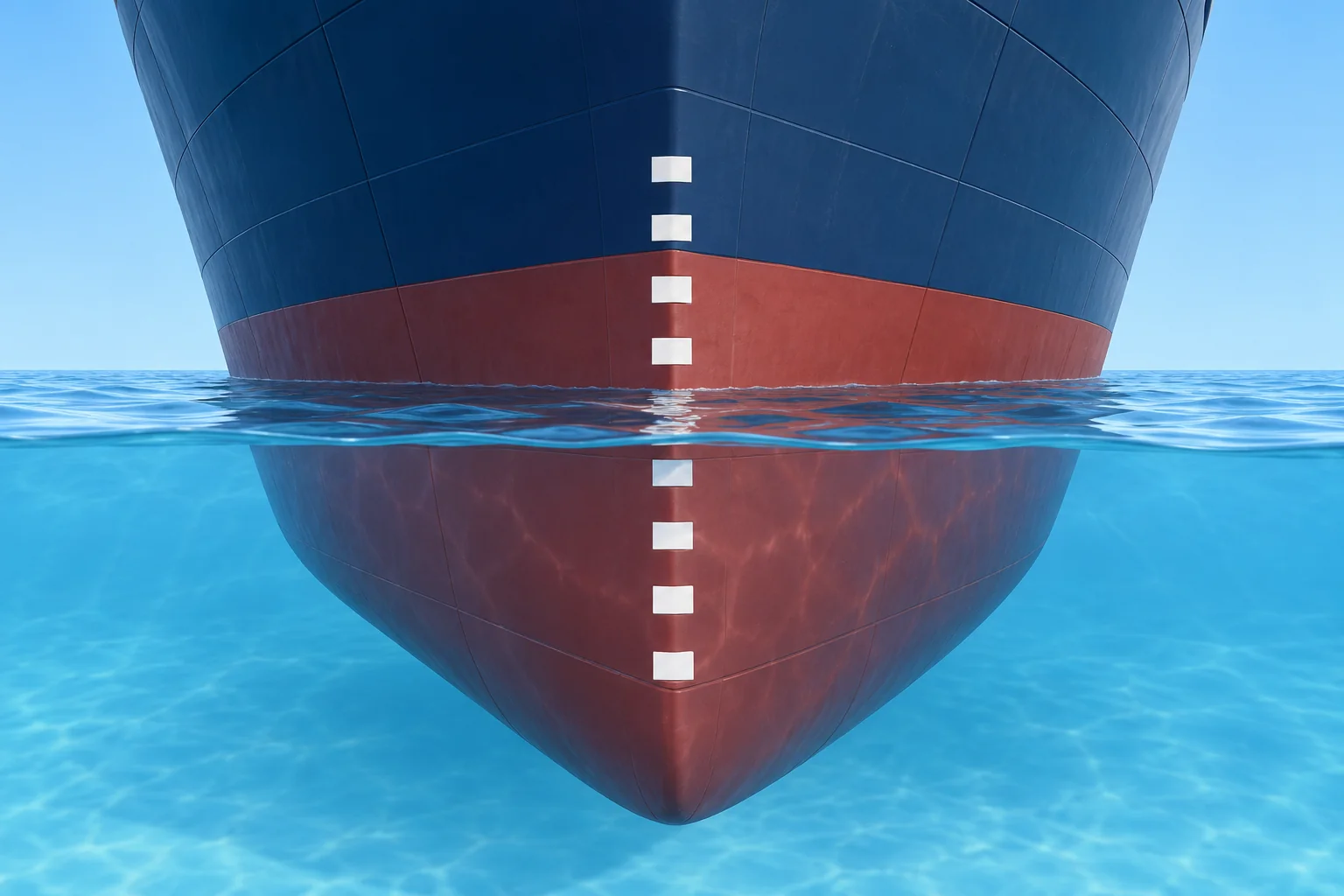
Draught marks show draught above the stated reference, usually the keel. Metric figures are 10 cm high, spaced every 20 cm; their bottom edge gives the marked draught. Whole metres carry M. Imperial figures are 6 inches high, with a 6-inch gap; their bottom edge gives the marked number of feet. At the top of an imperial 8 (or VIII), read 8 ft 6 in = 8.5 ft, not 8.6 ft. One foot is 12 inches. Check the ship's plans for the reference.
Reading them
Read from a boat or the quay, close to water level. In a swell, watch several waves and average the highest and lowest readings. Read both port and starboard at each position. A list is a steady lean to one side; averaging both sides gives the centreline draught.
Not at the perpendiculars
The bow and stern marks are seldom exactly at the forward and aft perpendiculars, the end points of the length between perpendiculars (LBP). For routine stability work the difference is often small; for a draught survey each reading is corrected to its perpendicular. That method is taught at management level.
Mean draught and deflection
The mean draught is (forward + aft) ÷ 2. Compare it with the midships draught. Use end draughts at the perpendiculars and a midships draught halfway between them. Deeper midships means the hull is sagging, bent down in the middle; shallower midships means hogging. Deflection affects displacement and indicates hull bending.
Which draught for the tables
Follow the booklet's draught reference. For small trim, the draught at the centre of flotation (LCF), the waterplane's area centre, approximates the entry to even-keel tables. The Trim unit explains the correction; larger trim may need different data.
2Step by step
Worked example: six readings
- 1
Forward: port 7.58 m, starboard 7.62 m, mean 7.60 m. Aft: 8.38 and 8.42 m, mean 8.40 m.
End readings are at the perpendiculars; midships is halfway between. Averaging each pair removes the list.
- 2
Midships: port 8.02 m, starboard 8.06 m, mean 8.04 m.
Starboard reads 4 cm deeper at all three positions, consistent with a small starboard list. Average each pair.
- 3
Trim, the difference between aft and forward draughts, = 8.40 − 7.60 = 0.80 m by the stern.
Aft is deeper.
- 4
Mean of forward and aft = (7.60 + 8.40) ÷ 2 = 8.00 m.
The straight line between the ends.
- 5
Deflection = 8.04 − 8.00 = 0.04 m: she sags 4 cm.
Midships is deeper than the mean of the ends.
3Key data
- Metric figures
- 10 cm high, every 20 cm; bottom edge = draught
- Pair of readings
- (Port + starboard) ÷ 2
- Mean draught
- (Forward + aft) ÷ 2
- Deflection
- Midships − mean of ends: + sag, − hog
4Key points
- 1
The bottom of a metric figure is its draught; figures come every 20 cm.
- 2
Read both sides at each mark and average for the centreline draught.
- 3
Midships deeper than the mean of the ends = sag; shallower = hog.
- 4
Follow the booklet's draught reference; the LCF entry is a small-trim approximation.
5Frequent mistakes
Wrong: Water at the top of the 6 figure above the 7 M mark means 7.60 m.
Right: The bottom of that figure is 7.60 m; its top is 7.70 m.
Wrong: Reading from the deck is accurate enough.
Right: Looking down at an angle gives errors of several centimetres. Read close to the water, from a boat or the quay.
6Practice case & exam keys
At the perpendiculars and halfway between, port/starboard draughts are: forward 5.12/5.18 m, aft 6.40/6.46 m, midships 5.86/5.92 m. A colleague uses only starboard readings as centreline draughts. Do you accept? Is the hull hogging or sagging?
Show the answer
No. Average both sides: forward 5.15 m, aft 6.43 m and midships 5.89 m. The end mean is 5.79 m, so midships is 0.10 m deeper: sagging. Starboard-only readings overstate each centreline draught by 0.03 m.
Exam keys
- Metric marks: 10 cm figures every 20 cm; the bottom edge is the reading.
- Mean draught = (F + A) ÷ 2; deflection = midships − mean (sag +, hog −).
- Average port and starboard; read close to the water.
Finish this unit
When you've read it, answer three questions. Get all three right to finish the unit; opening the page alone doesn't count.
My notes for this unit
No notes