

Hydrostatic tables and curves
1The lesson in plain words
Enter the hydrostatic table with the draught and read displacement, TPC, MCTC, LCB, LCF, KB and KM. Interpolate, and correct for density.
What's in them
The hydrostatic table lists values against draught, usually for sea water on even keel. Columns include Δ, TPC and MCTC, the moment to change trim by 1 cm.
Centres and heights
The centre of buoyancy is the displaced volume's centre; the centre of flotation is the waterplane's area centre. LCB and LCF give their fore-and-aft positions. KB is buoyancy-centre height above keel datum K; KM is metacentre height above K. The metacentre is a reference point for initial stability.
Interpolating
Draughts rarely fall on a table line. Use linear interpolation: find what fraction of the step your draught is, and apply that fraction to each value. Where a value curves sharply, such as KM near its minimum, or the steps are large, check the curves.
Density
At a given draught and trim, KB, KM, LCB and LCF depend on immersed hull geometry; displacement, TPC and MCTC also depend on water density. Tables normally use sea water of 1.025 t/m³. At the same draught in water of density ρ, Δ = Δ(table) × ρ ÷ 1.025. For a known Δ in dock water, first convert: Δ(table) = Δ × 1.025 ÷ ρ, then enter the table. Also, TPC = TPC(table) × ρ ÷ 1.025.
Trim
Follow the booklet's method and draught reference. Using the draught at the LCF with even-keel tables is a small-trim approximation. For larger trim, use approved trim-corrected data or the approved loading computer.
Curves
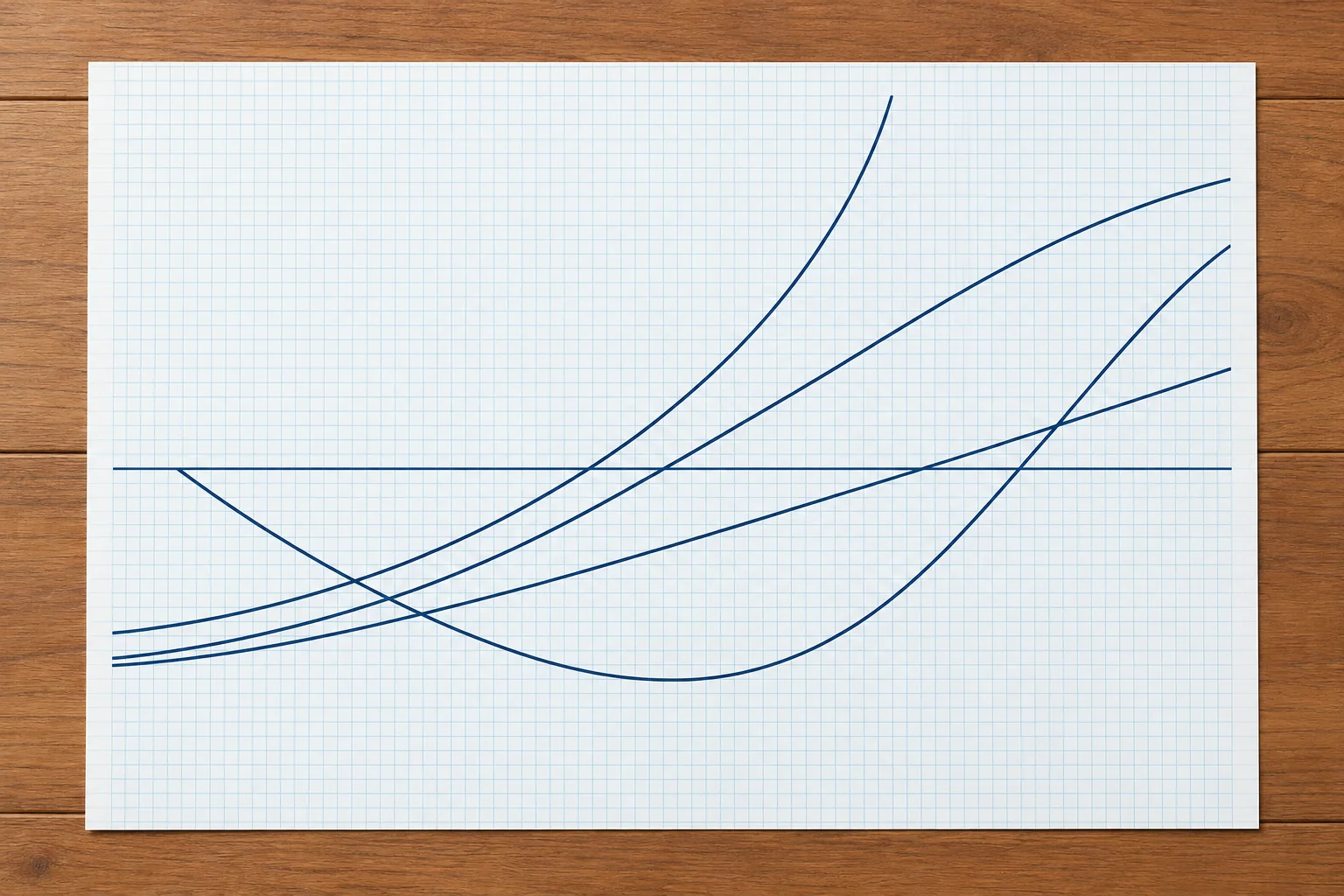
Hydrostatic curves plot the same values against draught on one sheet, each with its own scale. They show how values change with draught: displacement increases, while TPC follows waterplane area. KB generally rises; KM often falls to a minimum before rising again. The deadweight scale puts the main values side by side for quick use.
2Step by step
Worked example: interpolating the table
- 1
Table: 8.00 m: Δ 15,000 t, TPC 25.0, KM 8.40 m, LCF 66.0 m. 8.20 m: Δ 15,501 t, TPC 25.1, KM 8.38 m, LCF 65.6 m.
LCF measured forward of the aft perpendicular.
- 2
Draught 8.12 m: fraction = (8.12 − 8.00) ÷ 0.20 = 0.6.
The same fraction for every column.
- 3
Δ = 15,000 + 0.6 × 501 = 15,301 t; KM = 8.40 − 0.6 × 0.02 = 8.388 m.
KM falls slightly here.
- 4
TPC = 25.06 t/cm; LCF = 66.0 − 0.6 × 0.4 = 65.76 m.
Every column is treated the same way.
- 5
In dock water of 1.010 at 8.12 m: Δ = 15,301 × 1.010 ÷ 1.025 = 15,077 t.
KM and LCF stay as read: they depend on shape only.
3Key data
- Interpolation
- Lower + fraction × (upper − lower)
- Δ in dock water
- Δ(table) × ρ ÷ 1.025
- Draught for a Δ in dock water
- Enter the table with Δ × 1.025 ÷ ρ
- Shape-only values
- KB, KM, LCB, LCF: read at the draught
4Key points
- 1
Use the booklet's method and draught reference; interpolate between table rows.
- 2
Δ and TPC are for sea water: correct them by ρ ÷ 1.025.
- 3
At a given draught and trim, KB, KM, LCB and LCF depend on immersed hull geometry.
- 4
With a large trim, use the booklet's trim-corrected data or the approved computer.
5Frequent mistakes
Wrong: In dock water, read Δ straight off the table at the observed draught.
Right: That is the sea-water displacement. Multiply by ρ ÷ 1.025 for the true one.
Wrong: KM must be corrected for density, like displacement.
Right: KM depends on the shape at that draught, so read it directly.
6Practice case & exam keys
On even keel in dock water of 1.015 t/m³, Δ is 15,200 t. A colleague multiplies it by 1.015 ÷ 1.025 before entering the sea-water table. Do you accept? Find draught and KM using the table above.
Show the answer
No. Convert actual weight to its sea-water table equivalent by multiplying by 1.025 ÷ 1.015: 15,200 × 1.025 ÷ 1.015 = 15,350 t. The fraction between 15,000 t at 8.00 m and 15,501 t at 8.20 m is 350 ÷ 501 = 0.70. Draught = 8.00 + 0.70 × 0.20 = 8.14 m. KM = 8.40 − 0.70 × 0.02 = 8.386 m, about 8.39 m.
Exam keys
- Hydrostatic table: Δ, TPC, MCTC, LCB, LCF, KB, KM against draught, sea water, even keel.
- Δ at density ρ = Δ(table) × ρ ÷ 1.025; convert the other way before entering the table.
- Interpolate linearly between table lines.
Finish this unit
When you've read it, answer three questions. Get all three right to finish the unit; opening the page alone doesn't count.
My notes for this unit
No notes