

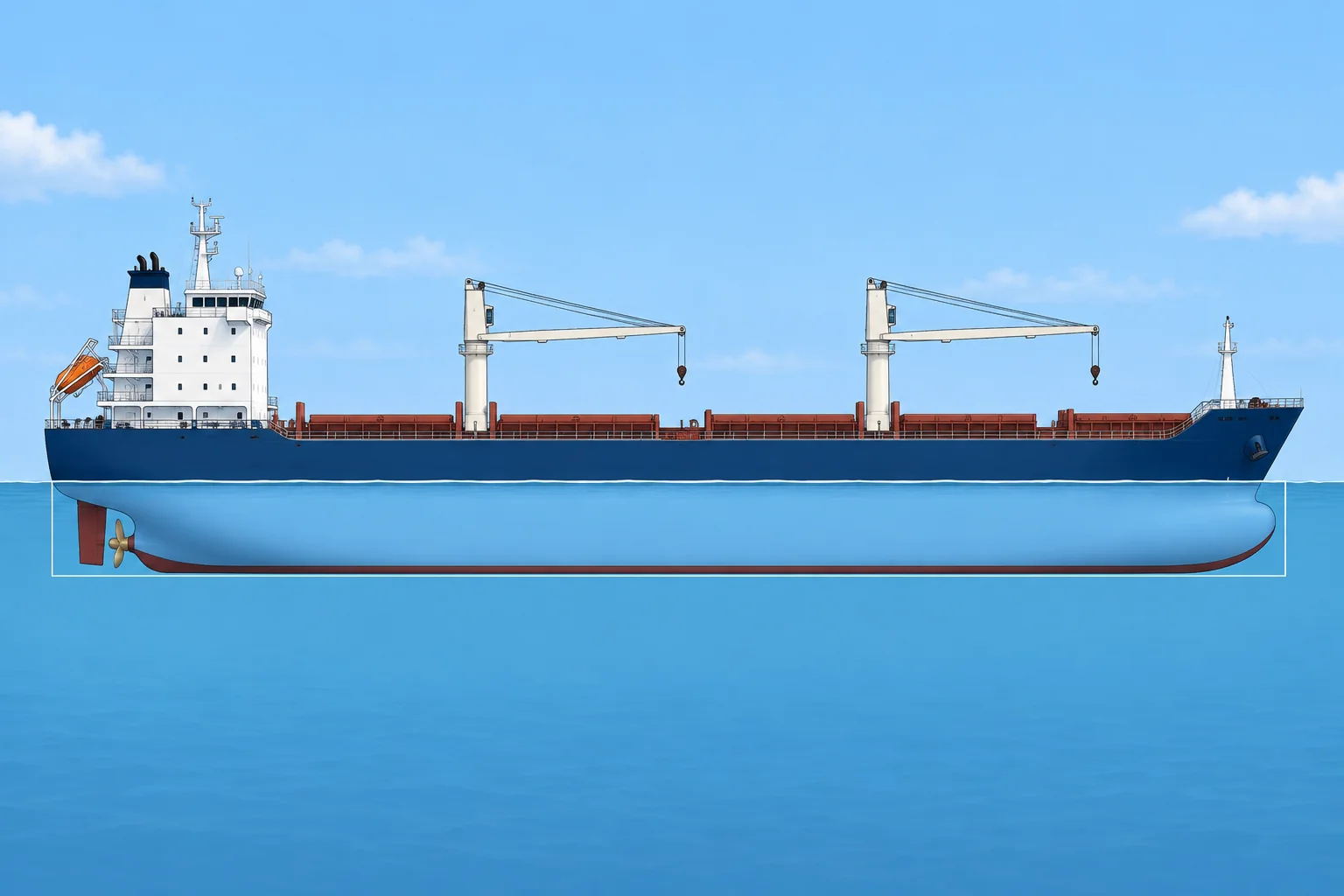
Displacement, lightship and deadweight
1The lesson in plain words
A floating ship weighs what the water she displaces weighs. From that one fact come displacement, lightship, deadweight and the block coefficient.
Displacement
Displacement (Δ) is the ship's total weight in tonnes. Afloat, she displaces her own weight of water: Δ = V × ρ, where V is the underwater volume in m³ and ρ the water density in t/m³, about 1.025 for sea water and 1.000 for fresh. The same ship has the same Δ in any water; only V and the draught change.
Lightship and deadweight
Lightship is the fully equipped ship without cargo, fuel, lubricating oil, ballast, fresh water and feed water in tanks, consumable stores, passengers, crew or their effects. Deadweight (DWT) is the difference: DWT = Δ − lightship. Summer deadweight is measured at the summer load line.
Cargo capacity
Deadweight is not all cargo. Take away fuel, oil, water, ballast, stores, crew and the constant: weights that build up aboard unnoticed, such as sediment in tanks and old spares, found by draught surveys. What remains is the cargo. The Loading unit works this out for a voyage.
Form coefficients
The block coefficient Cb = V ÷ (L × B × d) compares underwater volume with a box of length L, breadth B and draught d. Tankers and bulk carriers are fuller (0.80–0.85) than container ships (0.60–0.70). The waterplane area Aw is the horizontal area enclosed by the hull at the waterline. Cw = Aw ÷ (L × B), the waterplane coefficient, compares it with its enclosing rectangle.
Weight, not volume
Hydrostatic tables give displacement in sea water for each draught. Stability, deadweight and strength all work in tonnes, so turn volumes from tank and hold tables into weight with the right density first. Mixing up m³ and t is one of the commonest errors.
2Step by step
Worked example: displacement from dimensions
- 1
Data: length between perpendiculars (LBP) 140 m, breadth 20 m, draught 8.00 m, Cb 0.653, sea water.
Use the dimensions specified for Cb. Breadth and draught are moulded dimensions, measured inside the shell plating. Even keel means equal forward and aft draughts.
- 2
V = 140 × 20 × 8.00 × 0.653 = 14,627 m³.
The box volume times the block coefficient.
- 3
Δ = 14,627 × 1.025 = 14,993 t, about 15,000 t.
It agrees with the hydrostatic table at 8.00 m.
- 4
Lightship 4,500 t: DWT = 15,000 − 4,500 = 10,500 t.
Everything aboard that is not the ship herself.
- 5
At the summer draught Δ is 16,500 t: summer DWT = 12,000 t.
The summer deadweight is 1,500 t above the current deadweight.
3Key data
- Displacement
- Δ = V × ρ (t = m³ × t/m³)
- Sea water / fresh water
- 1.025 / 1.000 t/m³
- Deadweight
- DWT = Δ − lightship
- Block coefficient
- Cb = V ÷ (L × B × d)
- Typical Cb
- Tanker or bulk carrier 0.80–0.85; container ship 0.60–0.70
4Key points
- 1
Δ = V × ρ: the ship weighs what she displaces.
- 2
DWT = Δ − lightship; cargo is DWT minus consumables, ballast and the constant.
- 3
Cb = V ÷ (L × B × d) shows how full the hull is.
- 4
Turn volumes into tonnes with the right density before any moment calculation.
5Frequent mistakes
Wrong: In fresh water the ship weighs less, so her displacement falls.
Right: Δ is unchanged. Fresh water is lighter, so she displaces more volume and floats deeper.
Wrong: Deadweight is the cargo the ship can carry.
Right: Deadweight includes fuel, water, stores, ballast and the constant. Cargo is what remains.
6Practice case & exam keys
Δ is 15,000 t and lightship 4,500 t. Known non-cargo deadweight is 830 t, excluding a separate 120 t constant. The mate reports 10,500 t of cargo aboard. Do you accept?
Show the answer
No. 10,500 t is total deadweight. Cargo = 10,500 − 830 − 120 = 9,550 t. The constant is part of deadweight and must be included once.
Exam keys
- Δ = V × ρ; the ship's weight is the same in any water.
- Lightship is the fully equipped ship without variable loads; DWT = Δ − lightship.
- Cb = V ÷ (L × B × d); Cw = Aw ÷ (L × B).
Finish this unit
When you've read it, answer three questions. Get all three right to finish the unit; opening the page alone doesn't count.
My notes for this unit
No notes