

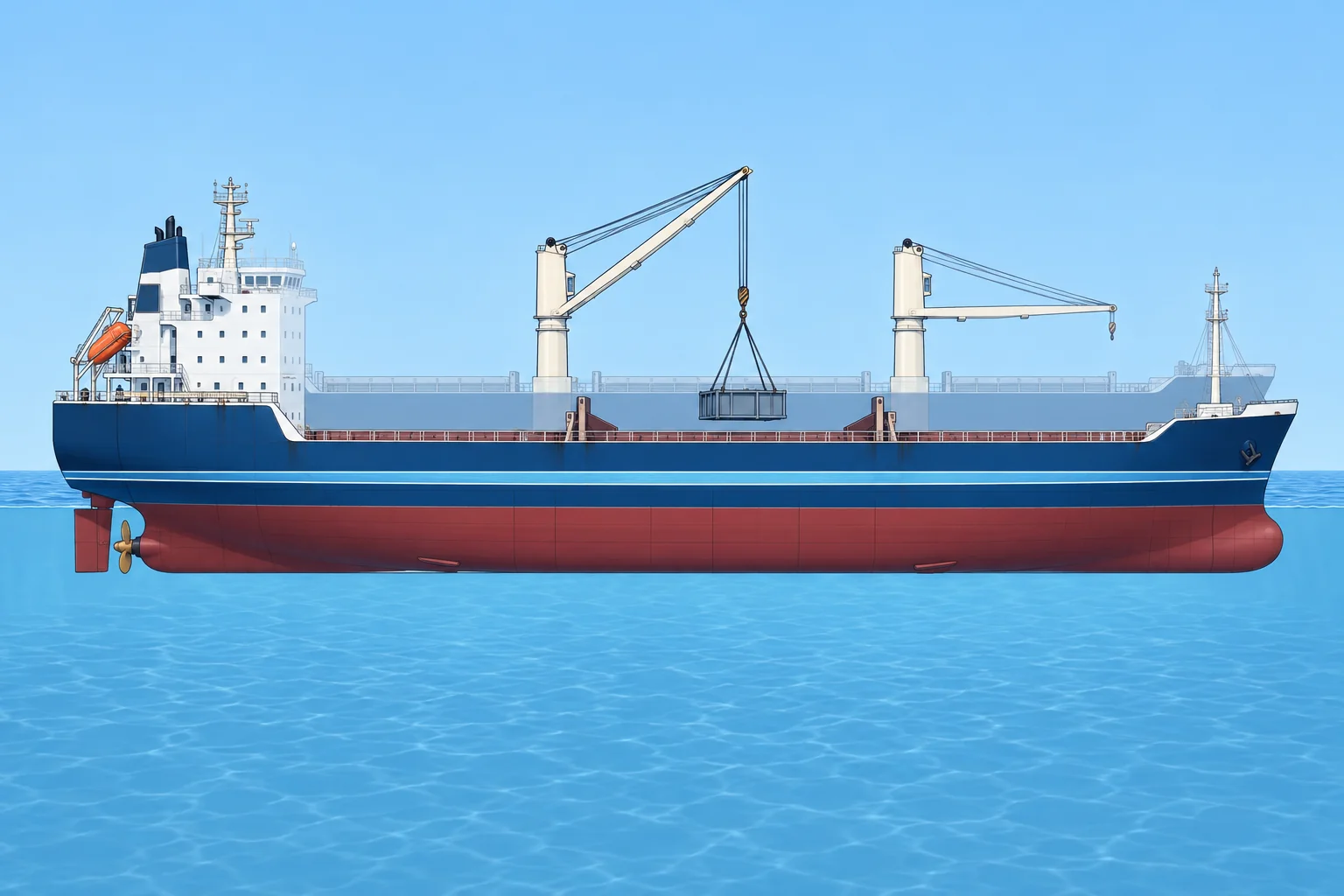
Tonnes per centimetre immersion (TPC)
1The lesson in plain words
TPC turns a weight into a change of draught: load 250 t on a ship with TPC 25 and she sinks 10 cm, if the weight goes over the centre of flotation.
What TPC is
TPC, tonnes per centimetre immersion, is the weight needed for a small, parallel increase of draught of 1 cm. A 1 cm layer at the waterline has a volume of Aw ÷ 100 m³, so TPC = Aw × ρ ÷ 100, with Aw the waterplane area in m² and ρ the density in t/m³.
Using it
Sinkage or rise (cm) = w ÷ TPC. Loading sinks her, discharging lets her rise. The ship goes down evenly, called bodily sinkage, only if the weight's centre is over the LCF, the centre of the waterplane. Anywhere else she trims as well; the Trim unit combines the two.
Limits
TPC varies with draught as waterplane area changes. It usually increases on flared hulls, where the sides widen upwards, but can stay constant or decrease. For small changes, use the current TPC. For larger changes, use a suitable average TPC or the displacement difference from the table.
Density
Tables give TPC for sea water of 1.025 t/m³. In dock or river water, TPC = TPC(sea) × ρ ÷ 1.025: the same weight sinks her a little more. That matters when you finish loading against a mark in dock water.
In practice
TPC lets you plan the last tonnes: how much more cargo before she reaches a mark, how much ballast for a draught limit, how far she rises as fuel is used. The deadweight scale, a chart that lines up draught, displacement, deadweight and TPC, gives quick answers.
2Step by step
Worked example: TPC and sinkage
- 1
Data: Aw 2,440 m², sea water. TPC = 2,440 × 1.025 ÷ 100 = 25.0 t/cm.
Assume TPC stays constant and each weight is loaded or discharged over the LCF.
- 2
Load 300 t over the LCF: sinkage = 300 ÷ 25.0 = 12 cm.
Mean draught 8.00 m becomes 8.12 m.
- 3
Discharge 450 t: rise = 450 ÷ 25.0 = 18 cm.
She comes up by the same rule.
- 4
In dock water of 1.010: TPC = 2,440 × 1.010 ÷ 100 = 24.6 t/cm.
Lighter water, slightly smaller TPC.
- 5
There 300 t sinks her 300 ÷ 24.6 = 12.2 cm.
A little more than in sea water.
3Key data
- TPC
- Aw × ρ ÷ 100 (t/cm)
- Sinkage or rise
- w ÷ TPC (cm)
- TPC in dock water
- TPC(sea) × ρ ÷ 1.025
- Even sinkage
- Only if the weight's centre is over the LCF
4Key points
- 1
TPC = Aw × ρ ÷ 100; sinkage (cm) = w ÷ TPC.
- 2
Even sinkage needs the weight over the LCF; elsewhere she also trims.
- 3
TPC varies with draught: for larger changes use a suitable average or the displacement column.
- 4
Correct TPC for density in dock water.
5Frequent mistakes
Wrong: TPC is the same at every draught.
Right: TPC follows waterplane area and need not always increase. Read it at the relevant draught.
Wrong: w ÷ TPC gives the new draughts forward and aft.
Right: It gives bodily sinkage or rise. It gives the changes at both ends only when trim is unchanged; otherwise use the Trim unit.
6Practice case & exam keys
Your ship is on even keel at 7.94 m in dock water of 1.010 t/m³. The draught limit is 8.10 m. Sea-water TPC is 25.0 t/cm. The mate proposes loading 400 t over the LCF. Accept? Treat TPC as constant.
Show the answer
No. Dock-water TPC = 25.0 × 1.010 ÷ 1.025 = 24.63 t/cm. The 16 cm margin represents about 394 t. Loading 400 t would slightly exceed the stated limit. The sea-water TPC overstates the tonnes available.
Exam keys
- TPC = Aw × ρ ÷ 100.
- Bodily sinkage or rise = w ÷ TPC, with the weight over the LCF.
- TPC in water of density ρ = TPC(sea) × ρ ÷ 1.025.
Finish this unit
When you've read it, answer three questions. Get all three right to finish the unit; opening the page alone doesn't count.
My notes for this unit
No notes